
Firm warns of council bureaucracy as landlord fined £5,000 over minor mistake
 admin
admin 

Property118

Firm warns of council bureaucracy as landlord fined £5,000 over minor mistake
A legal expert has accused councils of using “bureaucracy as a weapon to generate enforcement revenue” after a landlord was fined £5,000 for ticking the wrong box on a Houses in Multiple Occupation (HMO) form.
Phil Turtle from Landlord Licensing & Defence is warning landlords that minor application errors could cost them thousands of pounds in fines.
The firm helped one landlord after a council in the Midlands penalised them for inadvertently ticking the wrong box on HMO application forms.
The landlord only became exposed to enforcement because the council chose to refund their licence fee on the basis that they had applied for the wrong type of HMO licence.
Unregulated, unaccountable and landlord-hating
Landlord Licensing & Defence warns other councils are rejecting HMO applications where a landlord inadvertently uses an ‘additional’ licensing form instead of a ‘mandatory’ form, or vice versa.
Even though the schemes require the same physical licences and identical conditions.
The firm explains by rejecting the application and refunding the fee, which is often done without notifying the landlord, the council effectively removes the landlord’s statutory protection of having an ‘application duly made’ under the Housing Act 2004.
Once that protection is gone, councils are promptly issuing Civil Penalty Fines for the operation of an unlicensed HMO.
Phil Turtle, the compliance director at Landlord Licensing & Defence, said: “Whilst we achieved a reduction in this case, the council refused to accept they had created the situation.
“They have no right in law to refuse an HMO licence application simply because it was the ‘wrong sort’ of HMO application, but they are unregulated, unaccountable and frankly, landlord-hating.
“It is the classic equivalent of British Rail blaming ‘the wrong sort of snow’ on the line!”
He continued: “Sadly, the landlord was not prepared to take this to the First-tier Tribunal because of the severe reputational damage that a public airing would inflict on their business, which would have carried a far greater impact than the fine itself.
“Effectively, a landlord was bullied into accepting the council’s unlawful action as their own guilt!”
Councils are acting unlawfully
Mr Turtle adds that under the Housing Act 2004, there is no legal justification for a local authority to refuse or refund an HMO licence application that has otherwise been duly made just because the landlord did not understand the difference between two identical schemes or ticked the wrong box.
He said: “It’s obviously morally repugnant. The licences for most councils are exactly the same and rarely state whether they are mandatory or additional on the final document.
“By acting in this manner, councils are acting unlawfully and, as will surprise no-one, immorally. They are using pure bureaucracy as a weapon to generate enforcement revenue rather than to improve housing standards.”
Landlord Licensing & Defence are urging landlords to check their local council’s licensing criteria or seek professional representation when submitting HMO applications to avoid falling victim to these traps.
Landlords can book a no-charge, no-commitment 10-minute diagnostic call with an expert on HMO and selective licensing or other compliance matters by clicking here or by calling 0208 088 8393.
The post Firm warns of council bureaucracy as landlord fined £5,000 over minor mistake appeared first on Property118.
View Full Article: Firm warns of council bureaucracy as landlord fined £5,000 over minor mistake
Property118 puts HMRC manual BIM45700 under FTT scrutiny
Property118

Property118 puts HMRC manual BIM45700 under FTT scrutiny
Since late 2023, HMRC has argued that financing the withdrawal of a positive capital account balance prior to incorporation of a business is a notifiable tax avoidance scheme under DOTAS legislation.
From our perspective, this makes no sense because that practice is supported by highly regarded industry textbook guidance published by Lexis Nexis, which says as follows …
Simon’s Taxes B9:114 – refinancing and ESC D32 considerations
If there is a substantial capital account in the unincorporated business, the business owner(s) should be advised to draw this down before incorporation, otherwise that capital will be locked into the value of the shares.
More importantly, HMRC’s own manual BIM45700 clearly states:
A proprietor of a business may withdraw the profits of the business and the capital they have introduced to the business, even though substitute funding then has to be provided by interest bearing loans. The interest payable on the loans is an allowable deduction. This is on the basis that the purpose of the additional borrowing is to provide working capital for the business. There will, though, be an interest restriction if the proprietor’s capital account becomes overdrawn, see BIM45705 onwards.
Source: https://www.gov.uk/hmrc-internal-manuals/business-income-manual/bim45700
HMRC has also recently taken the currently unpublished view (discovered via an FOI request) that if a company takes on new mortgages and uses those funds to redeem existing pre-incorporation mortgage liabilities, such funds could be treated as taxable consideration under CGT rules.
Important context: Property118 is not currently recommending Section 162 incorporation for landlords with mortgages while legal uncertainty remains over the treatment of mortgage liabilities. Read our current position here: Why Property118 is not currently recommending s162 incorporation to landlords with mortgages
The reason for our current position is not that the underlying principles are wrong, but that HMRC’s current interpretation conflicts with its own published guidance.
The above is intended to serve as a warning not only to landlords, but also to accountants, solicitors, barristers, mortgage brokers, lenders and financial advisers.
What our critics say
Some influencers have suggested that the timing of the financing of capital withdrawn, being so close to the date of incorporation, is abusive. We disagree on the basis that there is no evidence supported by legislation or HMRC manuals to support this stance, hence taking the case to the FTT.
They also argue that using the funds to loan to the company, immediately post-incorporation, and for the company to repay the debt quickly, is also abusive. Again, we disagree based on the same principles.
Finally, our critics have suggested that transferring only beneficial interest at incorporation is also abusive and constitutes a breach of mortgage terms, and that mortgage novation is the only acceptable method. Again, we disagree on the basis that it is common knowledge that taxation follows beneficial interest and that the Law of Property Act 1925 protects the interests of mortgage lenders even if liabilities are indemnified without the lender’s consent or knowledge. Furthermore, novation has not been mentioned in the relevant HMRC manuals since the phrase indemnity was introduced into them over 50 years ago, and in any event, very few, if any, mortgage lenders now offer novation.
Tribunal outcome
We expect the First-tier tribunal to make a ruling later this year, but the losing side could then appeal to the Upper Tribunal and beyond, resulting in the wait for much need clarity potentially being pushed back even further. Meanwhile, these matters continue to frustrate landlords who would like to incorporate their businesses for the reasons explained in HMRC’s GAAR Guidance Part D paragraph 2.2, as follows …
GAAR guidance – D2.2 intended legislative choice
D2.2
D2.2.1 This covers, for example, giving assets to children to reduce future Inheritance Tax liabilities, sacrificing salary in return for enhanced pension rights, disclaiming capital allowances to preserve reliefs for a later period, deciding to incorporate a business or to sell shares rather than assets (in both cases so as to pay less tax or Stamp Duty Land Tax) and choosing to borrow to invest in buy to let rather than using surplus cash or having a bigger mortgage on your main residence.
D2.2.2 These are all clearly things that are recognised by the statute: Parliament has given taxpayers a choice as to the course of action to take. This category might also include reorganising a trust or corporate structure in a straightforward way to fit in with a new tax regime.
The commercial reasons landlords choose to incorporate their rental property business were also documented in a report published by the Office of Tax Simplification in November 2022.
Source: https://www.gov.uk/government/publications/ots-review-of-residential-property-income
A conversation worth having?
If you are weighing up your own strategy, whether that’s to sell, expand, or restructure to improve profitability, it is worth having a discussion with a Property118 consultant to take a closer look at how your portfolio is structured as a whole now, and to forecast the outcomes based on multiple scenarios.
These conversations are typically most useful for landlords with established portfolios and relatively modest borrowing who are beginning to reflect on how their assets could work more effectively in the years ahead.
/* “function”==typeof InitializeEditor,callIfLoaded:function(o){return!(!gform.domLoaded||!gform.scriptsLoaded||!gform.themeScriptsLoaded&&!gform.isFormEditor()||(gform.isFormEditor()&&console.warn(“The use of gform.initializeOnLoaded() is deprecated in the form editor context and will be removed in Gravity Forms 3.1.”),o(),0))},initializeOnLoaded:function(o){gform.callIfLoaded(o)||(document.addEventListener(“gform_main_scripts_loaded”,()=>{gform.scriptsLoaded=!0,gform.callIfLoaded(o)}),document.addEventListener(“gform/theme/scripts_loaded”,()=>{gform.themeScriptsLoaded=!0,gform.callIfLoaded(o)}),window.addEventListener(“DOMContentLoaded”,()=>{gform.domLoaded=!0,gform.callIfLoaded(o)}))},hooks:{action:{},filter:{}},addAction:function(o,r,e,t){gform.addHook(“action”,o,r,e,t)},addFilter:function(o,r,e,t){gform.addHook(“filter”,o,r,e,t)},doAction:function(o){gform.doHook(“action”,o,arguments)},applyFilters:function(o){return gform.doHook(“filter”,o,arguments)},removeAction:function(o,r){gform.removeHook(“action”,o,r)},removeFilter:function(o,r,e){gform.removeHook(“filter”,o,r,e)},addHook:function(o,r,e,t,n){null==gform.hooks[o][r]&&(gform.hooks[o][r]=[]);var d=gform.hooks[o][r];null==n&&(n=r+”_”+d.length),gform.hooks[o][r].push({tag:n,callable:e,priority:t=null==t?10:t})},doHook:function(r,o,e){var t;if(e=Array.prototype.slice.call(e,1),null!=gform.hooks[r][o]&&((o=gform.hooks[r][o]).sort(function(o,r){return o.priority-r.priority}),o.forEach(function(o){“function”!=typeof(t=o.callable)&&(t=window[t]),”action”==r?t.apply(null,e):e[0]=t.apply(null,e)})),”filter”==r)return e[0]},removeHook:function(o,r,t,n){var e;null!=gform.hooks[o][r]&&(e=(e=gform.hooks[o][r]).filter(function(o,r,e){return!!(null!=n&&n!=o.tag||null!=t&&t!=o.priority)}),gform.hooks[o][r]=e)}});
/* ]]> */
Enquire about a free initial discussion with a Property118 consultant
-
Mr.Mrs.MissMs.Dr.Prof.Rev.
-
-
 Important Notice – Scope of Planning Support
Where our recommendations touch on areas requiring regulated input, we refer clients to appropriately authorised professionals for advice and implementation.
-
-
-
/* = 0;if(!is_postback){return;}var form_content = jQuery(this).contents().find(‘#gform_wrapper_585′);var is_confirmation = jQuery(this).contents().find(‘#gform_confirmation_wrapper_585′).length > 0;var is_redirect = contents.indexOf(‘gformRedirect(){‘) >= 0;var is_form = form_content.length > 0 && ! is_redirect && ! is_confirmation;var mt = parseInt(jQuery(‘html’).css(‘margin-top’), 10) + parseInt(jQuery(‘body’).css(‘margin-top’), 10) + 100;if(is_form){jQuery(‘#gform_wrapper_585′).html(form_content.html());if(form_content.hasClass(‘gform_validation_error’)){jQuery(‘#gform_wrapper_585′).addClass(‘gform_validation_error’);} else {jQuery(‘#gform_wrapper_585′).removeClass(‘gform_validation_error’);}setTimeout( function() { /* delay the scroll by 50 milliseconds to fix a bug in chrome */ }, 50 );if(window[‘gformInitDatepicker’]) {gformInitDatepicker();}if(window[‘gformInitPriceFields’]) {gformInitPriceFields();}var current_page = jQuery(‘#gform_source_page_number_585′).val();gformInitSpinner( 585, ‘https://www.property118.com/wp-content/plugins/gravityforms/images/spinner.svg’, true );jQuery(document).trigger(‘gform_page_loaded’, [585, current_page]);window[‘gf_submitting_585′] = false;}else if(!is_redirect){var confirmation_content = jQuery(this).contents().find(‘.GF_AJAX_POSTBACK’).html();if(!confirmation_content){confirmation_content = contents;}jQuery(‘#gform_wrapper_585′).replaceWith(confirmation_content);jQuery(document).trigger(‘gform_confirmation_loaded’, [585]);window[‘gf_submitting_585′] = false;wp.a11y.speak(jQuery(‘#gform_confirmation_message_585′).text());}else{jQuery(‘#gform_585′).append(contents);if(window[‘gformRedirect’]) {gformRedirect();}}jQuery(document).trigger(“gform_pre_post_render”, [{ formId: “585”, currentPage: “current_page”, abort: function() { this.preventDefault(); } }]); if (event && event.defaultPrevented) { return; } const gformWrapperDiv = document.getElementById( “gform_wrapper_585″ ); if ( gformWrapperDiv ) { const visibilitySpan = document.createElement( “span” ); visibilitySpan.id = “gform_visibility_test_585″; gformWrapperDiv.insertAdjacentElement( “afterend”, visibilitySpan ); } const visibilityTestDiv = document.getElementById( “gform_visibility_test_585″ ); let postRenderFired = false; function triggerPostRender() { if ( postRenderFired ) { return; } postRenderFired = true; gform.core.triggerPostRenderEvents( 585, current_page ); if ( visibilityTestDiv ) { visibilityTestDiv.parentNode.removeChild( visibilityTestDiv ); } } function debounce( func, wait, immediate ) { var timeout; return function() { var context = this, args = arguments; var later = function() { timeout = null; if ( !immediate ) func.apply( context, args ); }; var callNow = immediate && !timeout; clearTimeout( timeout ); timeout = setTimeout( later, wait ); if ( callNow ) func.apply( context, args ); }; } const debouncedTriggerPostRender = debounce( function() { triggerPostRender(); }, 200 ); if ( visibilityTestDiv && visibilityTestDiv.offsetParent === null ) { const observer = new MutationObserver( ( mutations ) => { mutations.forEach( ( mutation ) => { if ( mutation.type === ‘attributes’ && visibilityTestDiv.offsetParent !== null ) { debouncedTriggerPostRender(); observer.disconnect(); } }); }); observer.observe( document.body, { attributes: true, childList: false, subtree: true, attributeFilter: [ ‘style’, ‘class’ ], }); } else { triggerPostRender(); } } );} );
/* ]]> */
|
★★★★★
|
Help other landlords find Property118If you have found Property118 useful, a short Trustpilot review would make a meaningful difference. It helps other landlords decide whether our research is worth following. |


The post Property118 puts HMRC manual BIM45700 under FTT scrutiny appeared first on Property118.
View Full Article: Property118 puts HMRC manual BIM45700 under FTT scrutiny
House prices dip in March as annual growth also slows
Property118

House prices dip in March as annual growth also slows
House prices fell by 0.5% last month, reversing a 0.3% rise in February and leaving the average property value at £299,677, Halifax reveals.
Its data also shows that annual growth slowed down to 0.8%, down from 1.2% in March.
Regional house price differences remain and these are more pronounced, with stronger gains recorded outside southern markets.
Northern Ireland continues to record the strongest annual house price growth, with average values up 8.7% to £224,809.
Scotland also posted an increase of 4.4%, taking the average property price to £222,716.
Regional house prices
Wales saw prices rise by 1.6% over the year, with the typical home now valued at £230,909.
Across England, higher growth remains concentrated in northern regions.
The North East recorded a 5% annual increase, with prices at £184,119, while the North West saw values rise 3.1% to an average of £247,442.
In southern markets, prices moved lower and the South East recorded a 1.9% annual fall to £383,573.
London’s homeowners saw values decline by 1.2% to £536,751.
Housing market slowdown
Amanda Bryden, the head of mortgages at Halifax, said: “The recent slowdown in the housing market reflects the wide uncertainty regarding the conflict in the Middle East.
“Concerns about higher energy prices have pushed up inflation expectations, which in turn led to a rise in mortgage rates, reducing confidence that interest rates will be cut this year and dampening the initial momentum in the market seen at the start of the year.”
She added: “The effect on house prices will largely depend on how long-lasting these pressures prove to be and the wider implications for the economy and unemployment.
“However, the recent increase in UK mortgage rates has been more modest than the sharp rises seen during the mini budget of 2022.”
Property sector reaction
Nathan Emerson, the CEO of Propertymark, said: “We are at an important intersection where we must clearly acknowledge future challenges ahead.
“We started the year with positivity in terms of seeing an uplift in the average number of viewings per available property, coupled with general consumer positivity regarding affordability.
“However, a lot has changed in a short space of time, with numerous sub 4% mortgage deals being withdrawn over the last few weeks as the wider economy adjusts to potential uncertainties.”
Karen Noye, a mortgage expert at Quilter, said: “Looking ahead, the path for house prices will depend largely on how the conflict evolves.
“If tensions ease and energy‑driven inflation pressures recede, mortgage rates could stabilise and drift lower again, supporting broadly flat prices.
“If the conflict drags on, persistently higher mortgage rates are more likely to translate into weaker activity and softer prices, particularly in more rate‑sensitive parts of the market.”
Tom Bill, the head of UK residential research at Knight Frank, said: “What goes up must come down, but for mortgage rates the drop will be more gradual than the sharp increase triggered by the Middle East conflict, even if the two-week ceasefire deal holds.
“Sentiment in the housing market will improve if the war stops, but its longer-term inflationary impact and weaker demand for UK government debt due its tight financial headroom and apparent inability to cut spending means mortgage rates won’t snap back to where they were in February. This will keep demand and house prices in check this year.”
Jason Tebb, president of OnTheMarket, said: “The momentum created by several interest rate reductions over the past year and a half, combined with post-Budget clarity, continues to be in evidence on the ground, with needs-driven buyers and sellers who have put moves on hold focused on transacting.
“With further rate reductions on hold for the short term at least, and the threat of rate rises a concern the longer the conflict in the Middle East continues, those with competitive mortgage offers are keen to proceed before rates edge higher.”
The post House prices dip in March as annual growth also slows appeared first on Property118.
View Full Article: House prices dip in March as annual growth also slows
Nearly 1 in 5 landlords planning to exit the market entirely
Property118

Nearly 1 in 5 landlords planning to exit the market entirely
A more concerning signal is now emerging from the UK private rented sector, and it goes beyond portfolio adjustments. According to the Property118 Landlord Sentiment Survey Q1 2026, a significant proportion of landlords are not simply reducing their exposure, they are considering leaving the market altogether.
Based on 2,380 completed responses, nearly one in five landlords indicated that they are planning a full exit from the sector. You can review the full dataset here.
The implication is clear: this is not just a rebalancing, it is a withdrawal.
A quiet but meaningful shift
Much of the public discussion around landlords has focused on regulatory change, tax pressure and tenant protections. What has been less visible is how landlords are actually responding in practice. This data provides a clearer answer.
While some landlords are choosing to hold or gradually reduce their portfolios, a notable proportion have reached a different conclusion. Rather than adapting further, they are choosing to step away entirely.
This is not happening loudly, and it is not being driven by panic. It is happening quietly, through individual decisions that, when viewed collectively, begin to form a clear pattern.
Who is leaving, and why it matters
The survey shows that the landlord base is heavily weighted towards older investors, with the majority aged 56 and above. This context matters when interpreting exit intentions.
For many, the decision to leave is not reactive, it is rational. After decades of building portfolios, many landlords are now reassessing whether the current environment justifies continued involvement. Regulatory complexity, shifting tax treatment and changing risk dynamics all play a role, but the underlying driver is often simpler; control. At a certain stage, landlords begin to prioritise certainty and simplicity over further growth.
Not distress, but decision
One of the more revealing aspects of the survey findings is that many of those considering exit are not highly leveraged. A large proportion of respondents report loan-to-value ratios below 50%, with a significant number owning properties outright. This suggests that exits are not being forced by financial pressure, but chosen as part of a wider strategic reassessment. This distinction is important because it points to a sector where experienced landlords are stepping back not because they have to, but because they want to.
Implications for housing supply
If even a portion of these intended exits materialise, the impact on housing supply could be significant. Properties leaving the rental sector do not automatically return as rental stock. In many cases, they are sold to owner-occupiers, reducing the number of homes available to rent. At the same time, as highlighted in the wider survey results, relatively few landlords are planning to expand. The combination of these two forces, increased exits and limited new investment, creates a clear directional pressure.
A turning point, not a temporary phase
This survey represents the first in a planned quarterly series, meaning these findings provide an early indication of sentiment rather than a one-off snapshot. However, the scale of the response and the consistency of the data suggest that this is not a temporary fluctuation. It may instead represent the early stages of a broader transition in how landlords engage with the private rented sector.
For now, one conclusion stands out: a growing proportion of landlords are not adjusting their strategy, they are choosing to leave the market altogether.
A conversation worth having?
If you are weighing up your own strategy, whether that’s to sell, expand, or restructure to improve profitibility, it is worth having a discussion with a Property118 consultant to take a closer look at how your portfolio is structured as a whole now, and to forecast the outcomes based on multiple scenario’s.
These conversations are typically most useful for landlords with established portfolios and relatively modest borrowing who are beginning to reflect on how their assets could work more effectively in the years ahead.
/* “function”==typeof InitializeEditor,callIfLoaded:function(o){return!(!gform.domLoaded||!gform.scriptsLoaded||!gform.themeScriptsLoaded&&!gform.isFormEditor()||(gform.isFormEditor()&&console.warn(“The use of gform.initializeOnLoaded() is deprecated in the form editor context and will be removed in Gravity Forms 3.1.”),o(),0))},initializeOnLoaded:function(o){gform.callIfLoaded(o)||(document.addEventListener(“gform_main_scripts_loaded”,()=>{gform.scriptsLoaded=!0,gform.callIfLoaded(o)}),document.addEventListener(“gform/theme/scripts_loaded”,()=>{gform.themeScriptsLoaded=!0,gform.callIfLoaded(o)}),window.addEventListener(“DOMContentLoaded”,()=>{gform.domLoaded=!0,gform.callIfLoaded(o)}))},hooks:{action:{},filter:{}},addAction:function(o,r,e,t){gform.addHook(“action”,o,r,e,t)},addFilter:function(o,r,e,t){gform.addHook(“filter”,o,r,e,t)},doAction:function(o){gform.doHook(“action”,o,arguments)},applyFilters:function(o){return gform.doHook(“filter”,o,arguments)},removeAction:function(o,r){gform.removeHook(“action”,o,r)},removeFilter:function(o,r,e){gform.removeHook(“filter”,o,r,e)},addHook:function(o,r,e,t,n){null==gform.hooks[o][r]&&(gform.hooks[o][r]=[]);var d=gform.hooks[o][r];null==n&&(n=r+”_”+d.length),gform.hooks[o][r].push({tag:n,callable:e,priority:t=null==t?10:t})},doHook:function(r,o,e){var t;if(e=Array.prototype.slice.call(e,1),null!=gform.hooks[r][o]&&((o=gform.hooks[r][o]).sort(function(o,r){return o.priority-r.priority}),o.forEach(function(o){“function”!=typeof(t=o.callable)&&(t=window[t]),”action”==r?t.apply(null,e):e[0]=t.apply(null,e)})),”filter”==r)return e[0]},removeHook:function(o,r,t,n){var e;null!=gform.hooks[o][r]&&(e=(e=gform.hooks[o][r]).filter(function(o,r,e){return!!(null!=n&&n!=o.tag||null!=t&&t!=o.priority)}),gform.hooks[o][r]=e)}});
/* ]]> */
Enquire about a free initial discussion with a Property118 consultant
-
Mr.Mrs.MissMs.Dr.Prof.Rev.
-
-
Important Notice – Scope of Planning Support
Where our recommendations touch on areas requiring regulated input, we refer clients to appropriately authorised professionals for advice and implementation.
-
-
-
/* = 0;if(!is_postback){return;}var form_content = jQuery(this).contents().find(‘#gform_wrapper_585′);var is_confirmation = jQuery(this).contents().find(‘#gform_confirmation_wrapper_585′).length > 0;var is_redirect = contents.indexOf(‘gformRedirect(){‘) >= 0;var is_form = form_content.length > 0 && ! is_redirect && ! is_confirmation;var mt = parseInt(jQuery(‘html’).css(‘margin-top’), 10) + parseInt(jQuery(‘body’).css(‘margin-top’), 10) + 100;if(is_form){jQuery(‘#gform_wrapper_585′).html(form_content.html());if(form_content.hasClass(‘gform_validation_error’)){jQuery(‘#gform_wrapper_585′).addClass(‘gform_validation_error’);} else {jQuery(‘#gform_wrapper_585′).removeClass(‘gform_validation_error’);}setTimeout( function() { /* delay the scroll by 50 milliseconds to fix a bug in chrome */ }, 50 );if(window[‘gformInitDatepicker’]) {gformInitDatepicker();}if(window[‘gformInitPriceFields’]) {gformInitPriceFields();}var current_page = jQuery(‘#gform_source_page_number_585′).val();gformInitSpinner( 585, ‘https://www.property118.com/wp-content/plugins/gravityforms/images/spinner.svg’, true );jQuery(document).trigger(‘gform_page_loaded’, [585, current_page]);window[‘gf_submitting_585′] = false;}else if(!is_redirect){var confirmation_content = jQuery(this).contents().find(‘.GF_AJAX_POSTBACK’).html();if(!confirmation_content){confirmation_content = contents;}jQuery(‘#gform_wrapper_585′).replaceWith(confirmation_content);jQuery(document).trigger(‘gform_confirmation_loaded’, [585]);window[‘gf_submitting_585′] = false;wp.a11y.speak(jQuery(‘#gform_confirmation_message_585′).text());}else{jQuery(‘#gform_585′).append(contents);if(window[‘gformRedirect’]) {gformRedirect();}}jQuery(document).trigger(“gform_pre_post_render”, [{ formId: “585”, currentPage: “current_page”, abort: function() { this.preventDefault(); } }]); if (event && event.defaultPrevented) { return; } const gformWrapperDiv = document.getElementById( “gform_wrapper_585″ ); if ( gformWrapperDiv ) { const visibilitySpan = document.createElement( “span” ); visibilitySpan.id = “gform_visibility_test_585″; gformWrapperDiv.insertAdjacentElement( “afterend”, visibilitySpan ); } const visibilityTestDiv = document.getElementById( “gform_visibility_test_585″ ); let postRenderFired = false; function triggerPostRender() { if ( postRenderFired ) { return; } postRenderFired = true; gform.core.triggerPostRenderEvents( 585, current_page ); if ( visibilityTestDiv ) { visibilityTestDiv.parentNode.removeChild( visibilityTestDiv ); } } function debounce( func, wait, immediate ) { var timeout; return function() { var context = this, args = arguments; var later = function() { timeout = null; if ( !immediate ) func.apply( context, args ); }; var callNow = immediate && !timeout; clearTimeout( timeout ); timeout = setTimeout( later, wait ); if ( callNow ) func.apply( context, args ); }; } const debouncedTriggerPostRender = debounce( function() { triggerPostRender(); }, 200 ); if ( visibilityTestDiv && visibilityTestDiv.offsetParent === null ) { const observer = new MutationObserver( ( mutations ) => { mutations.forEach( ( mutation ) => { if ( mutation.type === ‘attributes’ && visibilityTestDiv.offsetParent !== null ) { debouncedTriggerPostRender(); observer.disconnect(); } }); }); observer.observe( document.body, { attributes: true, childList: false, subtree: true, attributeFilter: [ ‘style’, ‘class’ ], }); } else { triggerPostRender(); } } );} );
/* ]]> */
|
★★★★★
|
Help other landlords find Property118If you have found Property118 useful, a short Trustpilot review would make a meaningful difference. It helps other landlords decide whether our research is worth following. |
The post Nearly 1 in 5 landlords planning to exit the market entirely appeared first on Property118.
View Full Article: Nearly 1 in 5 landlords planning to exit the market entirely
Tenant starts fight with management?
Property118

Tenant starts fight with management?
My rental tenant of eight years has got herself into a nasty fight with the managing agent of the development. The dispute concerns the new electronic gates of this gated development, which management says she deliberately damaged and was observed doing so.
Apparently, this happened back in January, but I was only contacted about it by email last night (2 April). They are insisting I pay up (amount unspecified as yet) for the repairs as I am her landlord and so ultimately responsible according to my lease.
I immediately forwarded the email to my tenant and asked her to explain. She replied that she has proof in her “records” that she was not at fault and will supply this to me at a future date. She also denies another vague charge from management that she deliberately “fly tipped” a bed frame on the site (the matter is “under investigation”). She even said she would take legal action against this second accusation if necessary.
I am quite shocked by all this, as my tenant works as a diplomat, and such behaviour seems out of character. She does have a boyfriend who lives with her part of the time. The management company is relatively new and does have a habit of sending out regular complaint emails to owners and tenants about everything from parking to satellite dishes to the electronic gates in question, which now require quite a complex procedure of digital key fobs and codes to gain entry to the site.
This is worrying as I am planning to sell the flat this summer (I have not told my tenant yet) and cannot afford to have an ongoing dispute with management, putting off potential buyers. I also do not want to pay what sounds like an escalating bill for this problem. My tenant gets a high salary and also benefits from diplomatic immunity, so I just want her to pay up for the damage ASAP and not cause me any more problems.
But she seems to want to fight management over this. Any advice from anyone?
Thanks,
Helen
The post Tenant starts fight with management? appeared first on Property118.
View Full Article: Tenant starts fight with management?
What the latest Property118 survey results means for mortgage lenders: fewer landlords, different behaviour
Property118

What the latest Property118 survey results means for mortgage lenders: fewer landlords, different behaviour
For lenders operating in the buy-to-let market, the most important shift is not interest rates or product design; it is behaviour.
The landlord base is no longer acting in the same way it did even a few years ago. Growth is no longer the default, expansion is no longer assumed and in many cases, it is no longer even the objective.
That changes the nature of demand. Historically, lending activity was driven by acquisition and refinancing cycles. Landlords borrowed to grow, then refinanced to release equity and repeat the process. Volume followed momentum but that momentum is now softening. A growing number of landlords are holding rather than expanding, or reducing exposure altogether. When that happens, demand for borrowing changes. It becomes more selective, more strategic and less volume-driven.
This creates a different lending environment. Rather than a broad base of borrowers seeking to expand, lenders are increasingly dealing with experienced landlords who are refining their portfolios. Conversations shift from “how much can I borrow?” to “what structure best supports my position?”.
That distinction matters becaue it suggests that future lending demand may be shaped less by expansion and more by optimisation.
Evidence of this shift can be seen in the Property118 Landlord Sentiment Survey Q1 2026, where a majority of landlords indicate an intention to reduce or hold, rather than grow.
For lenders, the implication is clear: The opportunity does not disappear, but it changes form.
Product design, underwriting and broker relationships may need to adapt to a market where landlords are not chasing scale, but seeking flexibility, efficiency and long-term alignment.
For now, one conclusion stands out: the future of buy-to-let lending will be shaped less by how landlords grow, and more by how they choose to manage what they already have.
For many landlords, the question is not whether the market is changing, but what that change means for their own position.
If you are holding a portfolio with relatively low borrowing, or are beginning to reassess how your assets are structured, this is often the point where a more joined-up view becomes useful.
An invitation for established landlords
If you find the Property118 articles helpful and are curious about how those ideas apply to your own portfolio, you are welcome to take the conversation a step further.
These conversations are typically most useful for landlords with established portfolios and relatively modest borrowing who are beginning to reflect on how their assets could work more effectively in the years ahead.
/* “function”==typeof InitializeEditor,callIfLoaded:function(o){return!(!gform.domLoaded||!gform.scriptsLoaded||!gform.themeScriptsLoaded&&!gform.isFormEditor()||(gform.isFormEditor()&&console.warn(“The use of gform.initializeOnLoaded() is deprecated in the form editor context and will be removed in Gravity Forms 3.1.”),o(),0))},initializeOnLoaded:function(o){gform.callIfLoaded(o)||(document.addEventListener(“gform_main_scripts_loaded”,()=>{gform.scriptsLoaded=!0,gform.callIfLoaded(o)}),document.addEventListener(“gform/theme/scripts_loaded”,()=>{gform.themeScriptsLoaded=!0,gform.callIfLoaded(o)}),window.addEventListener(“DOMContentLoaded”,()=>{gform.domLoaded=!0,gform.callIfLoaded(o)}))},hooks:{action:{},filter:{}},addAction:function(o,r,e,t){gform.addHook(“action”,o,r,e,t)},addFilter:function(o,r,e,t){gform.addHook(“filter”,o,r,e,t)},doAction:function(o){gform.doHook(“action”,o,arguments)},applyFilters:function(o){return gform.doHook(“filter”,o,arguments)},removeAction:function(o,r){gform.removeHook(“action”,o,r)},removeFilter:function(o,r,e){gform.removeHook(“filter”,o,r,e)},addHook:function(o,r,e,t,n){null==gform.hooks[o][r]&&(gform.hooks[o][r]=[]);var d=gform.hooks[o][r];null==n&&(n=r+”_”+d.length),gform.hooks[o][r].push({tag:n,callable:e,priority:t=null==t?10:t})},doHook:function(r,o,e){var t;if(e=Array.prototype.slice.call(e,1),null!=gform.hooks[r][o]&&((o=gform.hooks[r][o]).sort(function(o,r){return o.priority-r.priority}),o.forEach(function(o){“function”!=typeof(t=o.callable)&&(t=window[t]),”action”==r?t.apply(null,e):e[0]=t.apply(null,e)})),”filter”==r)return e[0]},removeHook:function(o,r,t,n){var e;null!=gform.hooks[o][r]&&(e=(e=gform.hooks[o][r]).filter(function(o,r,e){return!!(null!=n&&n!=o.tag||null!=t&&t!=o.priority)}),gform.hooks[o][r]=e)}});
/* ]]> */
Enquire about a free initial discussion with a Property118 consultant
-
Mr.Mrs.MissMs.Dr.Prof.Rev.
-
-
Important Notice – Scope of Planning Support
Where our recommendations touch on areas requiring regulated input, we refer clients to appropriately authorised professionals for advice and implementation.
-
-
-
/* = 0;if(!is_postback){return;}var form_content = jQuery(this).contents().find(‘#gform_wrapper_585′);var is_confirmation = jQuery(this).contents().find(‘#gform_confirmation_wrapper_585′).length > 0;var is_redirect = contents.indexOf(‘gformRedirect(){‘) >= 0;var is_form = form_content.length > 0 && ! is_redirect && ! is_confirmation;var mt = parseInt(jQuery(‘html’).css(‘margin-top’), 10) + parseInt(jQuery(‘body’).css(‘margin-top’), 10) + 100;if(is_form){jQuery(‘#gform_wrapper_585′).html(form_content.html());if(form_content.hasClass(‘gform_validation_error’)){jQuery(‘#gform_wrapper_585′).addClass(‘gform_validation_error’);} else {jQuery(‘#gform_wrapper_585′).removeClass(‘gform_validation_error’);}setTimeout( function() { /* delay the scroll by 50 milliseconds to fix a bug in chrome */ }, 50 );if(window[‘gformInitDatepicker’]) {gformInitDatepicker();}if(window[‘gformInitPriceFields’]) {gformInitPriceFields();}var current_page = jQuery(‘#gform_source_page_number_585′).val();gformInitSpinner( 585, ‘https://www.property118.com/wp-content/plugins/gravityforms/images/spinner.svg’, true );jQuery(document).trigger(‘gform_page_loaded’, [585, current_page]);window[‘gf_submitting_585′] = false;}else if(!is_redirect){var confirmation_content = jQuery(this).contents().find(‘.GF_AJAX_POSTBACK’).html();if(!confirmation_content){confirmation_content = contents;}jQuery(‘#gform_wrapper_585′).replaceWith(confirmation_content);jQuery(document).trigger(‘gform_confirmation_loaded’, [585]);window[‘gf_submitting_585′] = false;wp.a11y.speak(jQuery(‘#gform_confirmation_message_585′).text());}else{jQuery(‘#gform_585′).append(contents);if(window[‘gformRedirect’]) {gformRedirect();}}jQuery(document).trigger(“gform_pre_post_render”, [{ formId: “585”, currentPage: “current_page”, abort: function() { this.preventDefault(); } }]); if (event && event.defaultPrevented) { return; } const gformWrapperDiv = document.getElementById( “gform_wrapper_585″ ); if ( gformWrapperDiv ) { const visibilitySpan = document.createElement( “span” ); visibilitySpan.id = “gform_visibility_test_585″; gformWrapperDiv.insertAdjacentElement( “afterend”, visibilitySpan ); } const visibilityTestDiv = document.getElementById( “gform_visibility_test_585″ ); let postRenderFired = false; function triggerPostRender() { if ( postRenderFired ) { return; } postRenderFired = true; gform.core.triggerPostRenderEvents( 585, current_page ); if ( visibilityTestDiv ) { visibilityTestDiv.parentNode.removeChild( visibilityTestDiv ); } } function debounce( func, wait, immediate ) { var timeout; return function() { var context = this, args = arguments; var later = function() { timeout = null; if ( !immediate ) func.apply( context, args ); }; var callNow = immediate && !timeout; clearTimeout( timeout ); timeout = setTimeout( later, wait ); if ( callNow ) func.apply( context, args ); }; } const debouncedTriggerPostRender = debounce( function() { triggerPostRender(); }, 200 ); if ( visibilityTestDiv && visibilityTestDiv.offsetParent === null ) { const observer = new MutationObserver( ( mutations ) => { mutations.forEach( ( mutation ) => { if ( mutation.type === ‘attributes’ && visibilityTestDiv.offsetParent !== null ) { debouncedTriggerPostRender(); observer.disconnect(); } }); }); observer.observe( document.body, { attributes: true, childList: false, subtree: true, attributeFilter: [ ‘style’, ‘class’ ], }); } else { triggerPostRender(); } } );} );
/* ]]> */
From there we can arrange a free introductory discussion to explore how your portfolio works as a whole and what that might mean for the years ahead.
|
★★★★★
|
Help other landlords find Property118If you have found Property118 useful, a short Trustpilot review would make a meaningful difference. It helps other landlords decide whether our research is worth following. |
The post What the latest Property118 survey results means for mortgage lenders: fewer landlords, different behaviour appeared first on Property118.
View Full Article: What the latest Property118 survey results means for mortgage lenders: fewer landlords, different behaviour
East London boroughs top decade of house price growth
Property118

East London boroughs top decade of house price growth
East London boroughs have delivered the strongest long-term house price growth in the capital over the past decade, with Redbridge, Havering and Barking and Dagenham leading on annual gains.
Foxtons has analysed government data to find that average house prices across London have increased by around 1.4% a year over the last 10 years.
However, performance differs markedly between boroughs with Redbridge topping the table, with annual growth of 3.6%.
Havering and Barking and Dagenham follow close behind, each posting yearly increases of between 3.1% and 3.3% across the same period.
London house prices
The firm’s managing director of sales, James Stevenson, said: “London has always been a long-term investment story.
“While year-on-year house price performance may fluctuate, it’s this long-term consistency that makes London one of the most resilient and attractive global property markets, notably during periods of global uncertainty.”
He added: “Havering, Bexley and Barking and Dagenham’s performance, in particular, highlights how demand, affordability and lifestyle factors continue to shape the market beyond the traditional prime areas of the capital and, we expect London house prices to continue to post positive growth over the coming years.”
Average London house price
Foxton’s also found that Bexley recorded annual growth of 3.1%.
Sutton and Waltham Forest sit just behind, both seeing prices rise by an average of 2.7% a year.
Further down, Bromley and Greenwich registered annual gains of 2.4% and 2.2%. Lewisham and Enfield follow, each delivering average yearly growth of 2.1%.
Across the capital, the data shows consistent price increases over the decade, despite movements seen through 2025 and into early 2026.
The agency’s analysis also puts average annual house price growth at 1.3% when measured across all boroughs, pointing to steady movement in values over the longer term.
The post East London boroughs top decade of house price growth appeared first on Property118.
View Full Article: East London boroughs top decade of house price growth
Landlords now 8x more likely to reduce portfolios than expand
Property118

Landlords now 8x more likely to reduce portfolios than expand
A clear shift is emerging in the UK private rented sector, and it is not subtle. According to the Property118 Landlord Sentiment Survey Q1 2026, landlords are now significantly more likely to reduce their portfolios than grow them, pointing to a structural change in the direction of the market.
Based on 2,380 completed responses, covering a combined total of 23,098 rental properties, the survey provides one of the most detailed real-time snapshots of landlord behaviour currently available. You can read the full survey results here.
The headline figure is stark: 57% of landlords say they plan to reduce their portfolios over the next 12 months, compared with just 6.8% who intend to expand. That makes landlords more than eight times as likely to sell than to buy.
This is not a marginal imbalance; it is a decisive shift.
A market moving in one direction
At a surface level, the figures might suggest a cooling market, but the reality is more significant. When more than half of landlords are planning to reduce exposure, and fewer than one in fourteen are looking to grow, the direction of travel becomes difficult to ignore. This is not a market in equilibrium; it is a market contracting.
As the survey data published by Property118 shows, these responses were not drawn from a fringe audience. The average respondent owns 9.7 rental properties, which means these are decisions being made by experienced, commercially minded portfolio landlords.
Strategic decisions, not distress
One of the more revealing aspects of the data is what sits behind these decisions. The same Property118 Landlord Sentiment Survey Q1 2026 shows that a significant proportion of landlords are operating with relatively low leverage, with many holding loan-to-value ratios below 50%, and a notable percentage owning properties outright with no borrowing at all. This matters because it suggests that the decision to reduce portfolios is not being driven primarily by financial distress or forced sales. Instead, it points towards a more deliberate, strategic repositioning.
Landlords are choosing to step back.
A signal for policymakers and lenders
The implications extend beyond individual landlords.
A sustained imbalance between sellers and buyers has the potential to reshape supply dynamics across the private rented sector. Fewer landlords expanding means fewer new properties entering the rental market, while increased selling activity may reduce available stock over time, particularly if properties are sold to owner-occupiers.
For lenders, brokers and policymakers, the message is clear: Landlord behaviour is changing, and it is changing in one direction.
The beginning of a trend
This survey represents the first in a planned quarterly series, meaning the figures provide an early indication rather than a one-off anomaly.
If similar patterns emerge in future quarters, the Q1 2026 results may come to be seen as the start of a longer-term structural shift in how landlords engage with the market.
For now, one conclusion stands out: Landlords are not expanding, they are consolidating, repositioning and, in many cases, quietly exiting.
A conversation worth having?
If you are weighing up your own strategy, whether that’s to sell, expand, or restructure to improve profitibility, it is worth having a discussion with a Property118 consultant to take a closer look at how your portfolio is structured as a whole now, and to forecast the outcomes based on multiple scenario’s.
These conversations are typically most useful for landlords with established portfolios and relatively modest borrowing who are beginning to reflect on how their assets could work more effectively in the years ahead.
/* “function”==typeof InitializeEditor,callIfLoaded:function(o){return!(!gform.domLoaded||!gform.scriptsLoaded||!gform.themeScriptsLoaded&&!gform.isFormEditor()||(gform.isFormEditor()&&console.warn(“The use of gform.initializeOnLoaded() is deprecated in the form editor context and will be removed in Gravity Forms 3.1.”),o(),0))},initializeOnLoaded:function(o){gform.callIfLoaded(o)||(document.addEventListener(“gform_main_scripts_loaded”,()=>{gform.scriptsLoaded=!0,gform.callIfLoaded(o)}),document.addEventListener(“gform/theme/scripts_loaded”,()=>{gform.themeScriptsLoaded=!0,gform.callIfLoaded(o)}),window.addEventListener(“DOMContentLoaded”,()=>{gform.domLoaded=!0,gform.callIfLoaded(o)}))},hooks:{action:{},filter:{}},addAction:function(o,r,e,t){gform.addHook(“action”,o,r,e,t)},addFilter:function(o,r,e,t){gform.addHook(“filter”,o,r,e,t)},doAction:function(o){gform.doHook(“action”,o,arguments)},applyFilters:function(o){return gform.doHook(“filter”,o,arguments)},removeAction:function(o,r){gform.removeHook(“action”,o,r)},removeFilter:function(o,r,e){gform.removeHook(“filter”,o,r,e)},addHook:function(o,r,e,t,n){null==gform.hooks[o][r]&&(gform.hooks[o][r]=[]);var d=gform.hooks[o][r];null==n&&(n=r+”_”+d.length),gform.hooks[o][r].push({tag:n,callable:e,priority:t=null==t?10:t})},doHook:function(r,o,e){var t;if(e=Array.prototype.slice.call(e,1),null!=gform.hooks[r][o]&&((o=gform.hooks[r][o]).sort(function(o,r){return o.priority-r.priority}),o.forEach(function(o){“function”!=typeof(t=o.callable)&&(t=window[t]),”action”==r?t.apply(null,e):e[0]=t.apply(null,e)})),”filter”==r)return e[0]},removeHook:function(o,r,t,n){var e;null!=gform.hooks[o][r]&&(e=(e=gform.hooks[o][r]).filter(function(o,r,e){return!!(null!=n&&n!=o.tag||null!=t&&t!=o.priority)}),gform.hooks[o][r]=e)}});
/* ]]> */
Enquire about a free initial discussion with a Property118 consultant
-
Mr.Mrs.MissMs.Dr.Prof.Rev.
-
-
Important Notice – Scope of Planning Support
Where our recommendations touch on areas requiring regulated input, we refer clients to appropriately authorised professionals for advice and implementation.
-
-
-
/* = 0;if(!is_postback){return;}var form_content = jQuery(this).contents().find(‘#gform_wrapper_585′);var is_confirmation = jQuery(this).contents().find(‘#gform_confirmation_wrapper_585′).length > 0;var is_redirect = contents.indexOf(‘gformRedirect(){‘) >= 0;var is_form = form_content.length > 0 && ! is_redirect && ! is_confirmation;var mt = parseInt(jQuery(‘html’).css(‘margin-top’), 10) + parseInt(jQuery(‘body’).css(‘margin-top’), 10) + 100;if(is_form){jQuery(‘#gform_wrapper_585′).html(form_content.html());if(form_content.hasClass(‘gform_validation_error’)){jQuery(‘#gform_wrapper_585′).addClass(‘gform_validation_error’);} else {jQuery(‘#gform_wrapper_585′).removeClass(‘gform_validation_error’);}setTimeout( function() { /* delay the scroll by 50 milliseconds to fix a bug in chrome */ }, 50 );if(window[‘gformInitDatepicker’]) {gformInitDatepicker();}if(window[‘gformInitPriceFields’]) {gformInitPriceFields();}var current_page = jQuery(‘#gform_source_page_number_585′).val();gformInitSpinner( 585, ‘https://www.property118.com/wp-content/plugins/gravityforms/images/spinner.svg’, true );jQuery(document).trigger(‘gform_page_loaded’, [585, current_page]);window[‘gf_submitting_585′] = false;}else if(!is_redirect){var confirmation_content = jQuery(this).contents().find(‘.GF_AJAX_POSTBACK’).html();if(!confirmation_content){confirmation_content = contents;}jQuery(‘#gform_wrapper_585′).replaceWith(confirmation_content);jQuery(document).trigger(‘gform_confirmation_loaded’, [585]);window[‘gf_submitting_585′] = false;wp.a11y.speak(jQuery(‘#gform_confirmation_message_585′).text());}else{jQuery(‘#gform_585′).append(contents);if(window[‘gformRedirect’]) {gformRedirect();}}jQuery(document).trigger(“gform_pre_post_render”, [{ formId: “585”, currentPage: “current_page”, abort: function() { this.preventDefault(); } }]); if (event && event.defaultPrevented) { return; } const gformWrapperDiv = document.getElementById( “gform_wrapper_585″ ); if ( gformWrapperDiv ) { const visibilitySpan = document.createElement( “span” ); visibilitySpan.id = “gform_visibility_test_585″; gformWrapperDiv.insertAdjacentElement( “afterend”, visibilitySpan ); } const visibilityTestDiv = document.getElementById( “gform_visibility_test_585″ ); let postRenderFired = false; function triggerPostRender() { if ( postRenderFired ) { return; } postRenderFired = true; gform.core.triggerPostRenderEvents( 585, current_page ); if ( visibilityTestDiv ) { visibilityTestDiv.parentNode.removeChild( visibilityTestDiv ); } } function debounce( func, wait, immediate ) { var timeout; return function() { var context = this, args = arguments; var later = function() { timeout = null; if ( !immediate ) func.apply( context, args ); }; var callNow = immediate && !timeout; clearTimeout( timeout ); timeout = setTimeout( later, wait ); if ( callNow ) func.apply( context, args ); }; } const debouncedTriggerPostRender = debounce( function() { triggerPostRender(); }, 200 ); if ( visibilityTestDiv && visibilityTestDiv.offsetParent === null ) { const observer = new MutationObserver( ( mutations ) => { mutations.forEach( ( mutation ) => { if ( mutation.type === ‘attributes’ && visibilityTestDiv.offsetParent !== null ) { debouncedTriggerPostRender(); observer.disconnect(); } }); }); observer.observe( document.body, { attributes: true, childList: false, subtree: true, attributeFilter: [ ‘style’, ‘class’ ], }); } else { triggerPostRender(); } } );} );
/* ]]> */
|
★★★★★
|
Help other landlords find Property118If you have found Property118 useful, a short Trustpilot review would make a meaningful difference. It helps other landlords decide whether our research is worth following. |
The post Landlords now 8x more likely to reduce portfolios than expand appeared first on Property118.
View Full Article: Landlords now 8x more likely to reduce portfolios than expand
83% of housing growth came from private landlords
Property118
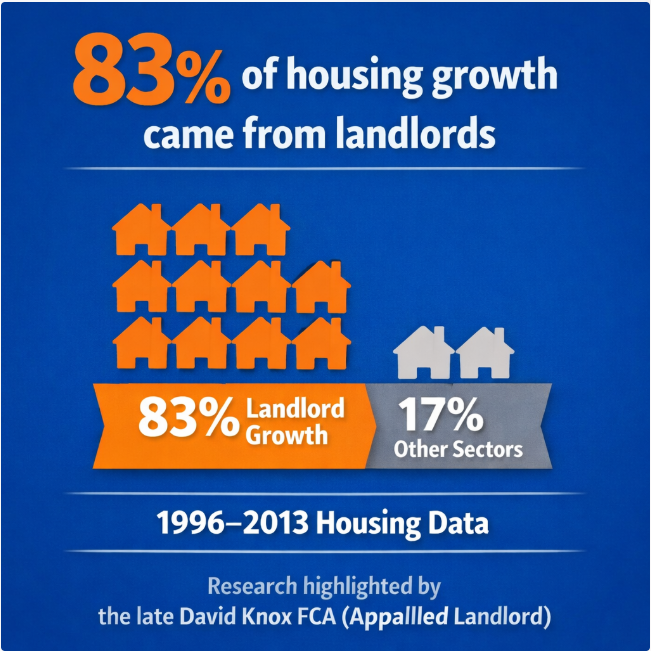
83% of housing growth came from private landlords
The overlooked statistic from England’s housing data that could reshape the policy debate.
Housing debates in Britain often start from a familiar assumption; that the growth of the private rented sector reduced housing supply by diverting homes away from first-time buyers, but one statistic tells a very different story.
Between 1996 and 2013, the number of dwellings in England increased from 20.3 million to 23.3 million homes, and during that same period the number of privately rented homes rose from around 2.0 million to 4.5 million. In other words, roughly 2.5 million of the additional homes appeared within the private rented sector.
That means the private rented sector accounted for around 83% of the increase in England’s housing stock during that period.
The statistic was highlighted back in 2016 by Property118 contributor David Knox, writing under the pseudonym “Appalled Landlord”, in an open letter to a Member of Parliament.
At the time, it challenged a narrative that was already gaining traction in housing policy debates. Today, it raises a more important question …
If private landlords played such a significant role in expanding housing supply in the past, what role could they play in addressing the housing shortage today?
How the private rented sector expanded so quickly
The growth of the private rented sector during the late 1990s and early 2000s did not happen by accident; several structural changes occurred at the same time.
The introduction of buy-to-let mortgages in the mid-1990s made it easier for individuals to invest in rental property. Financial institutions recognised that rental income could support borrowing, and lenders began offering products specifically designed for landlords. At the same time, demographic changes were increasing demand for rental housing. Labour mobility, rising student numbers and delayed home ownership meant more households were looking for rented accommodation, but demand alone does not increase housing supply.
What changed was the willingness of thousands of small investors to deploy capital into housing. Instead of relying solely on large developers or housing associations, the market suddenly had hundreds of thousands of individual participants willing to finance, renovate and operate rental homes. Many of those investors were not building entirely new homes. They were bringing existing housing stock back into productive use. That process, multiplied across the country, significantly expanded the number of homes available to rent.
The practical ways landlords increased housing supply
The expansion of the private rented sector did not simply involve buying completed homes and letting them out. Landlords often undertook projects that changed the way existing housing stock was used.
One common route was the renovation of empty or neglected properties. Across many towns and cities, landlords purchased houses that had been vacant or poorly maintained and refurbished them for rental use. Those properties that might otherwise have remained empty were returned to the housing market.
Another mechanism was conversion. Large houses were frequently converted into Houses in Multiple Occupation (HMOs), increasing the number of people who could live within the same building. In many urban areas this provided accommodation for students, young professionals and migrant workers who might otherwise have struggled to find housing.
Landlords also played an important role in supporting new developments. Purchasing properties off-plan helped developers secure financing for projects that might otherwise have stalled. Early investor purchases often provided the certainty developers needed to move ahead with construction.
In addition, some landlords converted commercial buildings or subdivided larger properties into smaller units, creating additional dwellings without requiring entirely new construction.
Taken individually, these projects may appear small, but taken together, they represented a significant contribution to housing availability.
This is why the statistics highlighted by David Knox are so striking; they suggest that the expansion of the private rented sector was not simply a shift in tenure. In many cases it involved bringing additional housing into use or increasing the number of households that existing buildings could accommodate.
What changed after the expansion years?
The period between the late 1990s and early 2010s was unusually favourable for investment in the private rented sector. Demand for rental housing was growing, credit was widely available and the regulatory framework was relatively stable. For many investors the economics of rental property were predictable enough to justify long-term commitments.
During the past decade, however, the environment for landlords has changed significantly.
A number of policy reforms were introduced that altered the financial and regulatory landscape of the sector. These included changes to mortgage interest tax relief, higher rates of Stamp Duty Land Tax on additional properties, tighter lending standards for buy-to-let borrowing and the gradual expansion of licensing and regulatory requirements in many local authority areas.
Each of these measures had its own policy objective. Some were introduced to address financial stability concerns, others to raise tax revenue or improve housing standards. but taken together they changed the risk profile of residential property investment.
For many smaller landlords, particularly those using borrowing to finance their investments, the economics became more uncertain. At the same time, rising interest rates and construction costs made property investment more capital intensive. The result has been a noticeable shift in behaviour.
Instead of expanding portfolios, many landlords have slowed investment, paused acquisitions or begun selling properties. At the same time fewer new investors have entered the sector than during the expansion years. None of this means the private rented sector is disappearing; millions of households still rely on it for housing. However, the pace of growth that characterised the earlier period has clearly slowed.
Why investor confidence matters in housing supply
Housing supply is often discussed primarily in terms of planning policy and large-scale development. Those factors are undeniably important; major housing developments require land allocation, infrastructure and the financial capacity of large builders, yet the experience of the private rented sector shows that housing supply can also expand through many smaller investment decisions.
When thousands of individual investors renovate vacant homes, convert properties or support new developments through early purchases, the cumulative effect can be substantial.
The expansion of the private rented sector between 1996 and 2013 illustrates how powerful that distributed investment model can be.
Conversely, when those investors lose confidence in the stability or profitability of the sector, the flow of capital into housing can slow just as quickly.
This dynamic is not unique to housing. In any sector where private capital plays a role, investment tends to follow confidence.
If private landlords once contributed significantly to the expansion of housing supply, what conditions would need to exist for them to do so again?
What would encourage landlords to invest again?
If housing policy is ultimately about increasing the number of homes available to live in, it is reasonable to ask what conditions encourage investment in housing.
The expansion of the private rented sector between 1996 and 2013 did not occur because government instructed landlords to invest. It happened because thousands of individuals concluded that investing in housing was both economically viable and socially acceptable.
Those conditions were not created by a single policy decision, they were the result of several factors working together.
The tax treatment of rental income was broadly aligned with other forms of business investment. Mortgage lending for buy-to-let was accessible but still subject to prudent underwriting. Regulatory requirements existed but changed relatively slowly, allowing investors to plan with some confidence.
Most importantly, the sector operated within a framework that was broadly predictable.
When investment decisions involve assets that may be held for decades, predictability matters. Investors do not require guaranteed returns, but they do need to understand the rules under which they are operating. When the policy environment becomes uncertain or changes frequently, investors tend to pause before committing capital.
The experience of the past decade suggests that investor behaviour in the housing market is no different from other sectors of the economy. When returns become less predictable or risks increase, investment tends to slow. Conversely, when the environment supports stable long-term investment, capital tends to return.
Lessons for housing policy
The purpose of this article is not to suggest that the private rented sector alone can solve Britain’s housing shortage. Housing supply depends on many factors, including planning policy, infrastructure, land availability and the capacity of major housebuilders, but the historical evidence does suggest that private landlords once played a significant role in expanding housing availability.
They did so not through large-scale national programmes, but through thousands of individual decisions to renovate properties, convert buildings and invest in new developments.
If policymakers are searching for ways to increase housing supply, that experience raises a question worth considering; is the current policy environment encouraging or discouraging that kind of distributed investment?
If the goal is to increase the number of homes available to rent or buy, the answer to that question may matter more than is often acknowledged in housing debates.
A simple thought experiment
Imagine the housing market between 1996 and 2013 without the private rented sector.
During that period England added around 3 million homes to its housing stock. Roughly 2.5 million of those appeared within the private rented sector.
Remove that expansion and the housing market would have looked very different.
Many of the renovated properties, converted buildings and investor-backed developments that became rental homes might never have appeared in the housing supply at all. That observation does not solve today’s housing shortage, but it does highlight something worth remembering when policymakers discuss the role of private landlords.
A statistic worth remembering
When David Knox wrote his open letter several years ago, he highlighted a statistic that had received relatively little attention.
During the period between 1996 and 2013, roughly 83% of the increase in England’s housing stock occurred within the private rented sector.
The number itself does not provide a complete explanation of Britain’s housing challenges, but it does remind us of something important. At one point in recent history, private landlords were responsible for a large share of the expansion in available housing. If Britain is searching for ways to increase housing supply again, it may be worth asking why.
Attribution
The statistic referenced in this article was highlighted by Property118 contributor David Knox, who wrote under the pseudonym “Appalled Landlord”.
David passed away in January 2020, but his research into housing policy and landlord economics remains part of the Property118 archive.
His original article can be read here:
Support Property118 and keep the platform independent
If you value evidence-led reporting like this, you can support the work here.
Monthly support helps fund independent reporting, research, and the free landlord forum.
The post 83% of housing growth came from private landlords appeared first on Property118.
View Full Article: 83% of housing growth came from private landlords
Five questions landlords often find themselves asking, usually just before something changes
Property118

Five questions landlords often find themselves asking, usually just before something changes
These are the questions landlords tend to ask themselves just before they make a change, even if they haven’t quite admitted it yet.
1. Do I actually feel in control of my portfolio, or am I just keeping things running as they are?
This is often the first shift in thinking. On the surface, everything may be working, but that does not always translate into a genuine sense of control.
2. If I had to simplify everything tomorrow, what would I keep and what would I let go, and why haven’t I done that already?
This question tends to highlight where complexity has built up over time, and whether it is still serving a purpose.
3. Are my financing decisions really supporting where I want to end up, or just maintaining where I am today?
What worked at one stage does not always support the next. The distinction is subtle, but important.
4. If something unexpected happened, would I have options, or would I feel exposed and forced into decisions?
This is less about predicting events and more about understanding how resilient your current position really is.
5. Have I actually designed this portfolio, or have I just arrived here over time without stepping back to reconsider it?
For many landlords, the answer sits somewhere in between. That is often where the most valuable conversations begin.
About these questions
None of these questions are designed to lead you towards a particular outcome, and in many cases, the right answer may be to change very little.
What they tend to do, however, is begin to build a roadmap towards clarity.
For some landlords, that clarity confirms they are on the right path. For others, it highlights opportunities to simplify, strengthen, or realign what they have already built. Either way, it moves things from continuing by default to moving forward with intent.
If any of these questions resonate, it may be worth exploring them in more detail.
An invitation for established landlords
If you find the Property118 articles helpful and are curious about how those ideas apply to your own portfolio, you are welcome to take the conversation a step further.
These conversations are typically most useful for landlords with established portfolios and relatively modest borrowing who are beginning to reflect on how their assets could work more effectively in the years ahead.
/* “function”==typeof InitializeEditor,callIfLoaded:function(o){return!(!gform.domLoaded||!gform.scriptsLoaded||!gform.themeScriptsLoaded&&!gform.isFormEditor()||(gform.isFormEditor()&&console.warn(“The use of gform.initializeOnLoaded() is deprecated in the form editor context and will be removed in Gravity Forms 3.1.”),o(),0))},initializeOnLoaded:function(o){gform.callIfLoaded(o)||(document.addEventListener(“gform_main_scripts_loaded”,()=>{gform.scriptsLoaded=!0,gform.callIfLoaded(o)}),document.addEventListener(“gform/theme/scripts_loaded”,()=>{gform.themeScriptsLoaded=!0,gform.callIfLoaded(o)}),window.addEventListener(“DOMContentLoaded”,()=>{gform.domLoaded=!0,gform.callIfLoaded(o)}))},hooks:{action:{},filter:{}},addAction:function(o,r,e,t){gform.addHook(“action”,o,r,e,t)},addFilter:function(o,r,e,t){gform.addHook(“filter”,o,r,e,t)},doAction:function(o){gform.doHook(“action”,o,arguments)},applyFilters:function(o){return gform.doHook(“filter”,o,arguments)},removeAction:function(o,r){gform.removeHook(“action”,o,r)},removeFilter:function(o,r,e){gform.removeHook(“filter”,o,r,e)},addHook:function(o,r,e,t,n){null==gform.hooks[o][r]&&(gform.hooks[o][r]=[]);var d=gform.hooks[o][r];null==n&&(n=r+”_”+d.length),gform.hooks[o][r].push({tag:n,callable:e,priority:t=null==t?10:t})},doHook:function(r,o,e){var t;if(e=Array.prototype.slice.call(e,1),null!=gform.hooks[r][o]&&((o=gform.hooks[r][o]).sort(function(o,r){return o.priority-r.priority}),o.forEach(function(o){“function”!=typeof(t=o.callable)&&(t=window[t]),”action”==r?t.apply(null,e):e[0]=t.apply(null,e)})),”filter”==r)return e[0]},removeHook:function(o,r,t,n){var e;null!=gform.hooks[o][r]&&(e=(e=gform.hooks[o][r]).filter(function(o,r,e){return!!(null!=n&&n!=o.tag||null!=t&&t!=o.priority)}),gform.hooks[o][r]=e)}});
/* ]]> */
Enquire about a free initial discussion with a Property118 consultant
-
Mr.Mrs.MissMs.Dr.Prof.Rev.
-
-
Important Notice – Scope of Planning Support
Where our recommendations touch on areas requiring regulated input, we refer clients to appropriately authorised professionals for advice and implementation.
-
-
-
/* = 0;if(!is_postback){return;}var form_content = jQuery(this).contents().find(‘#gform_wrapper_585′);var is_confirmation = jQuery(this).contents().find(‘#gform_confirmation_wrapper_585′).length > 0;var is_redirect = contents.indexOf(‘gformRedirect(){‘) >= 0;var is_form = form_content.length > 0 && ! is_redirect && ! is_confirmation;var mt = parseInt(jQuery(‘html’).css(‘margin-top’), 10) + parseInt(jQuery(‘body’).css(‘margin-top’), 10) + 100;if(is_form){jQuery(‘#gform_wrapper_585′).html(form_content.html());if(form_content.hasClass(‘gform_validation_error’)){jQuery(‘#gform_wrapper_585′).addClass(‘gform_validation_error’);} else {jQuery(‘#gform_wrapper_585′).removeClass(‘gform_validation_error’);}setTimeout( function() { /* delay the scroll by 50 milliseconds to fix a bug in chrome */ }, 50 );if(window[‘gformInitDatepicker’]) {gformInitDatepicker();}if(window[‘gformInitPriceFields’]) {gformInitPriceFields();}var current_page = jQuery(‘#gform_source_page_number_585′).val();gformInitSpinner( 585, ‘https://www.property118.com/wp-content/plugins/gravityforms/images/spinner.svg’, true );jQuery(document).trigger(‘gform_page_loaded’, [585, current_page]);window[‘gf_submitting_585′] = false;}else if(!is_redirect){var confirmation_content = jQuery(this).contents().find(‘.GF_AJAX_POSTBACK’).html();if(!confirmation_content){confirmation_content = contents;}jQuery(‘#gform_wrapper_585′).replaceWith(confirmation_content);jQuery(document).trigger(‘gform_confirmation_loaded’, [585]);window[‘gf_submitting_585′] = false;wp.a11y.speak(jQuery(‘#gform_confirmation_message_585′).text());}else{jQuery(‘#gform_585′).append(contents);if(window[‘gformRedirect’]) {gformRedirect();}}jQuery(document).trigger(“gform_pre_post_render”, [{ formId: “585”, currentPage: “current_page”, abort: function() { this.preventDefault(); } }]); if (event && event.defaultPrevented) { return; } const gformWrapperDiv = document.getElementById( “gform_wrapper_585″ ); if ( gformWrapperDiv ) { const visibilitySpan = document.createElement( “span” ); visibilitySpan.id = “gform_visibility_test_585″; gformWrapperDiv.insertAdjacentElement( “afterend”, visibilitySpan ); } const visibilityTestDiv = document.getElementById( “gform_visibility_test_585″ ); let postRenderFired = false; function triggerPostRender() { if ( postRenderFired ) { return; } postRenderFired = true; gform.core.triggerPostRenderEvents( 585, current_page ); if ( visibilityTestDiv ) { visibilityTestDiv.parentNode.removeChild( visibilityTestDiv ); } } function debounce( func, wait, immediate ) { var timeout; return function() { var context = this, args = arguments; var later = function() { timeout = null; if ( !immediate ) func.apply( context, args ); }; var callNow = immediate && !timeout; clearTimeout( timeout ); timeout = setTimeout( later, wait ); if ( callNow ) func.apply( context, args ); }; } const debouncedTriggerPostRender = debounce( function() { triggerPostRender(); }, 200 ); if ( visibilityTestDiv && visibilityTestDiv.offsetParent === null ) { const observer = new MutationObserver( ( mutations ) => { mutations.forEach( ( mutation ) => { if ( mutation.type === ‘attributes’ && visibilityTestDiv.offsetParent !== null ) { debouncedTriggerPostRender(); observer.disconnect(); } }); }); observer.observe( document.body, { attributes: true, childList: false, subtree: true, attributeFilter: [ ‘style’, ‘class’ ], }); } else { triggerPostRender(); } } );} );
/* ]]> */
From there we can arrange a free introductory discussion to explore how your portfolio works as a whole and what that might mean for the years ahead.
|
★★★★★
|
Help other landlords find Property118If you have found Property118 useful, a short Trustpilot review would make a meaningful difference. It helps other landlords decide whether our research is worth following. |
The post Five questions landlords often find themselves asking, usually just before something changes appeared first on Property118.
View Full Article: Five questions landlords often find themselves asking, usually just before something changes
Categories
- Landlords (19)
- Real Estate (9)
- Renewables & Green Issues (1)
- Rental Property Investment (1)
- Tenants (21)
- Uncategorized (12,685)
Archives
- May 2026 (32)
- April 2026 (78)
- March 2026 (72)
- February 2026 (55)
- January 2026 (52)
- December 2025 (62)
- August 2025 (51)
- July 2025 (51)
- June 2025 (49)
- May 2025 (50)
- April 2025 (48)
- March 2025 (54)
- February 2025 (51)
- January 2025 (52)
- December 2024 (55)
- November 2024 (64)
- October 2024 (82)
- September 2024 (69)
- August 2024 (55)
- July 2024 (64)
- June 2024 (54)
- May 2024 (73)
- April 2024 (59)
- March 2024 (49)
- February 2024 (57)
- January 2024 (58)
- December 2023 (56)
- November 2023 (59)
- October 2023 (67)
- September 2023 (136)
- August 2023 (131)
- July 2023 (129)
- June 2023 (128)
- May 2023 (140)
- April 2023 (121)
- March 2023 (168)
- February 2023 (155)
- January 2023 (152)
- December 2022 (136)
- November 2022 (158)
- October 2022 (146)
- September 2022 (148)
- August 2022 (169)
- July 2022 (124)
- June 2022 (124)
- May 2022 (130)
- April 2022 (116)
- March 2022 (155)
- February 2022 (124)
- January 2022 (120)
- December 2021 (117)
- November 2021 (139)
- October 2021 (130)
- September 2021 (138)
- August 2021 (110)
- July 2021 (110)
- June 2021 (60)
- May 2021 (127)
- April 2021 (122)
- March 2021 (156)
- February 2021 (154)
- January 2021 (133)
- December 2020 (126)
- November 2020 (159)
- October 2020 (169)
- September 2020 (181)
- August 2020 (147)
- July 2020 (172)
- June 2020 (158)
- May 2020 (177)
- April 2020 (188)
- March 2020 (234)
- February 2020 (212)
- January 2020 (164)
- December 2019 (107)
- November 2019 (131)
- October 2019 (145)
- September 2019 (123)
- August 2019 (112)
- July 2019 (93)
- June 2019 (82)
- May 2019 (94)
- April 2019 (88)
- March 2019 (78)
- February 2019 (77)
- January 2019 (71)
- December 2018 (37)
- November 2018 (85)
- October 2018 (108)
- September 2018 (110)
- August 2018 (135)
- July 2018 (140)
- June 2018 (118)
- May 2018 (113)
- April 2018 (64)
- March 2018 (96)
- February 2018 (82)
- January 2018 (92)
- December 2017 (62)
- November 2017 (100)
- October 2017 (105)
- September 2017 (97)
- August 2017 (101)
- July 2017 (104)
- June 2017 (155)
- May 2017 (135)
- April 2017 (113)
- March 2017 (138)
- February 2017 (150)
- January 2017 (127)
- December 2016 (90)
- November 2016 (135)
- October 2016 (149)
- September 2016 (135)
- August 2016 (48)
- July 2016 (52)
- June 2016 (54)
- May 2016 (52)
- April 2016 (24)
- October 2014 (8)
- April 2012 (2)
- December 2011 (2)
- November 2011 (10)
- October 2011 (9)
- September 2011 (9)
- August 2011 (3)
Calendar
Recent Posts
- What you might not know about Inheritance Tax and Whole of Life insurance
- Guidance clarifies council powers to enter premises and seize documents
- The great landlord contradiction: wanting companies, stuck in personal ownership
- Why some landlords are selling before the next repair bill arrives
- Concerns raised over £500 landlord tribunal fees and court delays
