
BR Investments: The trade most landlords never consider
 admin
admin 

Property118

BR Investments: The trade most landlords never consider
Many landlords only start thinking about this when they are already in their 60’s and above, and by then, some of the options are already close to closing.
The recent Property118 landlord survey revealed that many established landlords have very low LTV’s across their rental property portfolios, and some have no borrowing at all, but is that equity actually doing anything useful?” In many cases, it isn’t; it’s just sitting there while a future inheritance tax bill builds in the background.
Whole of Life insurance in trust is one option, but some people are uninsurable. Many landlords are over-exposed to property because that’s all they know. That’s why they rarely seek advice about diversification from a regulated whole of market IFA, but that’s a mistake.
The trade most landlords never consider
Let’s keep this simple.
You have £1,000,000 of equity sitting in your portfolio.
Left untouched, that £1,000,000 could face a 40% inheritance tax charge.
That is potentially a £400,000 problem, and likely a growing one.
Most landlords accept that as “something for later”, whereas others with an open mind might ask: “What happens if I borrow against that equity and reposition it?”
This is where Business Relief (BR) starts to become relevant, because certain investments into qualifying trading businesses such as Octopus can fall outside your estate for inheritance tax purposes after a two-year holding period. The investment remains accessible during your lifetime, meaning you’re not giving money away; you are repositioning it.
IMPORTANT NOTE: This is not an invitation to invest, nor is it to be regarded as financial advice or a recommendation of Octopus Investments. The purpose of this article is financial education.
Why some landlords are funding BR investments through borrowing
Rather than using existing cash, some landlords refinance part of their portfolio and use the capital released to fund Business Relief qualifying investments.
That may sound counterintuitive at first; why risk taking on debt to invest into something other than property?
The answer sits in the balance between cost and outcome.
The objective isn’t necessarily for the investment to outperform the cost of borrowing, even though it may be possible in some cases. Instead, the objective is to remove a 40% inheritance tax exposure on that capital after two years, and viewed through that lens, the decision is less about yield and more about liability management.
What this can achieve in practice
Used carefully, this approach can begin to reshape exposure to IHT over time because a portion of the estate becomes more liquid, part of the inheritance tax exposure starts to reduce after two years and yet the property portfolio itself remains intact. It also creates optionality if circumstances change because the arrangements could be reversed by cashing in the investment and paying debt back down.
This is not without risk
It is important to be clear that this is not a risk-free strategy. Borrowing introduces ongoing cost and lender considerations while Business Relief investments carry capital risk, and qualification depends on the nature of the underlying businesses at the time. This is not about replacing one certainty with another; it’s about deciding which risks you are more comfortable managing.
An invitation for established landlords
If you find the Property118 articles helpful and are curious about how those ideas apply to your own portfolio, you are welcome to take the conversation a step further.
These conversations are typically most useful for landlords with established portfolios and relatively modest borrowing who are beginning to reflect on how their assets could work more effectively in the years ahead.
/* “function”==typeof InitializeEditor,callIfLoaded:function(o){return!(!gform.domLoaded||!gform.scriptsLoaded||!gform.themeScriptsLoaded&&!gform.isFormEditor()||(gform.isFormEditor()&&console.warn(“The use of gform.initializeOnLoaded() is deprecated in the form editor context and will be removed in Gravity Forms 3.1.”),o(),0))},initializeOnLoaded:function(o){gform.callIfLoaded(o)||(document.addEventListener(“gform_main_scripts_loaded”,()=>{gform.scriptsLoaded=!0,gform.callIfLoaded(o)}),document.addEventListener(“gform/theme/scripts_loaded”,()=>{gform.themeScriptsLoaded=!0,gform.callIfLoaded(o)}),window.addEventListener(“DOMContentLoaded”,()=>{gform.domLoaded=!0,gform.callIfLoaded(o)}))},hooks:{action:{},filter:{}},addAction:function(o,r,e,t){gform.addHook(“action”,o,r,e,t)},addFilter:function(o,r,e,t){gform.addHook(“filter”,o,r,e,t)},doAction:function(o){gform.doHook(“action”,o,arguments)},applyFilters:function(o){return gform.doHook(“filter”,o,arguments)},removeAction:function(o,r){gform.removeHook(“action”,o,r)},removeFilter:function(o,r,e){gform.removeHook(“filter”,o,r,e)},addHook:function(o,r,e,t,n){null==gform.hooks[o][r]&&(gform.hooks[o][r]=[]);var d=gform.hooks[o][r];null==n&&(n=r+”_”+d.length),gform.hooks[o][r].push({tag:n,callable:e,priority:t=null==t?10:t})},doHook:function(r,o,e){var t;if(e=Array.prototype.slice.call(e,1),null!=gform.hooks[r][o]&&((o=gform.hooks[r][o]).sort(function(o,r){return o.priority-r.priority}),o.forEach(function(o){“function”!=typeof(t=o.callable)&&(t=window[t]),”action”==r?t.apply(null,e):e[0]=t.apply(null,e)})),”filter”==r)return e[0]},removeHook:function(o,r,t,n){var e;null!=gform.hooks[o][r]&&(e=(e=gform.hooks[o][r]).filter(function(o,r,e){return!!(null!=n&&n!=o.tag||null!=t&&t!=o.priority)}),gform.hooks[o][r]=e)}});
/* ]]> */
Enquire about a free initial discussion with a Property118 consultant
-
Mr.Mrs.MissMs.Dr.Prof.Rev.
-
-
 Important Notice – Scope of Planning Support
Where our recommendations touch on areas requiring regulated input, we refer clients to appropriately authorised professionals for advice and implementation.
-
-
-
/* = 0;if(!is_postback){return;}var form_content = jQuery(this).contents().find(‘#gform_wrapper_585′);var is_confirmation = jQuery(this).contents().find(‘#gform_confirmation_wrapper_585′).length > 0;var is_redirect = contents.indexOf(‘gformRedirect(){‘) >= 0;var is_form = form_content.length > 0 && ! is_redirect && ! is_confirmation;var mt = parseInt(jQuery(‘html’).css(‘margin-top’), 10) + parseInt(jQuery(‘body’).css(‘margin-top’), 10) + 100;if(is_form){jQuery(‘#gform_wrapper_585′).html(form_content.html());if(form_content.hasClass(‘gform_validation_error’)){jQuery(‘#gform_wrapper_585′).addClass(‘gform_validation_error’);} else {jQuery(‘#gform_wrapper_585′).removeClass(‘gform_validation_error’);}setTimeout( function() { /* delay the scroll by 50 milliseconds to fix a bug in chrome */ }, 50 );if(window[‘gformInitDatepicker’]) {gformInitDatepicker();}if(window[‘gformInitPriceFields’]) {gformInitPriceFields();}var current_page = jQuery(‘#gform_source_page_number_585′).val();gformInitSpinner( 585, ‘https://www.property118.com/wp-content/plugins/gravityforms/images/spinner.svg’, true );jQuery(document).trigger(‘gform_page_loaded’, [585, current_page]);window[‘gf_submitting_585′] = false;}else if(!is_redirect){var confirmation_content = jQuery(this).contents().find(‘.GF_AJAX_POSTBACK’).html();if(!confirmation_content){confirmation_content = contents;}jQuery(‘#gform_wrapper_585′).replaceWith(confirmation_content);jQuery(document).trigger(‘gform_confirmation_loaded’, [585]);window[‘gf_submitting_585′] = false;wp.a11y.speak(jQuery(‘#gform_confirmation_message_585′).text());}else{jQuery(‘#gform_585′).append(contents);if(window[‘gformRedirect’]) {gformRedirect();}}jQuery(document).trigger(“gform_pre_post_render”, [{ formId: “585”, currentPage: “current_page”, abort: function() { this.preventDefault(); } }]); if (event && event.defaultPrevented) { return; } const gformWrapperDiv = document.getElementById( “gform_wrapper_585″ ); if ( gformWrapperDiv ) { const visibilitySpan = document.createElement( “span” ); visibilitySpan.id = “gform_visibility_test_585″; gformWrapperDiv.insertAdjacentElement( “afterend”, visibilitySpan ); } const visibilityTestDiv = document.getElementById( “gform_visibility_test_585″ ); let postRenderFired = false; function triggerPostRender() { if ( postRenderFired ) { return; } postRenderFired = true; gform.core.triggerPostRenderEvents( 585, current_page ); if ( visibilityTestDiv ) { visibilityTestDiv.parentNode.removeChild( visibilityTestDiv ); } } function debounce( func, wait, immediate ) { var timeout; return function() { var context = this, args = arguments; var later = function() { timeout = null; if ( !immediate ) func.apply( context, args ); }; var callNow = immediate && !timeout; clearTimeout( timeout ); timeout = setTimeout( later, wait ); if ( callNow ) func.apply( context, args ); }; } const debouncedTriggerPostRender = debounce( function() { triggerPostRender(); }, 200 ); if ( visibilityTestDiv && visibilityTestDiv.offsetParent === null ) { const observer = new MutationObserver( ( mutations ) => { mutations.forEach( ( mutation ) => { if ( mutation.type === ‘attributes’ && visibilityTestDiv.offsetParent !== null ) { debouncedTriggerPostRender(); observer.disconnect(); } }); }); observer.observe( document.body, { attributes: true, childList: false, subtree: true, attributeFilter: [ ‘style’, ‘class’ ], }); } else { triggerPostRender(); } } );} );
/* ]]> */
From there we can arrange a free introductory discussion to explore how your portfolio works as a whole and what that might mean for the years ahead.
|
★★★★★
|
Help other landlords find Property118If you have found Property118 useful, a short Trustpilot review would make a meaningful difference. It helps other landlords decide whether our research is worth following. |

The post BR Investments: The trade most landlords never consider appeared first on Property118.
View Full Article: BR Investments: The trade most landlords never consider
EXCLUSIVE: SpareRoom suspends HMO agents over automation tool use
Property118

EXCLUSIVE: SpareRoom suspends HMO agents over automation tool use
Letting agents handling thousands of HMO rooms on behalf of landlords across the country were abruptly locked out of SpareRoom last week after the platform suspended dozens of professional accounts without warning.
The platform said their use of automation tools is a breach of its terms.
Emails sent to affected users said accounts would remain suspended for up to four days unless agents confirmed they had removed the third-party tools.
Between them, the suspended accounts covered thousands of rooms listed on the site.
For many agents, SpareRoom is the main route to market, leaving little room to manoeuvre when access is removed.
Activities stopped immediately
Lee Dumbarton, founder of UrbanShare, which operates across London, Surrey and the home counties, said routine activity stopped almost immediately.
He told Property118: “We weren’t trying to gain anything. We were trying to respond to people faster, which is better for tenants, too.
“To have the account suspended without any warning was a real shock.”
Because enquiries are handled through SpareRoom’s internal messaging system, agents found themselves unable to contact prospective tenants.
Viewings already booked for the weekend could not be confirmed or moved.
One agent told us that access was briefly restored after contacting the company and pointing to appointments already in the diary.
No other HMO platform
Other letting agents reported the same disruption, although most declined to be named.
One said: “If this were any other platform, we’d just move on. But you can’t. There’s nowhere else to go. So you just keep your head down and hope it’s not you next time.”
The issue centres on the platform’s prohibition on automated activity.
Its terms allow accounts to be suspended or terminated at its discretion and, at the same time, rule out tools designed to streamline responses or manage enquiries.
RRA impact for agents
In practice, agents say those tools are now part of daily operations, particularly with administrative pressure increasing ahead of the Renters’ Rights Act.
Larger operators, especially those with multiple staff, rely on them to schedule replies and organise viewings at scale.
The tool referenced in the suspensions is Nestflo, used by HMO agents to handle enquiries and bookings.
Its founder, Roland Tao, said the move came as a surprise.
He told Property118: “We built Nestflo to help agents work more efficiently. Faster responses to applicants, viewings booked sooner, fewer people left waiting to hear back.
“The tool operates across a number of platforms, and we have never had an issue of this kind before. We thought we were being careful.”
Issue over demand claim
He also questioned the figures included in SpareRoom’s emails, which stated that Nestflo had generated more than 300,000 requests within a 24-hour period.
He said: “We’re a much smaller company than SpareRoom. I’d expect our infrastructure to be significantly smaller than theirs.
“Handling that volume of requests would have caused us serious problems of our own.
“We’ve reviewed our logs and we have not experienced any issues of that kind.”
Some agents said they had not realised the full extent of the platform’s restrictions.
Others pointed to similar episodes in previous years, where accounts were suspended over tools that had been in routine use.
For agents managing large portfolios, even a short suspension feeds directly into pipeline delays and landlord relationships.
Site infrastructure under strain
SpareRoom said it acted to protect performance across the site and a statement, it told us: “We understand the need for automation but, in this case, a small group of users were using a particular bit of third party software that put a huge strain on site infrastructure.
“Had it continued, it could have resulted in site-wide performance issues for all SpareRoom users.
“We therefore took action to suspend the accounts responsible in order to protect the site.
“Now the situation has been resolved, all the accounts have been reactivated.”
SpareRoom access restored
While access may have been restored, agents say they have removed automation tools and returned to manual processes.
An industry insider said: “Whilst accounts may have been activated, we still have zero allowance of using any tools to help automate the business, and we are struggling now with a load of manual work that we previously had automated.
“Things like replying to tenants asking, ‘Is this still available?’, to let them know it is, and provide information on how to arrange a viewing now take much more time.
“There have been discussions as to whether developing in-house tools could help with automation, but the risk that SpareRoom will ban the account now without question has made this a risk.
“Whilst SpareRoom says ‘a small number’, it’s understood the number is 50+ of some of the biggest professional agencies.
“Arguably, that’s one or two per large city. If they have 500 rooms, that’s at least 25,000 rooms affected.”
The post EXCLUSIVE: SpareRoom suspends HMO agents over automation tool use appeared first on Property118.
View Full Article: EXCLUSIVE: SpareRoom suspends HMO agents over automation tool use
Landlords accused of rushing evictions ahead of Renters’ Rights Act
Property118

Landlords accused of rushing evictions ahead of Renters’ Rights Act
Charities claim an eviction surge is under way as landlords rush to evict tenants before the Renters’ Rights Act takes effect.
Tenant group Acorn told the Guardian that Section 21 evictions accounted for one in five reports from members in October, rising to nearly one in three by January.
The news comes ahead the Renters’ Rights Act coming into force on 1 May 2026.
Landlords exploiting this thin window
A spokesperson from Acorn told the Guardian: “This isn’t a coincidence. Landlords are clearly rushing to force through last-minute evictions before the ban comes into force.”
The housing charity Shelter also accused landlords of exploiting tenants.
A spokesperson told the Guardian: “It’s especially outrageous that some landlords are exploiting this thin window of time to serve no-fault evictions. It just goes to show how vital these new changes are for renters.”
A lawyer also told the paper he was seeing long-term tenants shocked by unexpected Section 21 notices.
Hugh Wilkinson, head of housing at the Central England Law Centre, said: “It can be quite upsetting for people. To think that they’ve been there for a long time and that the length of time doesn’t make any difference. The court won’t take into account the fairness of it.”
Landlords weighing up the risks
The National Residential Landlords Association (NRLA) defended landlords saying many weighing up the risks and benefits of continuing tenancies.
Meera Chindooroy, deputy director for campaigns for the NRLA, told the Guardian: “Landlords will be looking at their current tenants and considering whether these are tenancies that they are happy to continue with after May, or whether they have concerns about any risks, rent arrears, for example, or issues with antisocial behaviour.”
As previously reported on Property118, data analysed by the NRLA shows that Section 21 (‘accelerated’) possession claims in the county courts have dropped to their lowest level in several years.
According to government data, in 2025, 28,112 possession claims were brought to the county courts in England following the issuing of Section 21 notice to a tenant (known as the ‘accelerated’ procedure), the lowest level since 2022.
In the final quarter of 2025 (when the Renters’ Rights Act formally completed its passage through Parliament) 6,367 claims were brought under the Section 21 route. This is the lowest number since the final quarter of 2022.
The post Landlords accused of rushing evictions ahead of Renters’ Rights Act appeared first on Property118.
View Full Article: Landlords accused of rushing evictions ahead of Renters’ Rights Act
Most landlords now debt-light, with majority below 50% LTV
Property118
Most landlords now debt-light, with majority below 50% LTV
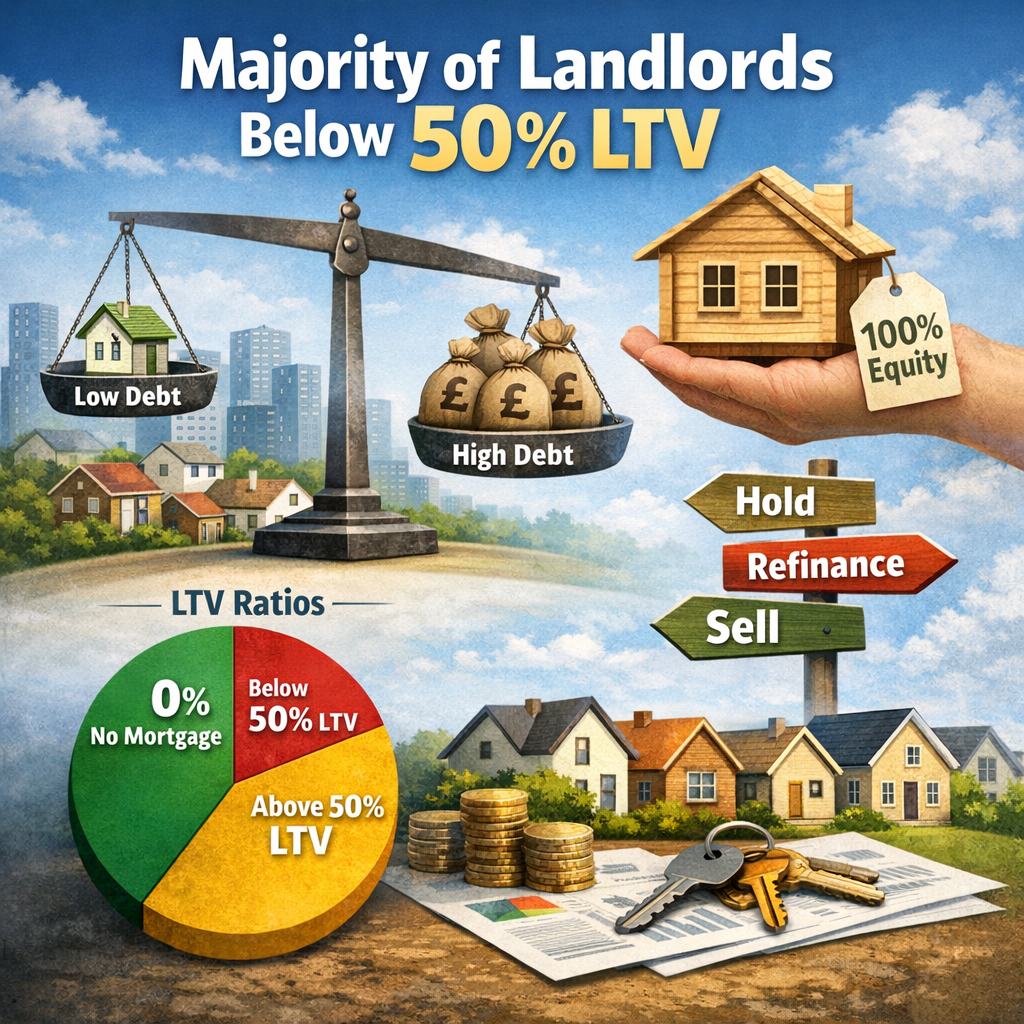
A widely held assumption about the private rented sector is that landlords are highly leveraged and therefore vulnerable to interest rate movements. The latest data suggests a different picture. According to the Property118 Landlord Sentiment Survey Q1 2026, most landlords are now operating with relatively low levels of borrowing.
Based on 2,380 completed responses, a majority of landlords report loan-to-value ratios at or below 50%, with a significant proportion owning properties outright with no mortgage debt at all. You can review the full dataset here.
The implication is clear: the sector is more resilient than it is often portrayed.
A different risk profile
At higher levels of borrowing, landlords are naturally more exposed to changes in interest rates and refinancing conditions. That exposure has shaped much of the public narrative over recent years. However, the survey findings point towards a different risk profile.
With many landlords holding significant equity and relatively modest debt, the immediate pressure from interest rate increases is less pronounced than often assumed. This does not remove risk entirely, but it changes its nature. The issue becomes less about survival and more about strategy.
Why this matters for market behaviour
The level of borrowing has a direct influence on how landlords respond to changing conditions. Highly leveraged landlords may be forced to act quickly when costs rise. By contrast, those with lower loan-to-value ratios have more flexibility. They can choose whether to refinance, hold, or sell, rather than being compelled into a decision.
This aligns with other findings from the Property118 dataset, which show that many landlords are planning to reduce portfolios despite not being under immediate financial pressure.
Equity creates options
Lower levels of borrowing mean higher levels of equity, and equity provides optionality.
Landlords with substantial equity can:
– sell selectively rather than under pressure
– refinance on more favourable terms
– release capital if required
– or simply hold assets without urgency
This flexibility changes the dynamics of the market. Rather than reacting to external pressures, many landlords are making proactive decisions about how their portfolios should evolve.
A shift in mindset
The combination of lower leverage and changing market conditions appears to be influencing how landlords think about their portfolios. For many, the focus is no longer on maximising growth through borrowing, but on consolidating gains, reducing complexity and improving long-term certainty. This is consistent with the broader trends highlighted in the survey results, including rising intentions to sell and a limited appetite for expansion.
A more stable, but more selective sector
A debt-light sector is, in many respects, a more stable one. Lower leverage reduces the risk of forced sales and financial distress. At the same time, it also means that landlords are under less pressure to remain active. When portfolios are secure and largely unencumbered, the decision to continue, expand or exit becomes a matter of choice rather than necessity.
For now, one conclusion stands out: landlords are not being pushed out by debt, they are choosing their next move from a position of strength.
A conversation worth having?
If you are weighing up your own strategy, whether that’s to sell, expand, or restructure to improve profitibility, it is worth having a discussion with a Property118 consultant to take a closer look at how your portfolio is structured as a whole now, and to forecast the outcomes based on multiple scenario’s.
These conversations are typically most useful for landlords with established portfolios and relatively modest borrowing who are beginning to reflect on how their assets could work more effectively in the years ahead.
/* “function”==typeof InitializeEditor,callIfLoaded:function(o){return!(!gform.domLoaded||!gform.scriptsLoaded||!gform.themeScriptsLoaded&&!gform.isFormEditor()||(gform.isFormEditor()&&console.warn(“The use of gform.initializeOnLoaded() is deprecated in the form editor context and will be removed in Gravity Forms 3.1.”),o(),0))},initializeOnLoaded:function(o){gform.callIfLoaded(o)||(document.addEventListener(“gform_main_scripts_loaded”,()=>{gform.scriptsLoaded=!0,gform.callIfLoaded(o)}),document.addEventListener(“gform/theme/scripts_loaded”,()=>{gform.themeScriptsLoaded=!0,gform.callIfLoaded(o)}),window.addEventListener(“DOMContentLoaded”,()=>{gform.domLoaded=!0,gform.callIfLoaded(o)}))},hooks:{action:{},filter:{}},addAction:function(o,r,e,t){gform.addHook(“action”,o,r,e,t)},addFilter:function(o,r,e,t){gform.addHook(“filter”,o,r,e,t)},doAction:function(o){gform.doHook(“action”,o,arguments)},applyFilters:function(o){return gform.doHook(“filter”,o,arguments)},removeAction:function(o,r){gform.removeHook(“action”,o,r)},removeFilter:function(o,r,e){gform.removeHook(“filter”,o,r,e)},addHook:function(o,r,e,t,n){null==gform.hooks[o][r]&&(gform.hooks[o][r]=[]);var d=gform.hooks[o][r];null==n&&(n=r+”_”+d.length),gform.hooks[o][r].push({tag:n,callable:e,priority:t=null==t?10:t})},doHook:function(r,o,e){var t;if(e=Array.prototype.slice.call(e,1),null!=gform.hooks[r][o]&&((o=gform.hooks[r][o]).sort(function(o,r){return o.priority-r.priority}),o.forEach(function(o){“function”!=typeof(t=o.callable)&&(t=window[t]),”action”==r?t.apply(null,e):e[0]=t.apply(null,e)})),”filter”==r)return e[0]},removeHook:function(o,r,t,n){var e;null!=gform.hooks[o][r]&&(e=(e=gform.hooks[o][r]).filter(function(o,r,e){return!!(null!=n&&n!=o.tag||null!=t&&t!=o.priority)}),gform.hooks[o][r]=e)}});
/* ]]> */
Enquire about a free initial discussion with a Property118 consultant
-
Mr.Mrs.MissMs.Dr.Prof.Rev.
-
-
Important Notice – Scope of Planning Support
Where our recommendations touch on areas requiring regulated input, we refer clients to appropriately authorised professionals for advice and implementation.
-
-
-
/* = 0;if(!is_postback){return;}var form_content = jQuery(this).contents().find(‘#gform_wrapper_585′);var is_confirmation = jQuery(this).contents().find(‘#gform_confirmation_wrapper_585′).length > 0;var is_redirect = contents.indexOf(‘gformRedirect(){‘) >= 0;var is_form = form_content.length > 0 && ! is_redirect && ! is_confirmation;var mt = parseInt(jQuery(‘html’).css(‘margin-top’), 10) + parseInt(jQuery(‘body’).css(‘margin-top’), 10) + 100;if(is_form){jQuery(‘#gform_wrapper_585′).html(form_content.html());if(form_content.hasClass(‘gform_validation_error’)){jQuery(‘#gform_wrapper_585′).addClass(‘gform_validation_error’);} else {jQuery(‘#gform_wrapper_585′).removeClass(‘gform_validation_error’);}setTimeout( function() { /* delay the scroll by 50 milliseconds to fix a bug in chrome */ }, 50 );if(window[‘gformInitDatepicker’]) {gformInitDatepicker();}if(window[‘gformInitPriceFields’]) {gformInitPriceFields();}var current_page = jQuery(‘#gform_source_page_number_585′).val();gformInitSpinner( 585, ‘https://www.property118.com/wp-content/plugins/gravityforms/images/spinner.svg’, true );jQuery(document).trigger(‘gform_page_loaded’, [585, current_page]);window[‘gf_submitting_585′] = false;}else if(!is_redirect){var confirmation_content = jQuery(this).contents().find(‘.GF_AJAX_POSTBACK’).html();if(!confirmation_content){confirmation_content = contents;}jQuery(‘#gform_wrapper_585′).replaceWith(confirmation_content);jQuery(document).trigger(‘gform_confirmation_loaded’, [585]);window[‘gf_submitting_585′] = false;wp.a11y.speak(jQuery(‘#gform_confirmation_message_585′).text());}else{jQuery(‘#gform_585′).append(contents);if(window[‘gformRedirect’]) {gformRedirect();}}jQuery(document).trigger(“gform_pre_post_render”, [{ formId: “585”, currentPage: “current_page”, abort: function() { this.preventDefault(); } }]); if (event && event.defaultPrevented) { return; } const gformWrapperDiv = document.getElementById( “gform_wrapper_585″ ); if ( gformWrapperDiv ) { const visibilitySpan = document.createElement( “span” ); visibilitySpan.id = “gform_visibility_test_585″; gformWrapperDiv.insertAdjacentElement( “afterend”, visibilitySpan ); } const visibilityTestDiv = document.getElementById( “gform_visibility_test_585″ ); let postRenderFired = false; function triggerPostRender() { if ( postRenderFired ) { return; } postRenderFired = true; gform.core.triggerPostRenderEvents( 585, current_page ); if ( visibilityTestDiv ) { visibilityTestDiv.parentNode.removeChild( visibilityTestDiv ); } } function debounce( func, wait, immediate ) { var timeout; return function() { var context = this, args = arguments; var later = function() { timeout = null; if ( !immediate ) func.apply( context, args ); }; var callNow = immediate && !timeout; clearTimeout( timeout ); timeout = setTimeout( later, wait ); if ( callNow ) func.apply( context, args ); }; } const debouncedTriggerPostRender = debounce( function() { triggerPostRender(); }, 200 ); if ( visibilityTestDiv && visibilityTestDiv.offsetParent === null ) { const observer = new MutationObserver( ( mutations ) => { mutations.forEach( ( mutation ) => { if ( mutation.type === ‘attributes’ && visibilityTestDiv.offsetParent !== null ) { debouncedTriggerPostRender(); observer.disconnect(); } }); }); observer.observe( document.body, { attributes: true, childList: false, subtree: true, attributeFilter: [ ‘style’, ‘class’ ], }); } else { triggerPostRender(); } } );} );
/* ]]> */
|
★★★★★
|
Help other landlords find Property118If you have found Property118 useful, a short Trustpilot review would make a meaningful difference. It helps other landlords decide whether our research is worth following. |
The post Most landlords now debt-light, with majority below 50% LTV appeared first on Property118.
View Full Article: Most landlords now debt-light, with majority below 50% LTV
Mayor of London urged to take action as key workers struggle with rent
Property118

Mayor of London urged to take action as key workers struggle with rent
Renting in London is now unaffordable for key workers, as a tenant group urges the Mayor of London to do more to tackle soaring rents.
Research by Generation Rent reveals teachers, nurses and bus drivers would struggle to rent the average one-bed home in most London boroughs.
Generation Rent is calling on London Mayor Sadiq Khan to “slam the brakes on local rents for key workers”.
Nine types of key workers would fail letting agent affordability checks
According to Generation Rent, nine types of key workers would fail letting agent affordability checks for the average one-bed home in every London borough, with average London wages worth less than 2.5 times the average rent.
In seven boroughs, the average one-bed home demands more rent than the average hairdresser in London earns in a year, with the rent in Kensington and Chelsea worth 138% of a hairdresser’s income of £22,641.
Across Greater London, the average monthly rent of £1,688 consumes. 40% of a community nurse’s income, 71% of a receptionist’s income, 80% of a pharmacy assistant’s income and 79% of a teaching assistant’s income
The most expensive borough was Kensington and Chelsea with the average rent for a 1-bed of £2,595 per month, and the cheapest was Bexley, with £1,138.
Slam the brakes on local rents
Dan Wilson Craw, deputy chief executive of Generation Rent, said: “London is one of the richest cities on the planet, but it depends on the key workers who clean up after us, take care of our sick and elderly, and drive our buses to where we need to go.
“London needs its key workers if the city can continue to thrive, but those workers cannot stay in a city that demands an arm and a leg for a place to recharge after a hard day and build their life from.
“The current cost of the renting crisis is devastating for London’s essential occupations and the rest of us. It is vital that the Mayor is given the power to slam the brakes on local rents and give our key workers the breathing space they need to live and work in their community. It is also vital that the mayor and the government build more affordable homes in the capital and increase how much social housing is available.”
As previously reported by Property118, London Mayor Sadiq Khan has pushed for rent controls under new devolution powers.
Mr Khan admitted that, in his conversations with the Labour government, ministers had been “not keen” on rent controls but said he would keep trying.
The post Mayor of London urged to take action as key workers struggle with rent appeared first on Property118.
View Full Article: Mayor of London urged to take action as key workers struggle with rent
Categories
- Landlords (19)
- Real Estate (9)
- Renewables & Green Issues (1)
- Rental Property Investment (1)
- Tenants (21)
- Uncategorized (12,777)
Archives
- June 2026 (54)
- May 2026 (70)
- April 2026 (78)
- March 2026 (72)
- February 2026 (55)
- January 2026 (52)
- December 2025 (62)
- August 2025 (51)
- July 2025 (51)
- June 2025 (49)
- May 2025 (50)
- April 2025 (48)
- March 2025 (54)
- February 2025 (51)
- January 2025 (52)
- December 2024 (55)
- November 2024 (64)
- October 2024 (82)
- September 2024 (69)
- August 2024 (55)
- July 2024 (64)
- June 2024 (54)
- May 2024 (73)
- April 2024 (59)
- March 2024 (49)
- February 2024 (57)
- January 2024 (58)
- December 2023 (56)
- November 2023 (59)
- October 2023 (67)
- September 2023 (136)
- August 2023 (131)
- July 2023 (129)
- June 2023 (128)
- May 2023 (140)
- April 2023 (121)
- March 2023 (168)
- February 2023 (155)
- January 2023 (152)
- December 2022 (136)
- November 2022 (158)
- October 2022 (146)
- September 2022 (148)
- August 2022 (169)
- July 2022 (124)
- June 2022 (124)
- May 2022 (130)
- April 2022 (116)
- March 2022 (155)
- February 2022 (124)
- January 2022 (120)
- December 2021 (117)
- November 2021 (139)
- October 2021 (130)
- September 2021 (138)
- August 2021 (110)
- July 2021 (110)
- June 2021 (60)
- May 2021 (127)
- April 2021 (122)
- March 2021 (156)
- February 2021 (154)
- January 2021 (133)
- December 2020 (126)
- November 2020 (159)
- October 2020 (169)
- September 2020 (181)
- August 2020 (147)
- July 2020 (172)
- June 2020 (158)
- May 2020 (177)
- April 2020 (188)
- March 2020 (234)
- February 2020 (212)
- January 2020 (164)
- December 2019 (107)
- November 2019 (131)
- October 2019 (145)
- September 2019 (123)
- August 2019 (112)
- July 2019 (93)
- June 2019 (82)
- May 2019 (94)
- April 2019 (88)
- March 2019 (78)
- February 2019 (77)
- January 2019 (71)
- December 2018 (37)
- November 2018 (85)
- October 2018 (108)
- September 2018 (110)
- August 2018 (135)
- July 2018 (140)
- June 2018 (118)
- May 2018 (113)
- April 2018 (64)
- March 2018 (96)
- February 2018 (82)
- January 2018 (92)
- December 2017 (62)
- November 2017 (100)
- October 2017 (105)
- September 2017 (97)
- August 2017 (101)
- July 2017 (104)
- June 2017 (155)
- May 2017 (135)
- April 2017 (113)
- March 2017 (138)
- February 2017 (150)
- January 2017 (127)
- December 2016 (90)
- November 2016 (135)
- October 2016 (149)
- September 2016 (135)
- August 2016 (48)
- July 2016 (52)
- June 2016 (54)
- May 2016 (52)
- April 2016 (24)
- October 2014 (8)
- April 2012 (2)
- December 2011 (2)
- November 2011 (10)
- October 2011 (9)
- September 2011 (9)
- August 2011 (3)
Calendar
Recent Posts
- Could Andy Burnham’s proposed land tax force landlords to sell?
- Buy to let lenders widen landlord options
- What the World Cup teaches landlords about selling property
- The Mortgage Works to pilot landlord EPC support package
- Landbay, Kensington and Dudley cut landlord BTL mortgage rates
