
More than 200,000 UK homes owned by overseas buyers
 admin
admin 

Property118

More than 200,000 UK homes owned by overseas buyers
There are 202,568 homes in the UK that are now registered to owners based outside the country, research reveals.
The findings from Enness Global show that the total has barely shifted over the past 12 months, rising by just 0.02%.
The data also offers a snapshot of where foreign ownership is concentrated, and which nationalities dominate different areas.
London accounts for the largest share, with 33.9% of all homes linked to overseas addresses, and the South East follows with 17.2%.
The North West ranks third at 15.9%.
Overseas buyers’ role
The firm’s chief executive, Islay Robinson, said: “International buyers continue to play an important role in the housing market, particularly across London and the wider South East where demand from overseas homeowners has long been a key feature of market activity.
“What’s particularly notable is how stable the overall level of international ownership has remained, with the total number of homes registered to overseas addresses changing very little over the past year.
“This suggests that, despite a challenging economic backdrop and ongoing political and tax uncertainty, the UK remains a desirable place to own property for many global buyers.”
She added: “London remains the clear focal point, accounting for over a third of all internationally owned homes across England and Wales.”
Biggest overseas owners
Buyers from Hong Kong emerge as the most prominent group overall, responsible for 13.8% of all internationally owned homes nationwide.
Singaporean owners take second place at 7.9%, ahead of purchasers from the United States of America on 6.8%.
Next is the United Arab Emirates on 5.9% and China on 5.8%.
Malaysia, Ireland, Australia, Kuwait and Saudi Arabia complete the top 10.
Who owns what
Hong Kong nationals also lead in several major regions, including the capital, the North West, the West Midlands and Yorkshire and the Humber.
Elsewhere, Malaysian buyers top the table in both the East Midlands and the East of England.
Irish owners are most common in the North East, Kuwaiti nationals dominate the South East, and US buyers lead across the South West and Wales.
Within London, 68,729 homes are registered to overseas addresses and, of these, 18.7% are linked to Hong Kong owners.
Singapore follows with 12.9%, while China moves into third place at 11.9%, ahead of the USA at 5.9%.
The post More than 200,000 UK homes owned by overseas buyers appeared first on Property118.
View Full Article: More than 200,000 UK homes owned by overseas buyers
Fed up of the bad news? Landlords: If you want to sell and get out, we can help you
Property118

Fed up of the bad news? Landlords: If you want to sell and get out, we can help you
Whether you’re an accidental landlord with a single property, or an owner with 100 properties, we’re all in the same boat. And I don’t just mean bored of the constant barrage of bad news.
This year is challenging. There’s no denying it. With the Renters’ Rights Act coming into play, plus new tax penalties and unrealistic regulations, it’s safe to say that either you don’t know where you stand, or you do and you don’t want to stand there anymore.
As Noel, a Property118 member, summarised perfectly: the “Renters’ Rights Act is a disaster.” He went on to say about the state of the property sector: “I think the plan is to keep people so downtrodden they won’t ever vote.”
Well he’s got a point. And the stats show you agree. With well over 80 landlords now contacting us every week to sell, your sentiments are the same: we’re out, but we need help.
So how do you sell without overpricing? Not to mention how do you avoid the long delays, price reductions or deals falling apart? And how do you work with someone who genuinely understands landlord property and can get the job done fast?
At Landlord Sales Agency we specialise in selling tenanted, recently vacated and soon-to-be vacant properties in a way that’s realistic, well-managed and designed to complete.
We’re not a traditional estate agent, and we’re not a fast-sale company either. Our focus is simply on certainty of sale at a fair, achievable price.
You can forget costly refurbs too. We have teams to help spruce up your properties with only what’s absolutely essential for your houses to sell, and our process is fast, gets the most achievable prices and allows you as a landlord to sit back and relax knowing it’s all in hand. How?
- We have an extensive database of over 30,000 active, chain free buyers looking to purchase anything from a single property to a full portfolio, allowing us to quickly match you with the perfect buyer.
- Buyers commit with non-refundable deposits, reducing fall-throughs
- We use realistic guide pricing to create momentum and competition, driving a bidding war on your properties
- And we work in combination with trusted local agents to ensure that your property is marketed via every possible avenue.
What’s more, our team of landlord experts is the best in the country at managing tenants, access and compliance.
We’re also completely transparent. We don’t promise the highest price at any cost. We focus on the best achievable price that actually completes. And it works. On average, all our properties sell in less than 28 days.
Throughout January and February, we’ll be focusing on properties from Liverpool, Nottingham, Manchester and Leeds, where our experts can get to you fastest.
If you’re a landlord looking to get out of this mess and start afresh, we’re here to help.
There’s no obligation to sell, and absolutely everything to gain.
/* “function”==typeof InitializeEditor,callIfLoaded:function(o){return!(!gform.domLoaded||!gform.scriptsLoaded||!gform.themeScriptsLoaded&&!gform.isFormEditor()||(gform.isFormEditor()&&console.warn(“The use of gform.initializeOnLoaded() is deprecated in the form editor context and will be removed in Gravity Forms 3.1.”),o(),0))},initializeOnLoaded:function(o){gform.callIfLoaded(o)||(document.addEventListener(“gform_main_scripts_loaded”,()=>{gform.scriptsLoaded=!0,gform.callIfLoaded(o)}),document.addEventListener(“gform/theme/scripts_loaded”,()=>{gform.themeScriptsLoaded=!0,gform.callIfLoaded(o)}),window.addEventListener(“DOMContentLoaded”,()=>{gform.domLoaded=!0,gform.callIfLoaded(o)}))},hooks:{action:{},filter:{}},addAction:function(o,r,e,t){gform.addHook(“action”,o,r,e,t)},addFilter:function(o,r,e,t){gform.addHook(“filter”,o,r,e,t)},doAction:function(o){gform.doHook(“action”,o,arguments)},applyFilters:function(o){return gform.doHook(“filter”,o,arguments)},removeAction:function(o,r){gform.removeHook(“action”,o,r)},removeFilter:function(o,r,e){gform.removeHook(“filter”,o,r,e)},addHook:function(o,r,e,t,n){null==gform.hooks[o][r]&&(gform.hooks[o][r]=[]);var d=gform.hooks[o][r];null==n&&(n=r+”_”+d.length),gform.hooks[o][r].push({tag:n,callable:e,priority:t=null==t?10:t})},doHook:function(r,o,e){var t;if(e=Array.prototype.slice.call(e,1),null!=gform.hooks[r][o]&&((o=gform.hooks[r][o]).sort(function(o,r){return o.priority-r.priority}),o.forEach(function(o){“function”!=typeof(t=o.callable)&&(t=window[t]),”action”==r?t.apply(null,e):e[0]=t.apply(null,e)})),”filter”==r)return e[0]},removeHook:function(o,r,t,n){var e;null!=gform.hooks[o][r]&&(e=(e=gform.hooks[o][r]).filter(function(o,r,e){return!!(null!=n&&n!=o.tag||null!=t&&t!=o.priority)}),gform.hooks[o][r]=e)}});
/* ]]> */
Contact Landlord Sales Agency
/* = 0;if(!is_postback){return;}var form_content = jQuery(this).contents().find(‘#gform_wrapper_515′);var is_confirmation = jQuery(this).contents().find(‘#gform_confirmation_wrapper_515′).length > 0;var is_redirect = contents.indexOf(‘gformRedirect(){‘) >= 0;var is_form = form_content.length > 0 && ! is_redirect && ! is_confirmation;var mt = parseInt(jQuery(‘html’).css(‘margin-top’), 10) + parseInt(jQuery(‘body’).css(‘margin-top’), 10) + 100;if(is_form){jQuery(‘#gform_wrapper_515′).html(form_content.html());if(form_content.hasClass(‘gform_validation_error’)){jQuery(‘#gform_wrapper_515′).addClass(‘gform_validation_error’);} else {jQuery(‘#gform_wrapper_515′).removeClass(‘gform_validation_error’);}setTimeout( function() { /* delay the scroll by 50 milliseconds to fix a bug in chrome */ }, 50 );if(window[‘gformInitDatepicker’]) {gformInitDatepicker();}if(window[‘gformInitPriceFields’]) {gformInitPriceFields();}var current_page = jQuery(‘#gform_source_page_number_515′).val();gformInitSpinner( 515, ‘https://www.property118.com/wp-content/plugins/gravityforms/images/spinner.svg’, true );jQuery(document).trigger(‘gform_page_loaded’, [515, current_page]);window[‘gf_submitting_515′] = false;}else if(!is_redirect){var confirmation_content = jQuery(this).contents().find(‘.GF_AJAX_POSTBACK’).html();if(!confirmation_content){confirmation_content = contents;}jQuery(‘#gform_wrapper_515′).replaceWith(confirmation_content);jQuery(document).trigger(‘gform_confirmation_loaded’, [515]);window[‘gf_submitting_515′] = false;wp.a11y.speak(jQuery(‘#gform_confirmation_message_515′).text());}else{jQuery(‘#gform_515′).append(contents);if(window[‘gformRedirect’]) {gformRedirect();}}jQuery(document).trigger(“gform_pre_post_render”, [{ formId: “515”, currentPage: “current_page”, abort: function() { this.preventDefault(); } }]); if (event && event.defaultPrevented) { return; } const gformWrapperDiv = document.getElementById( “gform_wrapper_515″ ); if ( gformWrapperDiv ) { const visibilitySpan = document.createElement( “span” ); visibilitySpan.id = “gform_visibility_test_515″; gformWrapperDiv.insertAdjacentElement( “afterend”, visibilitySpan ); } const visibilityTestDiv = document.getElementById( “gform_visibility_test_515″ ); let postRenderFired = false; function triggerPostRender() { if ( postRenderFired ) { return; } postRenderFired = true; gform.core.triggerPostRenderEvents( 515, current_page ); if ( visibilityTestDiv ) { visibilityTestDiv.parentNode.removeChild( visibilityTestDiv ); } } function debounce( func, wait, immediate ) { var timeout; return function() { var context = this, args = arguments; var later = function() { timeout = null; if ( !immediate ) func.apply( context, args ); }; var callNow = immediate && !timeout; clearTimeout( timeout ); timeout = setTimeout( later, wait ); if ( callNow ) func.apply( context, args ); }; } const debouncedTriggerPostRender = debounce( function() { triggerPostRender(); }, 200 ); if ( visibilityTestDiv && visibilityTestDiv.offsetParent === null ) { const observer = new MutationObserver( ( mutations ) => { mutations.forEach( ( mutation ) => { if ( mutation.type === ‘attributes’ && visibilityTestDiv.offsetParent !== null ) { debouncedTriggerPostRender(); observer.disconnect(); } }); }); observer.observe( document.body, { attributes: true, childList: false, subtree: true, attributeFilter: [ ‘style’, ‘class’ ], }); } else { triggerPostRender(); } } );} );
/* ]]> */
The post Fed up of the bad news? Landlords: If you want to sell and get out, we can help you appeared first on Property118.
View Full Article: Fed up of the bad news? Landlords: If you want to sell and get out, we can help you
Council’s citywide HMO licensing consultation to combat ‘public health crisis’
Property118

Council’s citywide HMO licensing consultation to combat ‘public health crisis’
A council has unveiled a consultation on a new citywide licensing scheme for houses in multiple occupation.
Proposals for an additional HMO licensing scheme have been approved and now the council needs the views from residents, landlords, letting agents and businesses.
However, one news report quotes Salford City Council Mayor Paul Dennett declaring HMO issues are a ‘public health crisis’.
Manchester World also quotes the mayor in the meeting as saying: ‘Landlords should be ashamed of themselves operating these sorts of properties in the city of Salford.’
Concerning results
Mr Dennett also said: “It is important we drive up our housing standards as much as we can in Salford.
“Initial research by officers has shown some concerning results.
“Information shows that a huge proportion of Section 257 HMOs failed to meet expected property standards.
“Many properties were found to suffer from poor maintenance, damp and inadequate energy efficiency, resulting in cold and unhealthy living environments.
“And the majority also failed to meet minimum fire safety standards.”
He added: “These findings make it clear that as a local authority we should give consideration to use powers available to us and take action.
“People should be able to rely on a safe and well-managed home in this city.
“And residents living near HMOs should not have to put up with antisocial behaviour.”
Landlord fines reinvested
Under the Housing Act 2004, councils can introduce additional licensing where there is evidence that HMOs are being poorly managed.
Before licensing is introduced, the council must demonstrate the scale of the issue and take local opinion into account.
Last summer, the council said it had issued £2.2m in fines to landlords renting out unsafe homes.
More than £500,000 of that was levied against 26 HMO landlords in July alone.
The council says the cash has been reinvested into housing standards and inspection teams.
The post Council’s citywide HMO licensing consultation to combat ‘public health crisis’ appeared first on Property118.
View Full Article: Council’s citywide HMO licensing consultation to combat ‘public health crisis’
Decent Homes Standard to apply to all private and social landlords by 2035
Property118

Decent Homes Standard to apply to all private and social landlords by 2035
The government has confirmed all private and social landlords will need to meet the Decent Homes Standard (DHS) by 2035.
Generation Rent has accused the government of “dragging their feet” after opting for a 2035 target.
The news comes after the government confirmed all private landlords will need to meet EPC C targets by 2030.
Homes will be classed as non-decent if landlord has not remediated damp and mould
Under the new standard, landlords will need to meet certain criteria, including that homes must be in a reasonable state of repair and provide core facilities and services, including a kitchen with adequate space and layout, an appropriately located bathroom and WC, and adequate protection from external noise.
A government document says homes must also be equipped with child-resistant window restrictors and provide a reasonable degree of thermal comfort. This includes ensuring homes meet Minimum Energy Efficiency Standards.
Homes will be classed as non-decent if a landlord has not remediated damp and mould. More information on the criteria can be found by clicking here.
All tenants will benefit
Housing Minister Matthew Pennycook says too many tenants are living in poor quality housing, with 21% of homes in the Private Rented Sector (PRS) and 10% of homes in the social rented sector failed to meet the DHS.
He said: “Our new, modernised DHS is designed to meet modern expectations of housing quality. By setting out in plain terms a series of ambitious yet proportionate standards for landlords to adhere to, it will help ensure we continue to drive down rates of non-decency across the country.
“Importantly, our new DHS will apply to both the social rented sector and private rented sector, meaning that all tenants in rented housing will benefit, regardless of who their landlord is.
“This important reform is one of a series of changes this government has made to drive a transformational and lasting change in the safety and quality of our housing stock. Our expectations are clear: no tenant should have to live in unsafe conditions for any amount of time, and social and private landlords should act as quickly as possible to ensure their properties are decent.
“However, we recognise the significant challenges that landlords are facing as a result of the bold and comprehensive regulatory changes we are enacting. We are also acutely aware that we are asking social landlords to balance the competing demands of improving their existing stock and building more desperately needed social and affordable homes. As such, we have decided that all rented properties will be required to meet the new DHS by 2035 at the latest, an implementation timeline that gives social landlords in particular the time and the certainty they need to boost housing supply as well as drive up the quality of the homes they manage.”
Industry reaction to Decent Homes Standard
Ben Twomey, chief executive of Generation Rent, said on X, formerly Twitter: “It is absurd to let landlords drag their feet for an entire decade, denying renters the most basic standards in our homes.
“It will mean millions of renters, including children, trapped in poor-quality homes with nowhere to turn.”
Ben Beadle, chief executive of the National Residential Landlords Association (NRLA), said: “Providing a decent, safe place to live should be the top priority for any landlord. Whilst we will study the detail carefully, we broadly welcome the government’s plans, which provide much-needed clarity for both landlords and tenants about the standards that should be expected of homes to rent.
“That said, all the standards in the world will mean nothing without robust enforcement to back them up. At present, too many councils lack the staff and resources needed to find and root out rogue landlords. Our research also shows many councils are failing to collect civil penalties issued against landlords even where they have been issued.
“It is time to ensure enforcement is properly funded and targeted, so that the cost of action falls on those breaking the rules, not the responsible majority of landlords already doing the right thing.”
The post Decent Homes Standard to apply to all private and social landlords by 2035 appeared first on Property118.
View Full Article: Decent Homes Standard to apply to all private and social landlords by 2035
MP raises concern over rent increases from Warm Homes Plan
Property118

MP raises concern over rent increases from Warm Homes Plan
An MP has asked whether the government will prevent landlords from raising rents under the Warm Homes Plan.
In a written question, Labour MP Bell Ribeiro-Addy asked if the government will stop landlords from increasing rents after using grants and loans from the plan to fund energy efficiency measures.
The government has again insisted that landlords will not need to raise rents to meet EPC C targets by 2030 and that the Renters’ Rights Act will help tenants challenge any excessive increases.
Changes do not require landlords to increase rents
Martin McCluskey, Minister for Energy Consumers, said: “The Warm Homes Plan will lift up to one million households out of fuel poverty through public investment and new minimum energy efficiency standards for private landlords and proposed standard for social landlords. These changes do not require landlords to increase rents. Instead, they will help tenants cut their energy bills by delivering more energy-efficient homes.
“There is support available for landlords, financing options, as well as new protections for renters in the Renters’ Rights Act 2025 to challenge above-market rent increases. As now, landlords will still be able to increase rents to market price for their properties and an independent tribunal will make a judgement on this, if needed.”
He adds: “Landlords will have discretion between meeting the heating system standard and the smart readiness standard so that they can choose what is most appropriate for their property.
“We estimate the new private rented sector minimum energy efficiency standards (MEES) could lift approximately 415,000 households out of fuel poverty by 2030. A cost cap of £10,000, compared to £15,000, reduces the risk of cost pass-through to tenants whilst still delivering substantial improvements to homes.”
Landlords could face costly upgrades
However, Timothy Douglas, head of policy and campaigns at Propertymark, warned landlords could face costly upgrades to meet EPC C targets by 2030.
He said: “In the private rented sector, landlords are being asked to deliver, in many cases, substantial and costly upgrades to reach EPC C by 2030, yet this is being imposed without clear, long-term funding commitments, realistic delivery timescales, or sufficient flexibility for older, complex, and hard-to-treat properties.
“A phased and realistic approach would allow landlords to maintain the Decent Homes Standard, manage costs effectively, and contribute meaningfully to the UK Government’s ambition to achieve net zero by 2050.”
Also, as previously reported by Property118, a government consultation on meeting EPC C targets admits landlords may sell up or increase rents due to EPC rules.
The post MP raises concern over rent increases from Warm Homes Plan appeared first on Property118.
View Full Article: MP raises concern over rent increases from Warm Homes Plan
Renters’ Rights Act depends on council enforcement claims tenant group
Property118

Renters’ Rights Act depends on council enforcement claims tenant group
A tenant group claims the “Renters’ Rights Act will only be as effective as how well it is enforced”, as they claim councils need more enforcement powers.
Speaking to the London Assembly Housing Committee on the implementation of the Renters’ Rights Act, the Renters’ Reform Coalition claimed local authorities have not used existing powers to prosecute landlords.
Generation Rent, who also spoke at the committee, claimed Awaab’s law needs to be implemented as soon as possible.
Renters’ Rights Act places several new obligations on councils
Niamh Evans, policy officer at Renters’ Reform Coalition, told the Housing Committee: “The Renters’ Rights Act will only be as effective as how well it is enforced.
“The act does place several new obligations on local authorities to protect renters’ rights and actually take enforcement action, but they currently aren’t able to enforce the existing system of rights that we have.
“For example, in the three-year period to 2024, over a third of councils didn’t prosecute a single landlord. In the last three years, only one landlord in London was prosecuted for an illegal eviction.
“Clearly, we have our work cut out in boosting capacity, and we would like councils to take various opportunities to boost their enforcement, whether that’s through on-the-spot fines and new inspection powers that are enabled by the new act, but also looking at some of the existing frameworks, such as expanding selective licensing.
“40% of London councils do not operate a single selective licensing scheme and this could help boost their capacity and provide a stable source of funding.”
Don’t need duplication of selective licensing
However, the Renters’ Reform Coalition failed to mention that, since December last year, councils have new powers under the Renters’ Rights Act to carry out surprise inspections, including entering premises where tenancy records are kept, and to issue fines running into thousands of pounds.
As previously reported by Property118, Ben Beadle, chief executive of the National Residential Landlords Association (NRLA), also spoke at the committee meeting and pointed out that selective licensing schemes should not be needed under the Renters’ Rights Act.
He said: “The Renters’ Rights Act will deal with licensing. It will create a database for landlords, and every property will be listed on it. If you don’t register your property, you will face a fine. With this system in place, you don’t need the duplication of selective licensing.
“Local authorities have become addicted to this cash, and it’s difficult to replace. The database system will allow for targeted enforcement and give renters the information they need, without the need for double licensing.”
Ten years for the Decent Homes Standard is far too long
Elsewhere during the committee meeting, Generation Rent claimed the implementation date of Awaab’s law for 2027 and the Decent Homes Standard for 2035 is too late.
Ben Twomey, chief executive of Generation Rent, said: “Ten years for the Decent Homes Standard is far too long and it creates uncertainty about whether there will even be a government committed to delivering it by that point.
“Awaab’s Law is such a simple law built on an awful tragedy. All it does is introduce clear timescales within which landlords must deal with serious hazards.
“There is no reason to wait years just to say these issues need to be addressed within a reasonable period of time, so bringing Awaab’s Law forward, ideally to this year, would be far better.
“As for the Decent Homes Standard, it would only require changes to properties that are not already decent.”
The post Renters’ Rights Act depends on council enforcement claims tenant group appeared first on Property118.
View Full Article: Renters’ Rights Act depends on council enforcement claims tenant group
Ground rents for leaseholders to be capped
Property118

Ground rents for leaseholders to be capped
The government has announced that ground rents in England and Wales will be capped at £250 a year for leaseholders.
Under the plans, they will fall to a peppercorn rent after 40 years, meaning no payment at all.
The cap will apply to most residential leasehold agreements signed before July 2023, removing future shocks for homeowners budgeting over the long term.
No new leasehold flats
The Prime Minister, Sir Keir Starmer, announced the cap in a TikTok video, saying: “I’ve spoken to so many people who say this will make a difference to them worth hundreds of pounds.”
The reforms will be published in the draft Leasehold and Commonhold Reform Bill, which will be introduced today (Tuesday).
Developers will also be barred from selling most new flats as leasehold.
Instead, new apartment blocks will be built under a commonhold structure, where residents collectively own and manage the building and the land beneath it.
The government is consulting on how the shift will work in practice, including limited exemptions and transition arrangements.
Convert to commonhold
Existing leaseholders are not excluded, and the proposals will make it easier for current flat owners to convert from leasehold to commonhold if they choose.
Doing so will allow them to access the same rights as those buying new homes.
The government is also moving to end forfeiture, a long-standing rule that can see homeowners lose their property over relatively small debts.
In its place, a court-led process with tighter safeguards will apply only in more serious cases.
Transparency on fees
Further measures aim to improve transparency around service charges and building costs.
Bills will be clearer, routes to challenge unfair fees strengthened and landlords or managing agents held to higher standards, reducing unexplained increases.
Reforms will also extend to nearly two million households living in freehold homes on privately managed estates.
They currently pay additional charges for shared spaces, a practice often labelled ‘fleecehold’.
Ministers say they want to curb its future use and give homeowners more protection.
Other leasehold plans
Other plans include banning a century old legal power that allows harsh penalties for missed payments.
The government will also introduce standardised estate charge statements, enabling tribunals to replace failing management firms.
There will also be a proposal on whether resident-run management should become the default.
The post Ground rents for leaseholders to be capped appeared first on Property118.
View Full Article: Ground rents for leaseholders to be capped
Rent Guarantee Insurance – Does It Really Work for Landlords?
Property118

Rent Guarantee Insurance – Does It Really Work for Landlords?
Tenant default is one of the biggest risks for landlords. Even with strong referencing, job losses, illness, or disputes can leave tenants unable or unwilling to pay. Rent guarantee insurance (RGI) promises to protect landlords against these losses, but the detail of each policy makes a huge difference. This article explains how RGI works, what’s usually covered, common exclusions, and what landlords should check before buying.
What Rent Guarantee Insurance Covers
A typical RGI policy pays landlords when tenants stop paying rent, usually from the date of default until the tenant vacates or possession is obtained. Cover usually includes:
- Monthly rent payments – up to a specified limit (e.g. £2,500 or £3,000 per month).
- Maximum duration – often 6 or 12 months of unpaid rent.
- Legal expenses – to fund possession proceedings and eviction if necessary.
- Alternative accommodation – occasionally included if tenants must be rehoused during legal processes (less common).
Eligibility and Referencing Requirements
RGI is not a blanket safety net. Policies are only valid if strict referencing criteria are met at the start of the tenancy. Typical requirements include:
- Full credit check – confirming no adverse CCJs or bankruptcies.
- Employer’s reference – verifying stable employment and sufficient income.
- Previous landlord reference – for existing tenants moving between rentals.
- Guarantor – sometimes required for students, self-employed tenants, or those with weaker credit.
- Deposit compliance – correct registration of deposits or valid deposit replacement schemes.
Failure to meet or document these requirements is the most common reason claims are declined.
Exclusions to Watch For
- Pre-existing arrears – cover only starts for arrears after the policy is in place.
- Unreferenced tenants – if references aren’t completed to the policy standard, claims may fail.
- Tenancy type restrictions – some policies exclude HMOs, students, or DSS tenants unless approved in advance.
- Delays in notification – landlords must notify insurers quickly once arrears begin, often within 30 days.
- Void periods – rent guarantee only covers arrears, not general voids between tenancies.
RGI vs Loss of Rent Insurance
Landlords often confuse rent guarantee with loss of rent cover. They are very different:
- Rent guarantee – covers unpaid rent due to tenant default.
- Loss of rent – covers loss of income after an insured peril (e.g. fire, flood) makes the property uninhabitable.
Both types of cover are valuable, but they serve different purposes. Savvy landlords often hold both.
Case Example
A landlord let a flat to a young professional. Six months in, the tenant lost their job and stopped paying rent. Because the landlord had completed full referencing and notified the insurer within the policy deadline, rent guarantee insurance paid the monthly rent for nine months until possession was regained. The policy also covered legal fees for eviction, saving the landlord thousands of pounds. Without RGI, the landlord would have lost over £12,000 in income.
Checklist Before Buying RGI
- Confirm the monthly rent limit covers your tenancy.
- Check the maximum payout period (6, 12, or more months).
- Review eligibility rules – referencing, guarantors, tenancy type.
- Understand the notification window for arrears.
- Clarify whether the policy includes legal expenses and up to what limit.
Final Thoughts
Rent guarantee insurance can be a lifesaver for landlords, but only if the referencing process is followed and claims are reported promptly. For those willing to maintain good records and act quickly on arrears, it provides valuable cash flow protection. Always check the small print before relying on it.
Request your quote or call-back
The most efficient way to get a personal quote with the best price and cover possible is to call the team on 01832 770965 so we can focus on your enquiry when you are ready and sitting down with your portfolio details to hand.
Alternatively, you can use the form below to request one of our team to give you a call back.
/* “function”==typeof InitializeEditor,callIfLoaded:function(o){return!(!gform.domLoaded||!gform.scriptsLoaded||!gform.themeScriptsLoaded&&!gform.isFormEditor()||(gform.isFormEditor()&&console.warn(“The use of gform.initializeOnLoaded() is deprecated in the form editor context and will be removed in Gravity Forms 3.1.”),o(),0))},initializeOnLoaded:function(o){gform.callIfLoaded(o)||(document.addEventListener(“gform_main_scripts_loaded”,()=>{gform.scriptsLoaded=!0,gform.callIfLoaded(o)}),document.addEventListener(“gform/theme/scripts_loaded”,()=>{gform.themeScriptsLoaded=!0,gform.callIfLoaded(o)}),window.addEventListener(“DOMContentLoaded”,()=>{gform.domLoaded=!0,gform.callIfLoaded(o)}))},hooks:{action:{},filter:{}},addAction:function(o,r,e,t){gform.addHook(“action”,o,r,e,t)},addFilter:function(o,r,e,t){gform.addHook(“filter”,o,r,e,t)},doAction:function(o){gform.doHook(“action”,o,arguments)},applyFilters:function(o){return gform.doHook(“filter”,o,arguments)},removeAction:function(o,r){gform.removeHook(“action”,o,r)},removeFilter:function(o,r,e){gform.removeHook(“filter”,o,r,e)},addHook:function(o,r,e,t,n){null==gform.hooks[o][r]&&(gform.hooks[o][r]=[]);var d=gform.hooks[o][r];null==n&&(n=r+”_”+d.length),gform.hooks[o][r].push({tag:n,callable:e,priority:t=null==t?10:t})},doHook:function(r,o,e){var t;if(e=Array.prototype.slice.call(e,1),null!=gform.hooks[r][o]&&((o=gform.hooks[r][o]).sort(function(o,r){return o.priority-r.priority}),o.forEach(function(o){“function”!=typeof(t=o.callable)&&(t=window[t]),”action”==r?t.apply(null,e):e[0]=t.apply(null,e)})),”filter”==r)return e[0]},removeHook:function(o,r,t,n){var e;null!=gform.hooks[o][r]&&(e=(e=gform.hooks[o][r]).filter(function(o,r,e){return!!(null!=n&&n!=o.tag||null!=t&&t!=o.priority)}),gform.hooks[o][r]=e)}});
/* ]]> */
Landlords Buying Group Insurance Renewal
/* = 0;if(!is_postback){return;}var form_content = jQuery(this).contents().find(‘#gform_wrapper_9′);var is_confirmation = jQuery(this).contents().find(‘#gform_confirmation_wrapper_9′).length > 0;var is_redirect = contents.indexOf(‘gformRedirect(){‘) >= 0;var is_form = form_content.length > 0 && ! is_redirect && ! is_confirmation;var mt = parseInt(jQuery(‘html’).css(‘margin-top’), 10) + parseInt(jQuery(‘body’).css(‘margin-top’), 10) + 100;if(is_form){jQuery(‘#gform_wrapper_9′).html(form_content.html());if(form_content.hasClass(‘gform_validation_error’)){jQuery(‘#gform_wrapper_9′).addClass(‘gform_validation_error’);} else {jQuery(‘#gform_wrapper_9′).removeClass(‘gform_validation_error’);}setTimeout( function() { /* delay the scroll by 50 milliseconds to fix a bug in chrome */ }, 50 );if(window[‘gformInitDatepicker’]) {gformInitDatepicker();}if(window[‘gformInitPriceFields’]) {gformInitPriceFields();}var current_page = jQuery(‘#gform_source_page_number_9′).val();gformInitSpinner( 9, ‘https://www.property118.com/wp-content/plugins/gravityforms/images/spinner.svg’, true );jQuery(document).trigger(‘gform_page_loaded’, [9, current_page]);window[‘gf_submitting_9′] = false;}else if(!is_redirect){var confirmation_content = jQuery(this).contents().find(‘.GF_AJAX_POSTBACK’).html();if(!confirmation_content){confirmation_content = contents;}jQuery(‘#gform_wrapper_9′).replaceWith(confirmation_content);jQuery(document).trigger(‘gform_confirmation_loaded’, [9]);window[‘gf_submitting_9′] = false;wp.a11y.speak(jQuery(‘#gform_confirmation_message_9′).text());}else{jQuery(‘#gform_9′).append(contents);if(window[‘gformRedirect’]) {gformRedirect();}}jQuery(document).trigger(“gform_pre_post_render”, [{ formId: “9”, currentPage: “current_page”, abort: function() { this.preventDefault(); } }]); if (event && event.defaultPrevented) { return; } const gformWrapperDiv = document.getElementById( “gform_wrapper_9″ ); if ( gformWrapperDiv ) { const visibilitySpan = document.createElement( “span” ); visibilitySpan.id = “gform_visibility_test_9″; gformWrapperDiv.insertAdjacentElement( “afterend”, visibilitySpan ); } const visibilityTestDiv = document.getElementById( “gform_visibility_test_9″ ); let postRenderFired = false; function triggerPostRender() { if ( postRenderFired ) { return; } postRenderFired = true; gform.core.triggerPostRenderEvents( 9, current_page ); if ( visibilityTestDiv ) { visibilityTestDiv.parentNode.removeChild( visibilityTestDiv ); } } function debounce( func, wait, immediate ) { var timeout; return function() { var context = this, args = arguments; var later = function() { timeout = null; if ( !immediate ) func.apply( context, args ); }; var callNow = immediate && !timeout; clearTimeout( timeout ); timeout = setTimeout( later, wait ); if ( callNow ) func.apply( context, args ); }; } const debouncedTriggerPostRender = debounce( function() { triggerPostRender(); }, 200 ); if ( visibilityTestDiv && visibilityTestDiv.offsetParent === null ) { const observer = new MutationObserver( ( mutations ) => { mutations.forEach( ( mutation ) => { if ( mutation.type === ‘attributes’ && visibilityTestDiv.offsetParent !== null ) { debouncedTriggerPostRender(); observer.disconnect(); } }); }); observer.observe( document.body, { attributes: true, childList: false, subtree: true, attributeFilter: [ ‘style’, ‘class’ ], }); } else { triggerPostRender(); } } );} );
/* ]]> */
Publication date: Tuesday 27 January 2026
The post Rent Guarantee Insurance – Does It Really Work for Landlords? appeared first on Property118.
View Full Article: Rent Guarantee Insurance – Does It Really Work for Landlords?
Tenant group urges freeze on evictions and rent increases following floods
Property118
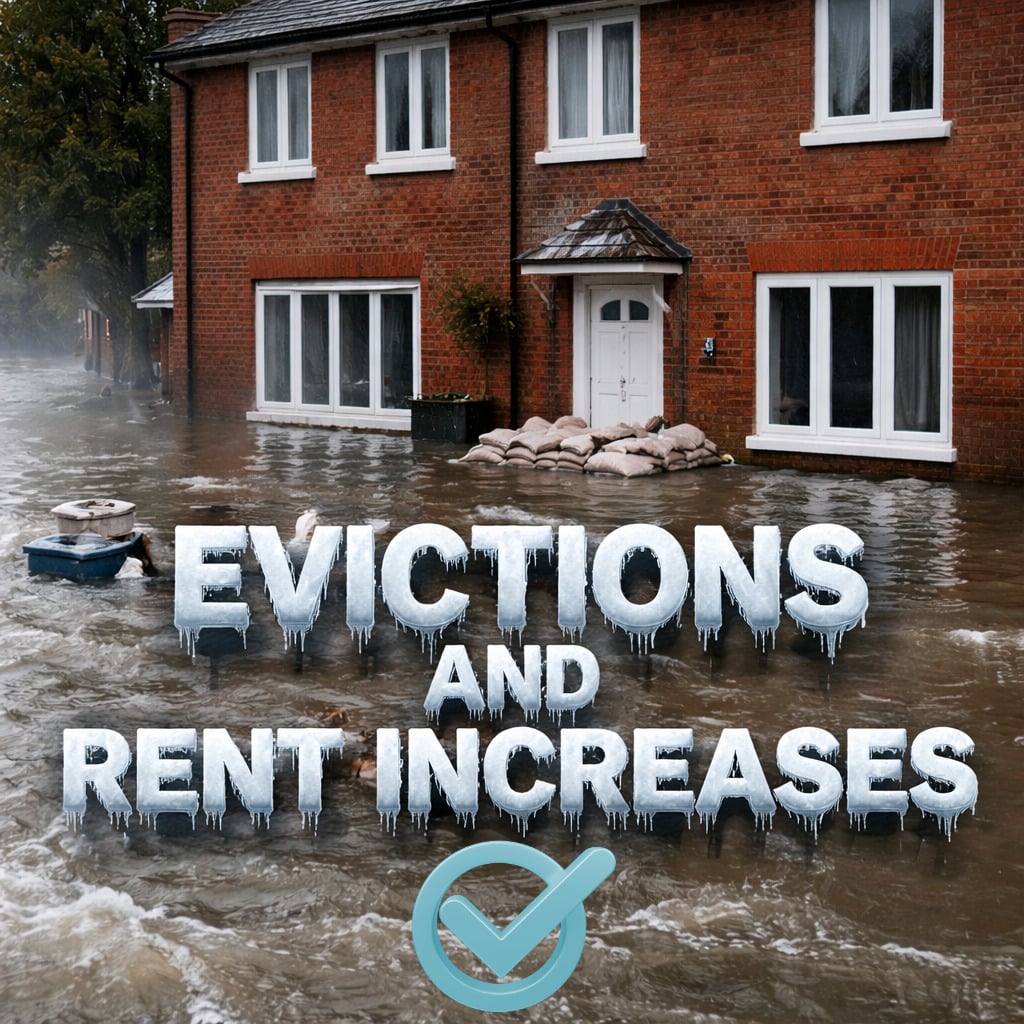
Tenant group urges freeze on evictions and rent increases following floods
A tenant group has demanded a freeze on evictions and rents during any post-flood repairs.
ACORN says there is no national voice for tenants on flooding, and renters bear the brunt of the consequences.
However, ACORN fails to mention that renters can take out insurance to protect their belongings in case of flooding.
Freeze on evictions and rent rises
In a policy document, the group says: “In England, landlords are responsible for making repairs to a property after flooding, and tenants can claim for a rent reduction while the repairs are carried out. While this is a good thing in principle, it is gravely undermined by the lack of protection from eviction for the tenants through this process.
“People will stay in terrible conditions because they are worried they will be evicted if they get the landlords to make the necessary repairs. Tenants should not have to choose between living in a potentially dangerous property and risking eviction.”
ACORN is now calling for a freeze on rents and evictions during flooding to help tenants and
The group adds: “There should be a freeze on evictions and rent rises during any improvement works and after they have been completed for a certain period, in order to ensure tenants feel empowered to demand repairs and to make sure that costs are not passed onto them.
“Until such national protections are in place, housing providers with properties in flood-prone areas should introduce policies that guarantee no evictions or rent hikes in the event of flooding.”
The group adds that funds should be made available to community organisations such as ACORN for flood resilience projects.
Only 46% of tenants hold contents insurance
However, ACORN fails to mention that if a rental property is flooded, it is the landlord’s responsibility to pay out of their own pocket for repairs to the property and any landlord-provided furnishings, and landlord insurance will typically cover alternative accommodation while repairs are carried out.
For tenant belongings, tenants need to take out contents insurance themselves to protect their belongings. However, as previously reported by Property118, only 46% of the UK’s private tenants currently hold contents insurance.
The post Tenant group urges freeze on evictions and rent increases following floods appeared first on Property118.
View Full Article: Tenant group urges freeze on evictions and rent increases following floods
EPC C targets should not require landlords to raise rents claims government
Property118

EPC C targets should not require landlords to raise rents claims government
The government claim landlords will not have to raise rents to meet EPC C targets by 2030, despite a government consultation claiming the opposite.
Under the Warm Homes Plan, the government announced all private rented properties will need to meet EPC C targets by 2030.
However, a government consultation on meeting EPC C targets admits landlords may sell up or increase rents due to EPC rules.
Our proposed changes should not require landlords to increase rents
In response to a written question from Conservative MP Paul Holmes on “whether the government has made an assessment of the potential impact of the costs of new energy efficiency measures on the level of open market rents.”
Martin McCluskey, Minister for Energy Consumers, said landlords would not need to raise rents.
He said: “The government recently consulted on increasing minimum energy efficiency standards in the domestic private rented sector, including proposals for rented homes to achieve Energy Performance Certificate C or equivalent by 2030.
“We have engaged with landlord and tenant groups in developing this policy and set out several proposals to help landlords reach the new standard.
“Our proposed changes should not require landlords to increase rents. Instead, they will help tenants cut their energy bills by delivering more energy-efficient homes.”
Landlords may decide to leave the market
However, as previously reported on Property118, a government consultation documents admits some landlords could choose to sell rather than comply with EPC rules.
The document says: “Landlords may decide to exit the market. The likelihood of this is dependent on the current profitability of their rental property, the level of costs they face, the price landlords would receive from the sale of their property and their wider financial circumstances.
“The prices of EPC F/G PRS properties affected by the current regulations (requiring PRS properties to be EPC E) decreased by about £5,000 to £9,000, relative to unaffected properties.
“If a similar situation were to arise in the context of higher Minimum Energy-Efficiency Standards (MEES), landlords may decide it is more profitable to improve properties and remain as landlords. However, landlords who face the highest costs may decide, on balance, it is still less costly to sell their property than comply with the higher energy performance standard.”
The document also says some landlords may also decide instead to pass costs onto tenants through higher rents, but some tenants may decide to stay if higher rents are offset by lower energy bills.
The post EPC C targets should not require landlords to raise rents claims government appeared first on Property118.
View Full Article: EPC C targets should not require landlords to raise rents claims government
Categories
- Landlords (19)
- Real Estate (9)
- Renewables & Green Issues (1)
- Rental Property Investment (1)
- Tenants (21)
- Uncategorized (12,723)
Archives
- May 2026 (70)
- April 2026 (78)
- March 2026 (72)
- February 2026 (55)
- January 2026 (52)
- December 2025 (62)
- August 2025 (51)
- July 2025 (51)
- June 2025 (49)
- May 2025 (50)
- April 2025 (48)
- March 2025 (54)
- February 2025 (51)
- January 2025 (52)
- December 2024 (55)
- November 2024 (64)
- October 2024 (82)
- September 2024 (69)
- August 2024 (55)
- July 2024 (64)
- June 2024 (54)
- May 2024 (73)
- April 2024 (59)
- March 2024 (49)
- February 2024 (57)
- January 2024 (58)
- December 2023 (56)
- November 2023 (59)
- October 2023 (67)
- September 2023 (136)
- August 2023 (131)
- July 2023 (129)
- June 2023 (128)
- May 2023 (140)
- April 2023 (121)
- March 2023 (168)
- February 2023 (155)
- January 2023 (152)
- December 2022 (136)
- November 2022 (158)
- October 2022 (146)
- September 2022 (148)
- August 2022 (169)
- July 2022 (124)
- June 2022 (124)
- May 2022 (130)
- April 2022 (116)
- March 2022 (155)
- February 2022 (124)
- January 2022 (120)
- December 2021 (117)
- November 2021 (139)
- October 2021 (130)
- September 2021 (138)
- August 2021 (110)
- July 2021 (110)
- June 2021 (60)
- May 2021 (127)
- April 2021 (122)
- March 2021 (156)
- February 2021 (154)
- January 2021 (133)
- December 2020 (126)
- November 2020 (159)
- October 2020 (169)
- September 2020 (181)
- August 2020 (147)
- July 2020 (172)
- June 2020 (158)
- May 2020 (177)
- April 2020 (188)
- March 2020 (234)
- February 2020 (212)
- January 2020 (164)
- December 2019 (107)
- November 2019 (131)
- October 2019 (145)
- September 2019 (123)
- August 2019 (112)
- July 2019 (93)
- June 2019 (82)
- May 2019 (94)
- April 2019 (88)
- March 2019 (78)
- February 2019 (77)
- January 2019 (71)
- December 2018 (37)
- November 2018 (85)
- October 2018 (108)
- September 2018 (110)
- August 2018 (135)
- July 2018 (140)
- June 2018 (118)
- May 2018 (113)
- April 2018 (64)
- March 2018 (96)
- February 2018 (82)
- January 2018 (92)
- December 2017 (62)
- November 2017 (100)
- October 2017 (105)
- September 2017 (97)
- August 2017 (101)
- July 2017 (104)
- June 2017 (155)
- May 2017 (135)
- April 2017 (113)
- March 2017 (138)
- February 2017 (150)
- January 2017 (127)
- December 2016 (90)
- November 2016 (135)
- October 2016 (149)
- September 2016 (135)
- August 2016 (48)
- July 2016 (52)
- June 2016 (54)
- May 2016 (52)
- April 2016 (24)
- October 2014 (8)
- April 2012 (2)
- December 2011 (2)
- November 2011 (10)
- October 2011 (9)
- September 2011 (9)
- August 2011 (3)
Calendar
Recent Posts
- Feeling the heat? How we turned a landlord nightmare into a cool £12k win — without having to evict tenants
- Potential pitfalls when inheriting rental properties
- Private rented sector key to solving London housing crisis – NRLA
- New buy to let deals unveiled by four lenders
- Renters’ Rights Act information sheet deadline warning issued to landlords
