
Government urges landlords to act on Decent Homes Standard
 admin
admin 

Property118

Government urges landlords to act on Decent Homes Standard
Landlords are being urged by the government to take action now to get their properties up to the upcoming Decent Homes Standard.
In a written question, Labour MP Sharon Hodgson acknowledged that bringing homes up to standard will take time, but confirmed the direction of travel is clear.
All private and social landlords will be expected to comply with the Decent Homes Standard by 2035.
Reduce illness linked to damp
In a written question, Green Party MP Carla Denyer asked: “Whether the Department of Health has had discussions with the Housing Secretary on the potential impact of the 2035 implementation date for the New Decent Homes Standard on incidence of illness caused by i) damp and mould and ii) other poor conditions in the private rented sector.”
In response, Ms Hodgson said the government has been working to tackle damp and mould in the private rented by introducing Awaab’s law, and landlords should start preparing now to meet the standard.
She said: “The Decent Homes Standard (DHS) is part of the package of government action and investment to support improvements in the quality of rented homes, including implementation of Awaab’s Law, the Renters’ Rights Act, and minimum energy efficiency standards. One aim of these measures is to reduce illness linked to damp, mould, and other housing hazards.
“The new Decent Homes Standard prioritises safety, decency, and warmth. The Department of Health and Social Care’s engagement has focused on the health-related aspects of the Decent Homes Standard.”
Take action now
She adds: “Decisions on the implementation timetable have been led by the Ministry of Housing, Communities and Local Government, and informed by consultation with the sector.
“The government expects landlords to begin taking action now to ensure their properties meet the Decent Homes Standard. We recognise, however, that it will take time to plan and deliver works sustainably.
“The Department of Health and Social Care will work with the Ministry of Housing, Communities and Local Government to produce guidance to support implementation of the Decent Homes Standard.”
The post Government urges landlords to act on Decent Homes Standard appeared first on Property118.
View Full Article: Government urges landlords to act on Decent Homes Standard
Landlords shifting future purchases towards limited companies
Property118

Landlords shifting future purchases towards limited companies
A clear shift in future buying behaviour is emerging across the UK private rented sector. According to the Property118 Landlord Sentiment Survey Q1 2026, while most landlords still hold property in their personal names, a growing majority would choose to purchase through a limited company if acquiring today.
Based on 2,380 completed responses, although 61% of landlords currently own personally, more than half indicate a preference for company ownership for any future acquisitions. You can review the full findings here.
The implication is clear: the direction of travel is corporate, even if the present reality is not.
A change driven by experience
This is not a trend driven by new entrants, but by experienced landlords reassessing their approach. Many respondents have built their portfolios over time under a different set of rules. As conditions have changed, so too has their view of how property should be held going forward.
The survey data reflects this shift in thinking. Rather than continuing with legacy structures, landlords are increasingly considering how future acquisitions can be structured more efficiently from the outset.
Why the structure matters
Ownership structure is not just a technical detail, it shapes how a portfolio functions. It influences financing options, tax treatment, profit extraction and long-term planning. As portfolios grow and mature, these factors become more significant.
The growing preference for company ownership suggests that landlords are placing greater emphasis on flexibility and control when making future decisions.
A gap between past and future
Despite this shift in preference, most existing portfolios remain in personal ownership. As highlighted in the Property118 dataset, this creates a disconnect between how landlords would choose to operate today and how they are currently structured. Bridging that gap is not always straightforward. Transferring existing properties into a company can involve tax considerations, financing changes and practical complexity, which means many landlords continue to operate within structures that no longer align with their preferred approach.
What this means for future supply
The shift towards company ownership is likely to influence how new rental stock enters the market. If fewer landlords are buying, and those who do are increasingly using corporate structures, the composition of the sector may gradually change over time. This is not an immediate transformation, but a directional one. Future supply may become more concentrated within corporate ownership, while existing personally held portfolios are gradually reduced or restructured.
A sector evolving in slow motion
The data points towards a sector that is evolving, but not uniformly. New decisions reflect current thinking, while existing portfolios reflect the past. The result is a market that operates across two parallel structures, one established and one emerging.
For now, one conclusion stands out: landlords may not be restructuring what they already own, but they are increasingly changing how they would invest going forward.
A quieter theme emerging from the latest landlord data is not about borrowing, but about what is not being done with existing equity. According to the Property118 Landlord Sentiment Survey Q1 2026, a large proportion of landlords now operate with low loan-to-value ratios or no borrowing at all, indicating substantial levels of equity sitting within portfolios.
Based on 2,380 completed responses, the majority of landlords report loan-to-value ratios below 50%, with many holding properties outright. You can explore the full dataset here.
The implication is clear: significant capital exists within the sector, but much of it is not actively deployed.
Equity without direction
For many landlords, equity has built up gradually over time through capital growth and mortgage repayment. This has created a position of financial strength, but not always a clear plan for what that capital is intended to achieve. In some cases, it simply remains within the properties themselves, without being actively utilised.
This is not necessarily a problem, but it does raise an important question:
If the equity is not being used to support growth, income or wider financial planning, what role is it serving?
From growth to preservation
The shift towards lower leverage suggests a broader change in mindset. Earlier stages of portfolio building often involve higher borrowing levels to accelerate growth. Over time, as portfolios mature, the focus tends to move towards consolidation and risk reduction.
The survey findings reflect this transition.
Many landlords are no longer looking to expand aggressively. Instead, they are holding substantial equity while reassessing their long-term objectives.
Opportunity or inefficiency?
Unused equity can be viewed in two ways. On one hand, it provides security. Lower borrowing reduces financial risk and creates resilience against market fluctuations. On the other, it may represent an opportunity cost.
Capital tied up in property is not easily accessible, and if it is not being actively deployed, it may not be contributing fully to income generation or broader financial planning.
This is where the distinction between holding assets and actively managing them becomes more relevant.
A factor in changing behaviour
The presence of significant equity also influences how landlords respond to current market conditions. As highlighted elsewhere in the Property118 dataset, many landlords are planning to reduce their portfolios or exit entirely. When equity levels are high, these decisions become easier to implement. Selling a property with low or no debt is a straightforward way to release capital, particularly if there is no immediate need to refinance or restructure, but is that the best option to choose?
A turning point in how portfolios are used
The data suggests that many landlords are approaching a turning point. Having built substantial equity over time, the focus is shifting from accumulation to utilisation. The question is no longer how to build the portfolio, but what to do with what has already been created.
For now, one conclusion stands out: a significant proportion of landlord wealth is tied up in property, but without a clear strategy, that equity risks remaining passive rather than productive.
Important context: Property118 is not currently recommending Section 162 incorporation for landlords with mortgages while legal uncertainty remains over the treatment of mortgage liabilities. Read our current position here: Why Property118 is not currently recommending s162 incorporation to landlords with mortgages
A conversation worth having?
If you are weighing up your own strategy, whether that’s to sell, expand, or restructure to improve profitibility, it is worth having a discussion with a Property118 consultant to take a closer look at how your portfolio is structured as a whole now, and to forecast the outcomes based on multiple scenario’s.
These conversations are typically most useful for landlords with established portfolios and relatively modest borrowing who are beginning to reflect on how their assets could work more effectively in the years ahead.
/* “function”==typeof InitializeEditor,callIfLoaded:function(o){return!(!gform.domLoaded||!gform.scriptsLoaded||!gform.themeScriptsLoaded&&!gform.isFormEditor()||(gform.isFormEditor()&&console.warn(“The use of gform.initializeOnLoaded() is deprecated in the form editor context and will be removed in Gravity Forms 3.1.”),o(),0))},initializeOnLoaded:function(o){gform.callIfLoaded(o)||(document.addEventListener(“gform_main_scripts_loaded”,()=>{gform.scriptsLoaded=!0,gform.callIfLoaded(o)}),document.addEventListener(“gform/theme/scripts_loaded”,()=>{gform.themeScriptsLoaded=!0,gform.callIfLoaded(o)}),window.addEventListener(“DOMContentLoaded”,()=>{gform.domLoaded=!0,gform.callIfLoaded(o)}))},hooks:{action:{},filter:{}},addAction:function(o,r,e,t){gform.addHook(“action”,o,r,e,t)},addFilter:function(o,r,e,t){gform.addHook(“filter”,o,r,e,t)},doAction:function(o){gform.doHook(“action”,o,arguments)},applyFilters:function(o){return gform.doHook(“filter”,o,arguments)},removeAction:function(o,r){gform.removeHook(“action”,o,r)},removeFilter:function(o,r,e){gform.removeHook(“filter”,o,r,e)},addHook:function(o,r,e,t,n){null==gform.hooks[o][r]&&(gform.hooks[o][r]=[]);var d=gform.hooks[o][r];null==n&&(n=r+”_”+d.length),gform.hooks[o][r].push({tag:n,callable:e,priority:t=null==t?10:t})},doHook:function(r,o,e){var t;if(e=Array.prototype.slice.call(e,1),null!=gform.hooks[r][o]&&((o=gform.hooks[r][o]).sort(function(o,r){return o.priority-r.priority}),o.forEach(function(o){“function”!=typeof(t=o.callable)&&(t=window[t]),”action”==r?t.apply(null,e):e[0]=t.apply(null,e)})),”filter”==r)return e[0]},removeHook:function(o,r,t,n){var e;null!=gform.hooks[o][r]&&(e=(e=gform.hooks[o][r]).filter(function(o,r,e){return!!(null!=n&&n!=o.tag||null!=t&&t!=o.priority)}),gform.hooks[o][r]=e)}});
/* ]]> */
Enquire about a free initial discussion with a Property118 consultant
-
About you
So our Executive Assistant knows who to greet. -
Mr.Mrs.MissMs.Dr.Prof.Rev.
-
-
Your portfolio
A short picture of how you currently hold property. -
-
-
-
-
Your situation
So the conversation can start where it should. -
-
-
-
-
-
-
-
-
Max. file size: 500 MB.
-
 Important Notice – Scope of Planning Support
Where our recommendations touch on areas requiring regulated input, we refer clients to appropriately authorised professionals for advice and implementation.
-
-
-
/* = 0;if(!is_postback){return;}var form_content = jQuery(this).contents().find(‘#gform_wrapper_585′);var is_confirmation = jQuery(this).contents().find(‘#gform_confirmation_wrapper_585′).length > 0;var is_redirect = contents.indexOf(‘gformRedirect(){‘) >= 0;var is_form = form_content.length > 0 && ! is_redirect && ! is_confirmation;var mt = parseInt(jQuery(‘html’).css(‘margin-top’), 10) + parseInt(jQuery(‘body’).css(‘margin-top’), 10) + 100;if(is_form){form_content.find(‘form’).css(‘opacity’, 0);jQuery(‘#gform_wrapper_585′).html(form_content.html());if(form_content.hasClass(‘gform_validation_error’)){jQuery(‘#gform_wrapper_585′).addClass(‘gform_validation_error’);} else {jQuery(‘#gform_wrapper_585′).removeClass(‘gform_validation_error’);}setTimeout( function() { /* delay the scroll by 50 milliseconds to fix a bug in chrome */ }, 50 );if(window[‘gformInitDatepicker’]) {gformInitDatepicker();}if(window[‘gformInitPriceFields’]) {gformInitPriceFields();}var current_page = jQuery(‘#gform_source_page_number_585′).val();gformInitSpinner( 585, ‘https://www.property118.com/wp-content/plugins/gravityforms/images/spinner.svg’, true );jQuery(document).trigger(‘gform_page_loaded’, [585, current_page]);window[‘gf_submitting_585′] = false;}else if(!is_redirect){var confirmation_content = jQuery(this).contents().find(‘.GF_AJAX_POSTBACK’).html();if(!confirmation_content){confirmation_content = contents;}jQuery(‘#gform_wrapper_585′).replaceWith(confirmation_content);jQuery(document).trigger(‘gform_confirmation_loaded’, [585]);window[‘gf_submitting_585′] = false;wp.a11y.speak(jQuery(‘#gform_confirmation_message_585′).text());}else{jQuery(‘#gform_585′).append(contents);if(window[‘gformRedirect’]) {gformRedirect();}}jQuery(document).trigger(“gform_pre_post_render”, [{ formId: “585”, currentPage: “current_page”, abort: function() { this.preventDefault(); } }]); if (event && event.defaultPrevented) { return; } const gformWrapperDiv = document.getElementById( “gform_wrapper_585″ ); if ( gformWrapperDiv ) { const visibilitySpan = document.createElement( “span” ); visibilitySpan.id = “gform_visibility_test_585″; gformWrapperDiv.insertAdjacentElement( “afterend”, visibilitySpan ); } const visibilityTestDiv = document.getElementById( “gform_visibility_test_585″ ); let postRenderFired = false; function triggerPostRender() { if ( postRenderFired ) { return; } postRenderFired = true; gform.core.triggerPostRenderEvents( 585, current_page ); if ( visibilityTestDiv ) { visibilityTestDiv.parentNode.removeChild( visibilityTestDiv ); } } function debounce( func, wait, immediate ) { var timeout; return function() { var context = this, args = arguments; var later = function() { timeout = null; if ( !immediate ) func.apply( context, args ); }; var callNow = immediate && !timeout; clearTimeout( timeout ); timeout = setTimeout( later, wait ); if ( callNow ) func.apply( context, args ); }; } const debouncedTriggerPostRender = debounce( function() { triggerPostRender(); }, 200 ); if ( visibilityTestDiv && visibilityTestDiv.offsetParent === null ) { const observer = new MutationObserver( ( mutations ) => { mutations.forEach( ( mutation ) => { if ( mutation.type === ‘attributes’ && visibilityTestDiv.offsetParent !== null ) { debouncedTriggerPostRender(); observer.disconnect(); } }); }); observer.observe( document.body, { attributes: true, childList: false, subtree: true, attributeFilter: [ ‘style’, ‘class’ ], }); } else { triggerPostRender(); } } );} );
/* ]]> */
|
★★★★★
|
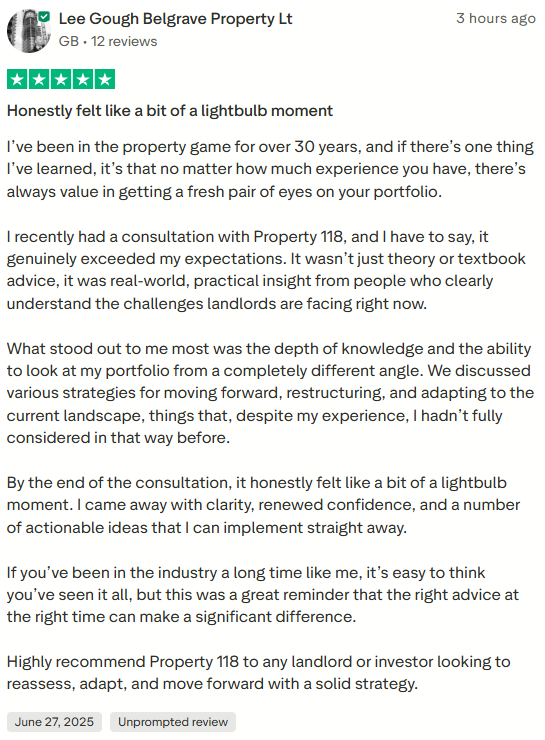
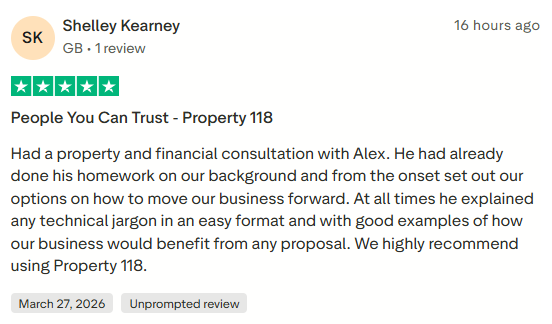
Help other landlords find Property118If you have found Property118 useful, a short Trustpilot review would make a meaningful difference. It helps other landlords decide whether our research is worth following. |
A conversation worth having?
If you are weighing up your own strategy, whether that’s to sell, expand, or restructure to improve profitibility, it is worth having a discussion with a Property118 consultant to take a closer look at how your portfolio is structured as a whole now, and to forecast the outcomes based on multiple scenario’s.
These conversations are typically most useful for landlords with established portfolios and relatively modest borrowing who are beginning to reflect on how their assets could work more effectively in the years ahead.
Enquire about a free initial discussion with a Property118 consultant
-
About you
So our Executive Assistant knows who to greet. -
Mr.Mrs.MissMs.Dr.Prof.Rev.
-
-
Your portfolio
A short picture of how you currently hold property. -
-
-
-
-
Your situation
So the conversation can start where it should. -
-
-
-
-
-
-
-
-
Max. file size: 500 MB.
-
Important Notice – Scope of Planning Support
Where our recommendations touch on areas requiring regulated input, we refer clients to appropriately authorised professionals for advice and implementation.
-
-
-
/* = 0;if(!is_postback){return;}var form_content = jQuery(this).contents().find(‘#gform_wrapper_585′);var is_confirmation = jQuery(this).contents().find(‘#gform_confirmation_wrapper_585′).length > 0;var is_redirect = contents.indexOf(‘gformRedirect(){‘) >= 0;var is_form = form_content.length > 0 && ! is_redirect && ! is_confirmation;var mt = parseInt(jQuery(‘html’).css(‘margin-top’), 10) + parseInt(jQuery(‘body’).css(‘margin-top’), 10) + 100;if(is_form){form_content.find(‘form’).css(‘opacity’, 0);jQuery(‘#gform_wrapper_585′).html(form_content.html());if(form_content.hasClass(‘gform_validation_error’)){jQuery(‘#gform_wrapper_585′).addClass(‘gform_validation_error’);} else {jQuery(‘#gform_wrapper_585′).removeClass(‘gform_validation_error’);}setTimeout( function() { /* delay the scroll by 50 milliseconds to fix a bug in chrome */ }, 50 );if(window[‘gformInitDatepicker’]) {gformInitDatepicker();}if(window[‘gformInitPriceFields’]) {gformInitPriceFields();}var current_page = jQuery(‘#gform_source_page_number_585′).val();gformInitSpinner( 585, ‘https://www.property118.com/wp-content/plugins/gravityforms/images/spinner.svg’, true );jQuery(document).trigger(‘gform_page_loaded’, [585, current_page]);window[‘gf_submitting_585′] = false;}else if(!is_redirect){var confirmation_content = jQuery(this).contents().find(‘.GF_AJAX_POSTBACK’).html();if(!confirmation_content){confirmation_content = contents;}jQuery(‘#gform_wrapper_585′).replaceWith(confirmation_content);jQuery(document).trigger(‘gform_confirmation_loaded’, [585]);window[‘gf_submitting_585′] = false;wp.a11y.speak(jQuery(‘#gform_confirmation_message_585′).text());}else{jQuery(‘#gform_585′).append(contents);if(window[‘gformRedirect’]) {gformRedirect();}}jQuery(document).trigger(“gform_pre_post_render”, [{ formId: “585”, currentPage: “current_page”, abort: function() { this.preventDefault(); } }]); if (event && event.defaultPrevented) { return; } const gformWrapperDiv = document.getElementById( “gform_wrapper_585″ ); if ( gformWrapperDiv ) { const visibilitySpan = document.createElement( “span” ); visibilitySpan.id = “gform_visibility_test_585″; gformWrapperDiv.insertAdjacentElement( “afterend”, visibilitySpan ); } const visibilityTestDiv = document.getElementById( “gform_visibility_test_585″ ); let postRenderFired = false; function triggerPostRender() { if ( postRenderFired ) { return; } postRenderFired = true; gform.core.triggerPostRenderEvents( 585, current_page ); if ( visibilityTestDiv ) { visibilityTestDiv.parentNode.removeChild( visibilityTestDiv ); } } function debounce( func, wait, immediate ) { var timeout; return function() { var context = this, args = arguments; var later = function() { timeout = null; if ( !immediate ) func.apply( context, args ); }; var callNow = immediate && !timeout; clearTimeout( timeout ); timeout = setTimeout( later, wait ); if ( callNow ) func.apply( context, args ); }; } const debouncedTriggerPostRender = debounce( function() { triggerPostRender(); }, 200 ); if ( visibilityTestDiv && visibilityTestDiv.offsetParent === null ) { const observer = new MutationObserver( ( mutations ) => { mutations.forEach( ( mutation ) => { if ( mutation.type === ‘attributes’ && visibilityTestDiv.offsetParent !== null ) { debouncedTriggerPostRender(); observer.disconnect(); } }); }); observer.observe( document.body, { attributes: true, childList: false, subtree: true, attributeFilter: [ ‘style’, ‘class’ ], }); } else { triggerPostRender(); } } );} );
/* ]]> */
|
★★★★★
|
Help other landlords find Property118If you have found Property118 useful, a short Trustpilot review would make a meaningful difference. It helps other landlords decide whether our research is worth following. |
The post Landlords shifting future purchases towards limited companies appeared first on Property118.
View Full Article: Landlords shifting future purchases towards limited companies
Rent rises affect one in three tenants since rental reforms
Property118

Rent rises affect one in three tenants since rental reforms
Nearly a third of tenants in England have experienced rent rises since the Renters’ Rights Act received Royal Assent six months ago, according to a new report.
Data from SpareRoom shows that 30% of tenants who have stayed in the same rental property during that period have had their rent increased.
The findings come as the Renters’ Rights Act is due to come fully into force on 1 May, when Section 21 evictions will be abolished and fixed-term tenancies will end.
Being a landlord requires work
According to SpareRoom, 28% of tenants in London said their rent had increased since the Act received Royal Assent.
Of those who experienced a rise, 39% said it was due to increased costs for landlords, while 11% said it was because mortgage rates had gone up.
Matt Hutchinson, director of SpareRoom, said: “Given the rental market is supposed to be made fairer by these reforms, it isn’t fair tenants have been at the receiving end of all the upheaval since the 1 May hard deadline was announced.
“On the upside, what we may find is landlords who treat their rentals as a passive income may decide enough is enough, and that’s not necessarily a bad thing. Being a landlord requires work and good landlords know that.
“But there will also be good landlords who’ve decided compliance isn’t worth the hassle and it will be a great shame to lose them.”
Under the Renters’ Rights Act, landlords will only be able to raise rents once a year using a Section 13 notice.
Not all landlords will be prepared
The data also reveals that 11% of tenants in England have received an eviction notice or been evicted since the Act received Royal Assent, with the main reason for eviction (43%) being landlords selling the property.
Mr Hutchinson adds that, although evictions have remained relatively stable, there could still be a delayed impact.
He said: “It would be an exaggeration to say supply in the flatshare market has been immune to the Renters’ Rights Act, but it’s been surprisingly resilient when you consider the response from landlords, many of whom said they planned to quit the market or reduce their portfolios.
“There’s still the risk of a delayed reaction after 1 May. Not all landlords will be as prepared as they should be, and they may be a flight risk.
“However, there are some signs that flatshare supply may now be under threat. Although supply has grown for the past three consecutive years, supply growth in the year to January 2026 slowed considerably.
“The Renters’ Rights Act will give tenants much greater security. The end of Section 21 ‘no fault’ evictions and fixed-term tenancies, and stopping landlords asking for several months’ rent in advance are truly game changing for tenants. What it’s unlikely to do, in the short term at least, is significantly reduce rents, but it is a huge step forward in correcting the power imbalance.”
The post Rent rises affect one in three tenants since rental reforms appeared first on Property118.
View Full Article: Rent rises affect one in three tenants since rental reforms
Categories
- Landlords (19)
- Real Estate (9)
- Renewables & Green Issues (1)
- Rental Property Investment (1)
- Tenants (21)
- Uncategorized (12,777)
Archives
- June 2026 (54)
- May 2026 (70)
- April 2026 (78)
- March 2026 (72)
- February 2026 (55)
- January 2026 (52)
- December 2025 (62)
- August 2025 (51)
- July 2025 (51)
- June 2025 (49)
- May 2025 (50)
- April 2025 (48)
- March 2025 (54)
- February 2025 (51)
- January 2025 (52)
- December 2024 (55)
- November 2024 (64)
- October 2024 (82)
- September 2024 (69)
- August 2024 (55)
- July 2024 (64)
- June 2024 (54)
- May 2024 (73)
- April 2024 (59)
- March 2024 (49)
- February 2024 (57)
- January 2024 (58)
- December 2023 (56)
- November 2023 (59)
- October 2023 (67)
- September 2023 (136)
- August 2023 (131)
- July 2023 (129)
- June 2023 (128)
- May 2023 (140)
- April 2023 (121)
- March 2023 (168)
- February 2023 (155)
- January 2023 (152)
- December 2022 (136)
- November 2022 (158)
- October 2022 (146)
- September 2022 (148)
- August 2022 (169)
- July 2022 (124)
- June 2022 (124)
- May 2022 (130)
- April 2022 (116)
- March 2022 (155)
- February 2022 (124)
- January 2022 (120)
- December 2021 (117)
- November 2021 (139)
- October 2021 (130)
- September 2021 (138)
- August 2021 (110)
- July 2021 (110)
- June 2021 (60)
- May 2021 (127)
- April 2021 (122)
- March 2021 (156)
- February 2021 (154)
- January 2021 (133)
- December 2020 (126)
- November 2020 (159)
- October 2020 (169)
- September 2020 (181)
- August 2020 (147)
- July 2020 (172)
- June 2020 (158)
- May 2020 (177)
- April 2020 (188)
- March 2020 (234)
- February 2020 (212)
- January 2020 (164)
- December 2019 (107)
- November 2019 (131)
- October 2019 (145)
- September 2019 (123)
- August 2019 (112)
- July 2019 (93)
- June 2019 (82)
- May 2019 (94)
- April 2019 (88)
- March 2019 (78)
- February 2019 (77)
- January 2019 (71)
- December 2018 (37)
- November 2018 (85)
- October 2018 (108)
- September 2018 (110)
- August 2018 (135)
- July 2018 (140)
- June 2018 (118)
- May 2018 (113)
- April 2018 (64)
- March 2018 (96)
- February 2018 (82)
- January 2018 (92)
- December 2017 (62)
- November 2017 (100)
- October 2017 (105)
- September 2017 (97)
- August 2017 (101)
- July 2017 (104)
- June 2017 (155)
- May 2017 (135)
- April 2017 (113)
- March 2017 (138)
- February 2017 (150)
- January 2017 (127)
- December 2016 (90)
- November 2016 (135)
- October 2016 (149)
- September 2016 (135)
- August 2016 (48)
- July 2016 (52)
- June 2016 (54)
- May 2016 (52)
- April 2016 (24)
- October 2014 (8)
- April 2012 (2)
- December 2011 (2)
- November 2011 (10)
- October 2011 (9)
- September 2011 (9)
- August 2011 (3)
Calendar
Recent Posts
- Could Andy Burnham’s proposed land tax force landlords to sell?
- Buy to let lenders widen landlord options
- What the World Cup teaches landlords about selling property
- The Mortgage Works to pilot landlord EPC support package
- Landbay, Kensington and Dudley cut landlord BTL mortgage rates
