
Majority of landlords still own personally despite shift towards companies
 admin
admin 

Property118

Majority of landlords still own personally despite shift towards companies
A growing disconnect is emerging within the structure of UK property ownership. According to the Property118 Landlord Sentiment Survey Q1 2026, most landlords continue to hold property in their personal names, even though many now indicate a preference for company ownership going forward.
Based on 2,380 completed responses, 61% of landlords currently own their properties personally. At the same time, a majority indicate that if they were acquiring today, they would do so through a limited company. You can explore the full findings here.
The implication is clear: a large proportion of the sector is effectively locked into structures that may no longer reflect current preferences.
A legacy structure in a changing environment
For many landlords, personal ownership reflects the conditions that existed when their portfolios were built. At that time, borrowing structures, tax treatment and regulatory expectations all supported individual ownership. Over time, those conditions have shifted. While new acquisitions are increasingly viewed through a company lens, existing portfolios remain where they started, in personal ownership, often without a clear pathway to restructure.
Why landlords do not simply switch
At first glance, the solution might appear straightforward. If company ownership is preferred, why not transfer existing properties?
In practice, the decision is more complex. Transferring property from personal ownership into a company can trigger a combination of costs, including capital gains tax and stamp duty. Financing arrangements may also need to be revisited, adding further friction. The result is a situation where landlords recognise a preferred structure, but remain in their current position due to the practical implications of change.
A structural constraint on decision making
This disconnect between current ownership and future preference has wider consequences. When landlords feel constrained by their structure, it can influence a range of decisions, including whether to expand, refinance or exit. In some cases, the lack of flexibility may contribute to the decision to reduce portfolios rather than attempt a complex restructure.
This aligns with other findings in the Property118 dataset, where a significant proportion of landlords are choosing to step back from the market rather than adapt their existing structures.
A gap between intention and action
The data highlights a clear gap between what landlords would choose to do today and what they have been able to implement in practice. This is not a question of awareness. Many landlords are fully aware of alternative structures and their potential benefits. The issue lies in execution. Bridging that gap requires careful consideration of tax, financing and long-term objectives, which means decisions are often delayed or avoided altogether.
A sector in transition
The coexistence of personal ownership and a growing preference for company structures suggests that the sector is in transition rather than at a fixed point.
Some landlords are moving towards corporate ownership for new acquisitions, while others remain anchored in legacy structures. Over time, this may lead to a gradual shift in how property is held, but the pace of that change is likely to be uneven.
For now, one conclusion stands out: many landlords are not operating in the structure they would choose today, and that constraint is shaping how they respond to the market.
Important context: Property118 is not currently recommending Section 162 incorporation for landlords with mortgages while legal uncertainty remains over the treatment of mortgage liabilities. Read our current position here: Why Property118 is not currently recommending s162 incorporation to landlords with mortgages
A conversation worth having?
If you are weighing up your own strategy, whether that’s to sell, expand, or restructure to improve profitibility, it is worth having a discussion with a Property118 consultant to take a closer look at how your portfolio is structured as a whole now, and to forecast the outcomes based on multiple scenario’s.
These conversations are typically most useful for landlords with established portfolios and relatively modest borrowing who are beginning to reflect on how their assets could work more effectively in the years ahead.
/* “function”==typeof InitializeEditor,callIfLoaded:function(o){return!(!gform.domLoaded||!gform.scriptsLoaded||!gform.themeScriptsLoaded&&!gform.isFormEditor()||(gform.isFormEditor()&&console.warn(“The use of gform.initializeOnLoaded() is deprecated in the form editor context and will be removed in Gravity Forms 3.1.”),o(),0))},initializeOnLoaded:function(o){gform.callIfLoaded(o)||(document.addEventListener(“gform_main_scripts_loaded”,()=>{gform.scriptsLoaded=!0,gform.callIfLoaded(o)}),document.addEventListener(“gform/theme/scripts_loaded”,()=>{gform.themeScriptsLoaded=!0,gform.callIfLoaded(o)}),window.addEventListener(“DOMContentLoaded”,()=>{gform.domLoaded=!0,gform.callIfLoaded(o)}))},hooks:{action:{},filter:{}},addAction:function(o,r,e,t){gform.addHook(“action”,o,r,e,t)},addFilter:function(o,r,e,t){gform.addHook(“filter”,o,r,e,t)},doAction:function(o){gform.doHook(“action”,o,arguments)},applyFilters:function(o){return gform.doHook(“filter”,o,arguments)},removeAction:function(o,r){gform.removeHook(“action”,o,r)},removeFilter:function(o,r,e){gform.removeHook(“filter”,o,r,e)},addHook:function(o,r,e,t,n){null==gform.hooks[o][r]&&(gform.hooks[o][r]=[]);var d=gform.hooks[o][r];null==n&&(n=r+”_”+d.length),gform.hooks[o][r].push({tag:n,callable:e,priority:t=null==t?10:t})},doHook:function(r,o,e){var t;if(e=Array.prototype.slice.call(e,1),null!=gform.hooks[r][o]&&((o=gform.hooks[r][o]).sort(function(o,r){return o.priority-r.priority}),o.forEach(function(o){“function”!=typeof(t=o.callable)&&(t=window[t]),”action”==r?t.apply(null,e):e[0]=t.apply(null,e)})),”filter”==r)return e[0]},removeHook:function(o,r,t,n){var e;null!=gform.hooks[o][r]&&(e=(e=gform.hooks[o][r]).filter(function(o,r,e){return!!(null!=n&&n!=o.tag||null!=t&&t!=o.priority)}),gform.hooks[o][r]=e)}});
/* ]]> */
Enquire about a free initial discussion with a Property118 consultant
-
Mr.Mrs.MissMs.Dr.Prof.Rev.
-
-
 Important Notice – Scope of Planning Support
Where our recommendations touch on areas requiring regulated input, we refer clients to appropriately authorised professionals for advice and implementation.
-
-
-
/* = 0;if(!is_postback){return;}var form_content = jQuery(this).contents().find(‘#gform_wrapper_585′);var is_confirmation = jQuery(this).contents().find(‘#gform_confirmation_wrapper_585′).length > 0;var is_redirect = contents.indexOf(‘gformRedirect(){‘) >= 0;var is_form = form_content.length > 0 && ! is_redirect && ! is_confirmation;var mt = parseInt(jQuery(‘html’).css(‘margin-top’), 10) + parseInt(jQuery(‘body’).css(‘margin-top’), 10) + 100;if(is_form){jQuery(‘#gform_wrapper_585′).html(form_content.html());if(form_content.hasClass(‘gform_validation_error’)){jQuery(‘#gform_wrapper_585′).addClass(‘gform_validation_error’);} else {jQuery(‘#gform_wrapper_585′).removeClass(‘gform_validation_error’);}setTimeout( function() { /* delay the scroll by 50 milliseconds to fix a bug in chrome */ }, 50 );if(window[‘gformInitDatepicker’]) {gformInitDatepicker();}if(window[‘gformInitPriceFields’]) {gformInitPriceFields();}var current_page = jQuery(‘#gform_source_page_number_585′).val();gformInitSpinner( 585, ‘https://www.property118.com/wp-content/plugins/gravityforms/images/spinner.svg’, true );jQuery(document).trigger(‘gform_page_loaded’, [585, current_page]);window[‘gf_submitting_585′] = false;}else if(!is_redirect){var confirmation_content = jQuery(this).contents().find(‘.GF_AJAX_POSTBACK’).html();if(!confirmation_content){confirmation_content = contents;}jQuery(‘#gform_wrapper_585′).replaceWith(confirmation_content);jQuery(document).trigger(‘gform_confirmation_loaded’, [585]);window[‘gf_submitting_585′] = false;wp.a11y.speak(jQuery(‘#gform_confirmation_message_585′).text());}else{jQuery(‘#gform_585′).append(contents);if(window[‘gformRedirect’]) {gformRedirect();}}jQuery(document).trigger(“gform_pre_post_render”, [{ formId: “585”, currentPage: “current_page”, abort: function() { this.preventDefault(); } }]); if (event && event.defaultPrevented) { return; } const gformWrapperDiv = document.getElementById( “gform_wrapper_585″ ); if ( gformWrapperDiv ) { const visibilitySpan = document.createElement( “span” ); visibilitySpan.id = “gform_visibility_test_585″; gformWrapperDiv.insertAdjacentElement( “afterend”, visibilitySpan ); } const visibilityTestDiv = document.getElementById( “gform_visibility_test_585″ ); let postRenderFired = false; function triggerPostRender() { if ( postRenderFired ) { return; } postRenderFired = true; gform.core.triggerPostRenderEvents( 585, current_page ); if ( visibilityTestDiv ) { visibilityTestDiv.parentNode.removeChild( visibilityTestDiv ); } } function debounce( func, wait, immediate ) { var timeout; return function() { var context = this, args = arguments; var later = function() { timeout = null; if ( !immediate ) func.apply( context, args ); }; var callNow = immediate && !timeout; clearTimeout( timeout ); timeout = setTimeout( later, wait ); if ( callNow ) func.apply( context, args ); }; } const debouncedTriggerPostRender = debounce( function() { triggerPostRender(); }, 200 ); if ( visibilityTestDiv && visibilityTestDiv.offsetParent === null ) { const observer = new MutationObserver( ( mutations ) => { mutations.forEach( ( mutation ) => { if ( mutation.type === ‘attributes’ && visibilityTestDiv.offsetParent !== null ) { debouncedTriggerPostRender(); observer.disconnect(); } }); }); observer.observe( document.body, { attributes: true, childList: false, subtree: true, attributeFilter: [ ‘style’, ‘class’ ], }); } else { triggerPostRender(); } } );} );
/* ]]> */
|
★★★★★
|
Help other landlords find Property118If you have found Property118 useful, a short Trustpilot review would make a meaningful difference. It helps other landlords decide whether our research is worth following. |


The post Majority of landlords still own personally despite shift towards companies appeared first on Property118.
View Full Article: Majority of landlords still own personally despite shift towards companies
Renters’ Rights Act Masterclass – Are you ready for 1 May?
Property118

Renters’ Rights Act Masterclass – Are you ready for 1 May?
With the Renters’ Rights Act coming into force on 1 May 2026, landlords are facing the biggest legal changes in a generation.
I’m finding that many landlords still aren’t entirely clear what they need to do and more importantly, what they need to do now to stay compliant and avoid problems later.
Over the past few months, I’ve been running training sessions for Landlord Law members on the new rules. But given the scale of the changes, I’ve decided to run a longer, more detailed session open to everyone.
So, on 21 April, I will be running a 3-hour Renters’ Rights Act Masterclass, where I will cover:
- what actually changes on 1 May
- what you must do (and by when)
- how to avoid fines and compliance problems
- practical strategies for managing tenancies going forward
This is designed to be a practical, no-nonsense session—not just theory, but what the changes mean for you in real terms.
How to attend
The Masterclass is free for Landlord Law members (in place of the usual 1.5-hour training session).
Non-members can attend for £40, or you can join Landlord Law from £25–£30 pcm (no minimum term) and attend for free, along with access to all member resources.
This includes my new Renters’ Rights Act – compliant tenancy agreement, which I am currently drafting.
Even if you’ve already done some training, this is one of those situations where it really helps to go through everything carefully — there is a lot to take in, and quite a few potential pitfalls.
Masterclass details in a nutshell:
Date: Tuesday 21 April 2026
Venue: Online
Time: Starts at 9.00 am, ending at 12.15 pm with a 15-minute comfort break
Cost: Free (members) / £40 inc VAT (non-members)
CPD: 3 hours – certificate provided if our system shows you attended
Recording: Available to business-level members only after the event.
I look forward to seeing you all on 21 April! Click here to view full details and book your place.
Tessa Shepperson.
Tessa is a specialist landlord and tenant lawyer with over 25 years experience. She runs the Landlord Law online information service at www.landlordlaw.co.uk. You can sign up to her free weekly bulletin (and get a free pet form) at www.landlordlaw.co.uk/bulletin.
The post Renters’ Rights Act Masterclass – Are you ready for 1 May? appeared first on Property118.
View Full Article: Renters’ Rights Act Masterclass – Are you ready for 1 May?
BR Investments: The trade most landlords never consider
Property118

BR Investments: The trade most landlords never consider
Many landlords only start thinking about this when they are already in their 60’s and above, and by then, some of the options are already close to closing.
The recent Property118 landlord survey revealed that many established landlords have very low LTV’s across their rental property portfolios, and some have no borrowing at all, but is that equity actually doing anything useful?” In many cases, it isn’t; it’s just sitting there while a future inheritance tax bill builds in the background.
Whole of Life insurance in trust is one option, but some people are uninsurable. Many landlords are over-exposed to property because that’s all they know. That’s why they rarely seek advice about diversification from a regulated whole of market IFA, but that’s a mistake.
The trade most landlords never consider
Let’s keep this simple.
You have £1,000,000 of equity sitting in your portfolio.
Left untouched, that £1,000,000 could face a 40% inheritance tax charge.
That is potentially a £400,000 problem, and likely a growing one.
Most landlords accept that as “something for later”, whereas others with an open mind might ask: “What happens if I borrow against that equity and reposition it?”
This is where Business Relief (BR) starts to become relevant, because certain investments into qualifying trading businesses such as Octopus can fall outside your estate for inheritance tax purposes after a two-year holding period. The investment remains accessible during your lifetime, meaning you’re not giving money away; you are repositioning it.
IMPORTANT NOTE: This is not an invitation to invest, nor is it to be regarded as financial advice or a recommendation of Octopus Investments. The purpose of this article is financial education.
Why some landlords are funding BR investments through borrowing
Rather than using existing cash, some landlords refinance part of their portfolio and use the capital released to fund Business Relief qualifying investments.
That may sound counterintuitive at first; why risk taking on debt to invest into something other than property?
The answer sits in the balance between cost and outcome.
The objective isn’t necessarily for the investment to outperform the cost of borrowing, even though it may be possible in some cases. Instead, the objective is to remove a 40% inheritance tax exposure on that capital after two years, and viewed through that lens, the decision is less about yield and more about liability management.
What this can achieve in practice
Used carefully, this approach can begin to reshape exposure to IHT over time because a portion of the estate becomes more liquid, part of the inheritance tax exposure starts to reduce after two years and yet the property portfolio itself remains intact. It also creates optionality if circumstances change because the arrangements could be reversed by cashing in the investment and paying debt back down.
This is not without risk
It is important to be clear that this is not a risk-free strategy. Borrowing introduces ongoing cost and lender considerations while Business Relief investments carry capital risk, and qualification depends on the nature of the underlying businesses at the time. This is not about replacing one certainty with another; it’s about deciding which risks you are more comfortable managing.
An invitation for established landlords
If you find the Property118 articles helpful and are curious about how those ideas apply to your own portfolio, you are welcome to take the conversation a step further.
These conversations are typically most useful for landlords with established portfolios and relatively modest borrowing who are beginning to reflect on how their assets could work more effectively in the years ahead.
/* “function”==typeof InitializeEditor,callIfLoaded:function(o){return!(!gform.domLoaded||!gform.scriptsLoaded||!gform.themeScriptsLoaded&&!gform.isFormEditor()||(gform.isFormEditor()&&console.warn(“The use of gform.initializeOnLoaded() is deprecated in the form editor context and will be removed in Gravity Forms 3.1.”),o(),0))},initializeOnLoaded:function(o){gform.callIfLoaded(o)||(document.addEventListener(“gform_main_scripts_loaded”,()=>{gform.scriptsLoaded=!0,gform.callIfLoaded(o)}),document.addEventListener(“gform/theme/scripts_loaded”,()=>{gform.themeScriptsLoaded=!0,gform.callIfLoaded(o)}),window.addEventListener(“DOMContentLoaded”,()=>{gform.domLoaded=!0,gform.callIfLoaded(o)}))},hooks:{action:{},filter:{}},addAction:function(o,r,e,t){gform.addHook(“action”,o,r,e,t)},addFilter:function(o,r,e,t){gform.addHook(“filter”,o,r,e,t)},doAction:function(o){gform.doHook(“action”,o,arguments)},applyFilters:function(o){return gform.doHook(“filter”,o,arguments)},removeAction:function(o,r){gform.removeHook(“action”,o,r)},removeFilter:function(o,r,e){gform.removeHook(“filter”,o,r,e)},addHook:function(o,r,e,t,n){null==gform.hooks[o][r]&&(gform.hooks[o][r]=[]);var d=gform.hooks[o][r];null==n&&(n=r+”_”+d.length),gform.hooks[o][r].push({tag:n,callable:e,priority:t=null==t?10:t})},doHook:function(r,o,e){var t;if(e=Array.prototype.slice.call(e,1),null!=gform.hooks[r][o]&&((o=gform.hooks[r][o]).sort(function(o,r){return o.priority-r.priority}),o.forEach(function(o){“function”!=typeof(t=o.callable)&&(t=window[t]),”action”==r?t.apply(null,e):e[0]=t.apply(null,e)})),”filter”==r)return e[0]},removeHook:function(o,r,t,n){var e;null!=gform.hooks[o][r]&&(e=(e=gform.hooks[o][r]).filter(function(o,r,e){return!!(null!=n&&n!=o.tag||null!=t&&t!=o.priority)}),gform.hooks[o][r]=e)}});
/* ]]> */
Enquire about a free initial discussion with a Property118 consultant
-
Mr.Mrs.MissMs.Dr.Prof.Rev.
-
-
Important Notice – Scope of Planning Support
Where our recommendations touch on areas requiring regulated input, we refer clients to appropriately authorised professionals for advice and implementation.
-
-
-
/* = 0;if(!is_postback){return;}var form_content = jQuery(this).contents().find(‘#gform_wrapper_585′);var is_confirmation = jQuery(this).contents().find(‘#gform_confirmation_wrapper_585′).length > 0;var is_redirect = contents.indexOf(‘gformRedirect(){‘) >= 0;var is_form = form_content.length > 0 && ! is_redirect && ! is_confirmation;var mt = parseInt(jQuery(‘html’).css(‘margin-top’), 10) + parseInt(jQuery(‘body’).css(‘margin-top’), 10) + 100;if(is_form){jQuery(‘#gform_wrapper_585′).html(form_content.html());if(form_content.hasClass(‘gform_validation_error’)){jQuery(‘#gform_wrapper_585′).addClass(‘gform_validation_error’);} else {jQuery(‘#gform_wrapper_585′).removeClass(‘gform_validation_error’);}setTimeout( function() { /* delay the scroll by 50 milliseconds to fix a bug in chrome */ }, 50 );if(window[‘gformInitDatepicker’]) {gformInitDatepicker();}if(window[‘gformInitPriceFields’]) {gformInitPriceFields();}var current_page = jQuery(‘#gform_source_page_number_585′).val();gformInitSpinner( 585, ‘https://www.property118.com/wp-content/plugins/gravityforms/images/spinner.svg’, true );jQuery(document).trigger(‘gform_page_loaded’, [585, current_page]);window[‘gf_submitting_585′] = false;}else if(!is_redirect){var confirmation_content = jQuery(this).contents().find(‘.GF_AJAX_POSTBACK’).html();if(!confirmation_content){confirmation_content = contents;}jQuery(‘#gform_wrapper_585′).replaceWith(confirmation_content);jQuery(document).trigger(‘gform_confirmation_loaded’, [585]);window[‘gf_submitting_585′] = false;wp.a11y.speak(jQuery(‘#gform_confirmation_message_585′).text());}else{jQuery(‘#gform_585′).append(contents);if(window[‘gformRedirect’]) {gformRedirect();}}jQuery(document).trigger(“gform_pre_post_render”, [{ formId: “585”, currentPage: “current_page”, abort: function() { this.preventDefault(); } }]); if (event && event.defaultPrevented) { return; } const gformWrapperDiv = document.getElementById( “gform_wrapper_585″ ); if ( gformWrapperDiv ) { const visibilitySpan = document.createElement( “span” ); visibilitySpan.id = “gform_visibility_test_585″; gformWrapperDiv.insertAdjacentElement( “afterend”, visibilitySpan ); } const visibilityTestDiv = document.getElementById( “gform_visibility_test_585″ ); let postRenderFired = false; function triggerPostRender() { if ( postRenderFired ) { return; } postRenderFired = true; gform.core.triggerPostRenderEvents( 585, current_page ); if ( visibilityTestDiv ) { visibilityTestDiv.parentNode.removeChild( visibilityTestDiv ); } } function debounce( func, wait, immediate ) { var timeout; return function() { var context = this, args = arguments; var later = function() { timeout = null; if ( !immediate ) func.apply( context, args ); }; var callNow = immediate && !timeout; clearTimeout( timeout ); timeout = setTimeout( later, wait ); if ( callNow ) func.apply( context, args ); }; } const debouncedTriggerPostRender = debounce( function() { triggerPostRender(); }, 200 ); if ( visibilityTestDiv && visibilityTestDiv.offsetParent === null ) { const observer = new MutationObserver( ( mutations ) => { mutations.forEach( ( mutation ) => { if ( mutation.type === ‘attributes’ && visibilityTestDiv.offsetParent !== null ) { debouncedTriggerPostRender(); observer.disconnect(); } }); }); observer.observe( document.body, { attributes: true, childList: false, subtree: true, attributeFilter: [ ‘style’, ‘class’ ], }); } else { triggerPostRender(); } } );} );
/* ]]> */
From there we can arrange a free introductory discussion to explore how your portfolio works as a whole and what that might mean for the years ahead.
|
★★★★★
|
Help other landlords find Property118If you have found Property118 useful, a short Trustpilot review would make a meaningful difference. It helps other landlords decide whether our research is worth following. |
The post BR Investments: The trade most landlords never consider appeared first on Property118.
View Full Article: BR Investments: The trade most landlords never consider
EXCLUSIVE: SpareRoom suspends HMO agents over automation tool use
Property118

EXCLUSIVE: SpareRoom suspends HMO agents over automation tool use
Letting agents handling thousands of HMO rooms on behalf of landlords across the country were abruptly locked out of SpareRoom last week after the platform suspended dozens of professional accounts without warning.
The platform said their use of automation tools is a breach of its terms.
Emails sent to affected users said accounts would remain suspended for up to four days unless agents confirmed they had removed the third-party tools.
Between them, the suspended accounts covered thousands of rooms listed on the site.
For many agents, SpareRoom is the main route to market, leaving little room to manoeuvre when access is removed.
Activities stopped immediately
Lee Dumbarton, founder of UrbanShare, which operates across London, Surrey and the home counties, said routine activity stopped almost immediately.
He told Property118: “We weren’t trying to gain anything. We were trying to respond to people faster, which is better for tenants, too.
“To have the account suspended without any warning was a real shock.”
Because enquiries are handled through SpareRoom’s internal messaging system, agents found themselves unable to contact prospective tenants.
Viewings already booked for the weekend could not be confirmed or moved.
One agent told us that access was briefly restored after contacting the company and pointing to appointments already in the diary.
No other HMO platform
Other letting agents reported the same disruption, although most declined to be named.
One said: “If this were any other platform, we’d just move on. But you can’t. There’s nowhere else to go. So you just keep your head down and hope it’s not you next time.”
The issue centres on the platform’s prohibition on automated activity.
Its terms allow accounts to be suspended or terminated at its discretion and, at the same time, rule out tools designed to streamline responses or manage enquiries.
RRA impact for agents
In practice, agents say those tools are now part of daily operations, particularly with administrative pressure increasing ahead of the Renters’ Rights Act.
Larger operators, especially those with multiple staff, rely on them to schedule replies and organise viewings at scale.
The tool referenced in the suspensions is Nestflo, used by HMO agents to handle enquiries and bookings.
Its founder, Roland Tao, said the move came as a surprise.
He told Property118: “We built Nestflo to help agents work more efficiently. Faster responses to applicants, viewings booked sooner, fewer people left waiting to hear back.
“The tool operates across a number of platforms, and we have never had an issue of this kind before. We thought we were being careful.”
Issue over demand claim
He also questioned the figures included in SpareRoom’s emails, which stated that Nestflo had generated more than 300,000 requests within a 24-hour period.
He said: “We’re a much smaller company than SpareRoom. I’d expect our infrastructure to be significantly smaller than theirs.
“Handling that volume of requests would have caused us serious problems of our own.
“We’ve reviewed our logs and we have not experienced any issues of that kind.”
Some agents said they had not realised the full extent of the platform’s restrictions.
Others pointed to similar episodes in previous years, where accounts were suspended over tools that had been in routine use.
For agents managing large portfolios, even a short suspension feeds directly into pipeline delays and landlord relationships.
Site infrastructure under strain
SpareRoom said it acted to protect performance across the site and a statement, it told us: “We understand the need for automation but, in this case, a small group of users were using a particular bit of third party software that put a huge strain on site infrastructure.
“Had it continued, it could have resulted in site-wide performance issues for all SpareRoom users.
“We therefore took action to suspend the accounts responsible in order to protect the site.
“Now the situation has been resolved, all the accounts have been reactivated.”
SpareRoom access restored
While access may have been restored, agents say they have removed automation tools and returned to manual processes.
An industry insider said: “Whilst accounts may have been activated, we still have zero allowance of using any tools to help automate the business, and we are struggling now with a load of manual work that we previously had automated.
“Things like replying to tenants asking, ‘Is this still available?’, to let them know it is, and provide information on how to arrange a viewing now take much more time.
“There have been discussions as to whether developing in-house tools could help with automation, but the risk that SpareRoom will ban the account now without question has made this a risk.
“Whilst SpareRoom says ‘a small number’, it’s understood the number is 50+ of some of the biggest professional agencies.
“Arguably, that’s one or two per large city. If they have 500 rooms, that’s at least 25,000 rooms affected.”
The post EXCLUSIVE: SpareRoom suspends HMO agents over automation tool use appeared first on Property118.
View Full Article: EXCLUSIVE: SpareRoom suspends HMO agents over automation tool use
Landlords accused of rushing evictions ahead of Renters’ Rights Act
Property118

Landlords accused of rushing evictions ahead of Renters’ Rights Act
Charities claim an eviction surge is under way as landlords rush to evict tenants before the Renters’ Rights Act takes effect.
Tenant group Acorn told the Guardian that Section 21 evictions accounted for one in five reports from members in October, rising to nearly one in three by January.
The news comes ahead the Renters’ Rights Act coming into force on 1 May 2026.
Landlords exploiting this thin window
A spokesperson from Acorn told the Guardian: “This isn’t a coincidence. Landlords are clearly rushing to force through last-minute evictions before the ban comes into force.”
The housing charity Shelter also accused landlords of exploiting tenants.
A spokesperson told the Guardian: “It’s especially outrageous that some landlords are exploiting this thin window of time to serve no-fault evictions. It just goes to show how vital these new changes are for renters.”
A lawyer also told the paper he was seeing long-term tenants shocked by unexpected Section 21 notices.
Hugh Wilkinson, head of housing at the Central England Law Centre, said: “It can be quite upsetting for people. To think that they’ve been there for a long time and that the length of time doesn’t make any difference. The court won’t take into account the fairness of it.”
Landlords weighing up the risks
The National Residential Landlords Association (NRLA) defended landlords saying many weighing up the risks and benefits of continuing tenancies.
Meera Chindooroy, deputy director for campaigns for the NRLA, told the Guardian: “Landlords will be looking at their current tenants and considering whether these are tenancies that they are happy to continue with after May, or whether they have concerns about any risks, rent arrears, for example, or issues with antisocial behaviour.”
As previously reported on Property118, data analysed by the NRLA shows that Section 21 (‘accelerated’) possession claims in the county courts have dropped to their lowest level in several years.
According to government data, in 2025, 28,112 possession claims were brought to the county courts in England following the issuing of Section 21 notice to a tenant (known as the ‘accelerated’ procedure), the lowest level since 2022.
In the final quarter of 2025 (when the Renters’ Rights Act formally completed its passage through Parliament) 6,367 claims were brought under the Section 21 route. This is the lowest number since the final quarter of 2022.
The post Landlords accused of rushing evictions ahead of Renters’ Rights Act appeared first on Property118.
View Full Article: Landlords accused of rushing evictions ahead of Renters’ Rights Act
Most landlords now debt-light, with majority below 50% LTV
Property118

Most landlords now debt-light, with majority below 50% LTV
A widely held assumption about the private rented sector is that landlords are highly leveraged and therefore vulnerable to interest rate movements. The latest data suggests a different picture. According to the Property118 Landlord Sentiment Survey Q1 2026, most landlords are now operating with relatively low levels of borrowing.
Based on 2,380 completed responses, a majority of landlords report loan-to-value ratios at or below 50%, with a significant proportion owning properties outright with no mortgage debt at all. You can review the full dataset here.
The implication is clear: the sector is more resilient than it is often portrayed.
A different risk profile
At higher levels of borrowing, landlords are naturally more exposed to changes in interest rates and refinancing conditions. That exposure has shaped much of the public narrative over recent years. However, the survey findings point towards a different risk profile.
With many landlords holding significant equity and relatively modest debt, the immediate pressure from interest rate increases is less pronounced than often assumed. This does not remove risk entirely, but it changes its nature. The issue becomes less about survival and more about strategy.
Why this matters for market behaviour
The level of borrowing has a direct influence on how landlords respond to changing conditions. Highly leveraged landlords may be forced to act quickly when costs rise. By contrast, those with lower loan-to-value ratios have more flexibility. They can choose whether to refinance, hold, or sell, rather than being compelled into a decision.
This aligns with other findings from the Property118 dataset, which show that many landlords are planning to reduce portfolios despite not being under immediate financial pressure.
Equity creates options
Lower levels of borrowing mean higher levels of equity, and equity provides optionality.
Landlords with substantial equity can:
– sell selectively rather than under pressure
– refinance on more favourable terms
– release capital if required
– or simply hold assets without urgency
This flexibility changes the dynamics of the market. Rather than reacting to external pressures, many landlords are making proactive decisions about how their portfolios should evolve.
A shift in mindset
The combination of lower leverage and changing market conditions appears to be influencing how landlords think about their portfolios. For many, the focus is no longer on maximising growth through borrowing, but on consolidating gains, reducing complexity and improving long-term certainty. This is consistent with the broader trends highlighted in the survey results, including rising intentions to sell and a limited appetite for expansion.
A more stable, but more selective sector
A debt-light sector is, in many respects, a more stable one. Lower leverage reduces the risk of forced sales and financial distress. At the same time, it also means that landlords are under less pressure to remain active. When portfolios are secure and largely unencumbered, the decision to continue, expand or exit becomes a matter of choice rather than necessity.
For now, one conclusion stands out: landlords are not being pushed out by debt, they are choosing their next move from a position of strength.
A conversation worth having?
If you are weighing up your own strategy, whether that’s to sell, expand, or restructure to improve profitibility, it is worth having a discussion with a Property118 consultant to take a closer look at how your portfolio is structured as a whole now, and to forecast the outcomes based on multiple scenario’s.
These conversations are typically most useful for landlords with established portfolios and relatively modest borrowing who are beginning to reflect on how their assets could work more effectively in the years ahead.
/* “function”==typeof InitializeEditor,callIfLoaded:function(o){return!(!gform.domLoaded||!gform.scriptsLoaded||!gform.themeScriptsLoaded&&!gform.isFormEditor()||(gform.isFormEditor()&&console.warn(“The use of gform.initializeOnLoaded() is deprecated in the form editor context and will be removed in Gravity Forms 3.1.”),o(),0))},initializeOnLoaded:function(o){gform.callIfLoaded(o)||(document.addEventListener(“gform_main_scripts_loaded”,()=>{gform.scriptsLoaded=!0,gform.callIfLoaded(o)}),document.addEventListener(“gform/theme/scripts_loaded”,()=>{gform.themeScriptsLoaded=!0,gform.callIfLoaded(o)}),window.addEventListener(“DOMContentLoaded”,()=>{gform.domLoaded=!0,gform.callIfLoaded(o)}))},hooks:{action:{},filter:{}},addAction:function(o,r,e,t){gform.addHook(“action”,o,r,e,t)},addFilter:function(o,r,e,t){gform.addHook(“filter”,o,r,e,t)},doAction:function(o){gform.doHook(“action”,o,arguments)},applyFilters:function(o){return gform.doHook(“filter”,o,arguments)},removeAction:function(o,r){gform.removeHook(“action”,o,r)},removeFilter:function(o,r,e){gform.removeHook(“filter”,o,r,e)},addHook:function(o,r,e,t,n){null==gform.hooks[o][r]&&(gform.hooks[o][r]=[]);var d=gform.hooks[o][r];null==n&&(n=r+”_”+d.length),gform.hooks[o][r].push({tag:n,callable:e,priority:t=null==t?10:t})},doHook:function(r,o,e){var t;if(e=Array.prototype.slice.call(e,1),null!=gform.hooks[r][o]&&((o=gform.hooks[r][o]).sort(function(o,r){return o.priority-r.priority}),o.forEach(function(o){“function”!=typeof(t=o.callable)&&(t=window[t]),”action”==r?t.apply(null,e):e[0]=t.apply(null,e)})),”filter”==r)return e[0]},removeHook:function(o,r,t,n){var e;null!=gform.hooks[o][r]&&(e=(e=gform.hooks[o][r]).filter(function(o,r,e){return!!(null!=n&&n!=o.tag||null!=t&&t!=o.priority)}),gform.hooks[o][r]=e)}});
/* ]]> */
Enquire about a free initial discussion with a Property118 consultant
-
Mr.Mrs.MissMs.Dr.Prof.Rev.
-
-
Important Notice – Scope of Planning Support
Where our recommendations touch on areas requiring regulated input, we refer clients to appropriately authorised professionals for advice and implementation.
-
-
-
/* = 0;if(!is_postback){return;}var form_content = jQuery(this).contents().find(‘#gform_wrapper_585′);var is_confirmation = jQuery(this).contents().find(‘#gform_confirmation_wrapper_585′).length > 0;var is_redirect = contents.indexOf(‘gformRedirect(){‘) >= 0;var is_form = form_content.length > 0 && ! is_redirect && ! is_confirmation;var mt = parseInt(jQuery(‘html’).css(‘margin-top’), 10) + parseInt(jQuery(‘body’).css(‘margin-top’), 10) + 100;if(is_form){jQuery(‘#gform_wrapper_585′).html(form_content.html());if(form_content.hasClass(‘gform_validation_error’)){jQuery(‘#gform_wrapper_585′).addClass(‘gform_validation_error’);} else {jQuery(‘#gform_wrapper_585′).removeClass(‘gform_validation_error’);}setTimeout( function() { /* delay the scroll by 50 milliseconds to fix a bug in chrome */ }, 50 );if(window[‘gformInitDatepicker’]) {gformInitDatepicker();}if(window[‘gformInitPriceFields’]) {gformInitPriceFields();}var current_page = jQuery(‘#gform_source_page_number_585′).val();gformInitSpinner( 585, ‘https://www.property118.com/wp-content/plugins/gravityforms/images/spinner.svg’, true );jQuery(document).trigger(‘gform_page_loaded’, [585, current_page]);window[‘gf_submitting_585′] = false;}else if(!is_redirect){var confirmation_content = jQuery(this).contents().find(‘.GF_AJAX_POSTBACK’).html();if(!confirmation_content){confirmation_content = contents;}jQuery(‘#gform_wrapper_585′).replaceWith(confirmation_content);jQuery(document).trigger(‘gform_confirmation_loaded’, [585]);window[‘gf_submitting_585′] = false;wp.a11y.speak(jQuery(‘#gform_confirmation_message_585′).text());}else{jQuery(‘#gform_585′).append(contents);if(window[‘gformRedirect’]) {gformRedirect();}}jQuery(document).trigger(“gform_pre_post_render”, [{ formId: “585”, currentPage: “current_page”, abort: function() { this.preventDefault(); } }]); if (event && event.defaultPrevented) { return; } const gformWrapperDiv = document.getElementById( “gform_wrapper_585″ ); if ( gformWrapperDiv ) { const visibilitySpan = document.createElement( “span” ); visibilitySpan.id = “gform_visibility_test_585″; gformWrapperDiv.insertAdjacentElement( “afterend”, visibilitySpan ); } const visibilityTestDiv = document.getElementById( “gform_visibility_test_585″ ); let postRenderFired = false; function triggerPostRender() { if ( postRenderFired ) { return; } postRenderFired = true; gform.core.triggerPostRenderEvents( 585, current_page ); if ( visibilityTestDiv ) { visibilityTestDiv.parentNode.removeChild( visibilityTestDiv ); } } function debounce( func, wait, immediate ) { var timeout; return function() { var context = this, args = arguments; var later = function() { timeout = null; if ( !immediate ) func.apply( context, args ); }; var callNow = immediate && !timeout; clearTimeout( timeout ); timeout = setTimeout( later, wait ); if ( callNow ) func.apply( context, args ); }; } const debouncedTriggerPostRender = debounce( function() { triggerPostRender(); }, 200 ); if ( visibilityTestDiv && visibilityTestDiv.offsetParent === null ) { const observer = new MutationObserver( ( mutations ) => { mutations.forEach( ( mutation ) => { if ( mutation.type === ‘attributes’ && visibilityTestDiv.offsetParent !== null ) { debouncedTriggerPostRender(); observer.disconnect(); } }); }); observer.observe( document.body, { attributes: true, childList: false, subtree: true, attributeFilter: [ ‘style’, ‘class’ ], }); } else { triggerPostRender(); } } );} );
/* ]]> */
|
★★★★★
|
Help other landlords find Property118If you have found Property118 useful, a short Trustpilot review would make a meaningful difference. It helps other landlords decide whether our research is worth following. |
The post Most landlords now debt-light, with majority below 50% LTV appeared first on Property118.
View Full Article: Most landlords now debt-light, with majority below 50% LTV
Mayor of London urged to take action as key workers struggle with rent
Property118

Mayor of London urged to take action as key workers struggle with rent
Renting in London is now unaffordable for key workers, as a tenant group urges the Mayor of London to do more to tackle soaring rents.
Research by Generation Rent reveals teachers, nurses and bus drivers would struggle to rent the average one-bed home in most London boroughs.
Generation Rent is calling on London Mayor Sadiq Khan to “slam the brakes on local rents for key workers”.
Nine types of key workers would fail letting agent affordability checks
According to Generation Rent, nine types of key workers would fail letting agent affordability checks for the average one-bed home in every London borough, with average London wages worth less than 2.5 times the average rent.
In seven boroughs, the average one-bed home demands more rent than the average hairdresser in London earns in a year, with the rent in Kensington and Chelsea worth 138% of a hairdresser’s income of £22,641.
Across Greater London, the average monthly rent of £1,688 consumes. 40% of a community nurse’s income, 71% of a receptionist’s income, 80% of a pharmacy assistant’s income and 79% of a teaching assistant’s income
The most expensive borough was Kensington and Chelsea with the average rent for a 1-bed of £2,595 per month, and the cheapest was Bexley, with £1,138.
Slam the brakes on local rents
Dan Wilson Craw, deputy chief executive of Generation Rent, said: “London is one of the richest cities on the planet, but it depends on the key workers who clean up after us, take care of our sick and elderly, and drive our buses to where we need to go.
“London needs its key workers if the city can continue to thrive, but those workers cannot stay in a city that demands an arm and a leg for a place to recharge after a hard day and build their life from.
“The current cost of the renting crisis is devastating for London’s essential occupations and the rest of us. It is vital that the Mayor is given the power to slam the brakes on local rents and give our key workers the breathing space they need to live and work in their community. It is also vital that the mayor and the government build more affordable homes in the capital and increase how much social housing is available.”
As previously reported by Property118, London Mayor Sadiq Khan has pushed for rent controls under new devolution powers.
Mr Khan admitted that, in his conversations with the Labour government, ministers had been “not keen” on rent controls but said he would keep trying.
The post Mayor of London urged to take action as key workers struggle with rent appeared first on Property118.
View Full Article: Mayor of London urged to take action as key workers struggle with rent
Tenants told how to challenge rent repayment orders
Property118

Tenants told how to challenge rent repayment orders
The government has released guidance for tenants on challenging landlords through rent repayment orders.
Under the Renters’ Rights Act, landlords face tougher penalties, with the maximum amount of rent they can be ordered to repay doubling from 12 to 24 months.
The government has also published separate guidance for tenants on the court eviction process under the Act.
Tenants can prove an offence has been committed
The government says the guidance is “primarily intended for tenants in the private rented sector, but councils may also find it useful when applying for Rent Repayment Orders.”
The government guidance explains that tenants can challenge their landlord by proving an offence has been committed, such as operating an unlicensed HMO or failing to obtain a selective licence.
According to the government guidance, tenants can check whether a landlord has committed an offence by:
- Typing the name of their council followed by “landlord licensing scheme” into a search engine to find details of any schemes in place.
- Searching for the council’s “landlord licensing register”. The guidance notes that some councils publish a public register of licensed properties, while others do not. If a property does not appear, this does not necessarily mean it is unlicensed, as registers may not always be up to date.
- Contacting the council directly if the property cannot be found on the register.
The government guidance advises tenants to also include the address, the dates they lived at the property and the number of unrelated people they shared the home with
It also says tenants should ask the council:
- whether the property is licensable
- if so, whether it currently holds a licence under any local scheme
- whether a valid licence application or Temporary Exemption Notice (TEN) has been submitted
- and, if applicable, the effective date of that application or TEN
Selective licence offence
The government guidance says that to prove a landlord has committed an offence by failing to hold a selective licence, tenants must show:
- the council had a selective licensing scheme covering the property
- the property was privately rented
- the landlord did not hold a licence
It explains that tenants should include evidence in their application bundle such as:
- a copy of the council’s licensing scheme and confirmation it covered their postcode
- proof the property was privately rented, including witness statements, tenancy agreements and deposit documents
- confirmation from the council that the property was not licensed
The guidance also advises including supporting material such as communications with the landlord or letting agent.
Elsewhere in the guidance, it gives a list of the defences landlords may use such as reasonable excuse. The guidance says: “To argue this successfully, the First Tier Tribunal needs to be satisfied that the landlord has a valid reason for not meeting the legal requirement.”
Severe consequences for landlords
As previously reported by Property118, Landlord Licensing & Defence expert Des Taylor warns rent repayment orders are a serious offence with potentially severe consequences for landlords.
He said: “Rent repayment orders are strict liability offences. If a property was unlicensed when the law required one, the landlord is guilty regardless of whether the agent failed them or they were unaware of the requirement.”
The only defence, Mr Taylor says, is to have the evidence that proves the landlord’s case.
This means time-stamped proof of a licence application, payment receipts, bank statements, council acknowledgements and detailed phone call records. Without this, the tribunal will take the council’s word that no valid licence existed.
The post Tenants told how to challenge rent repayment orders appeared first on Property118.
View Full Article: Tenants told how to challenge rent repayment orders
RICS survey shows housing slowdown and rising rents
Property118

RICS survey shows housing slowdown and rising rents
Tenant demand rose again in March even as the housing market lost momentum, the Royal Institution of Chartered Surveyors (RICS) says.
Its member survey for March shows that lettings demand edged up to 10%, but landlord instructions stayed at -25%.
Members are also highlighting that rents will continue rising over the short term.
Buyer enquiries fall
The monthly survey also shows that new home buyer enquiries fell to a net balance of -39%, from -29% in February, in the weakest reading since August 2023.
It adds that the weaker sales activity is down to rising borrowing costs and Middle East tensions.
Agreed sales, meanwhile, dropped to -34% from -13% a month earlier.
Short-term sales expectations fell sharply to -33%, compared with -4% in February.
House prices to soften
The 12-month outlook also slipped to -1%, losing the modest positive position seen previously.
Prices showed further softening through March as the headline price balance came in at -23%, down from -14% and -10% in the two months before.
Expectations over the next three months weakened to -43%, while the 12-month view edged to +2%.
Across the regions, London, East Anglia, the South East and the South West all recorded readings below the national average.
Scotland and Northern Ireland continued to report positive price balances.
New instructions remained subdued at -6%, and unsold stock rose to an average of 47 properties, up from roughly 45 at the start of the year.
Conflict brings housing market issues
Tarrant Parsons, RICS’ head of market research and analysis, said: “The mood across the UK housing market has shifted markedly over the past couple of months.
“What had been a cautiously improving picture for activity has been knocked off course by the wider macro fallout from the Middle East conflict, as the renewed deterioration in the mortgage rate outlook has proved particularly challenging.”
He added: “Indeed, with average fixed rates climbing back above 5% according to some sources, it is unsurprising that buyer demand has softened.
“The path ahead hinges on whether or not recent surges in oil and energy costs begin to reverse in what remains a highly uncertain geopolitical environment.”
Tom Bill, the head of UK residential research at Knight Frank, said: “Sentiment in the UK housing market will improve if the two-week ceasefire in the Middle East holds, supporting transaction levels as the spring market gets underway.
“However, mortgage rates won’t snap back to where they were in February due to the longer-term inflationary impact of the war and the associated vulnerability of the government’s financial position, which will keep house prices in check.”
The post RICS survey shows housing slowdown and rising rents appeared first on Property118.
View Full Article: RICS survey shows housing slowdown and rising rents
UK rental market dominated by landlords aged over 55
Property118
UK rental market dominated by landlords aged over 55
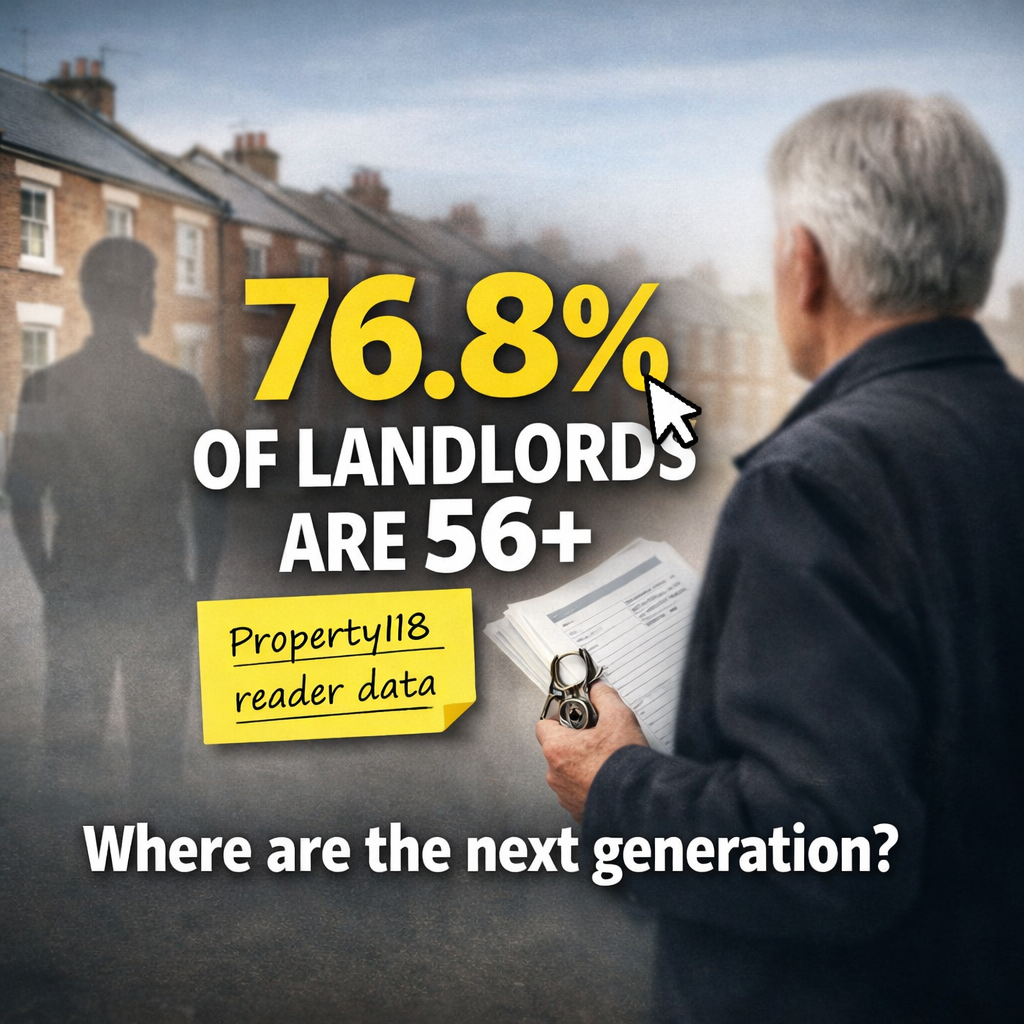
A striking demographic pattern has emerged from the latest UK landlord data, and it raises important questions about the future of the private rented sector. According to the Property118 Landlord Sentiment Survey Q1 2026, the overwhelming majority of landlords are now aged 56 and above, with very limited representation from younger investors.
Based on 2,380 completed responses, 76.8% of landlords fall into the 56+ age bracket, while fewer than 3% are under the age of 40. You can explore the full survey findings here.
The implication is immediate: the UK rental market is increasingly reliant on an ageing landlord base.
A generational imbalance
At a glance, the data highlights a widening gap between those currently operating in the sector and those entering it. Older landlords dominate the landscape, while younger participation remains extremely limited. This is not simply a reflection of experience or time in the market, it points towards a deeper structural issue: fewer new entrants mean fewer replacements.
As existing landlords begin to reduce portfolios or exit entirely, the absence of a younger pipeline becomes more significant.
Barriers to entry are becoming more visible
The survey results do not explicitly ask why younger landlords are underrepresented, but the broader context offers some clues. Higher entry costs, tighter lending criteria and increased regulatory complexity all contribute to a more challenging environment for new investors. In addition, the shift in tax treatment over recent years has made it more difficult for individuals to build portfolios in the same way previous generations did. The result is a market that is not naturally replenishing itself.
Experience concentrated at the top end
The age profile of landlords also aligns with the size and maturity of their portfolios.
As highlighted in the Property118 dataset, the average respondent owns 9.7 rental properties, suggesting that much of the sector is controlled by experienced, long-term investors. This concentration of experience brings stability, but it also introduces a dependency. When a large proportion of housing supply is managed by landlords approaching or already in later life, future supply becomes increasingly tied to their personal decisions.
What happens next?
The demographic imbalance would be less significant if younger landlords were entering the market at a similar pace, but the survey data suggests that this is not currently the case. At the same time, as explored in the wider survey findings, a meaningful proportion of existing landlords are already considering reducing their portfolios or exiting altogether. This creates a simple but important question; if older landlords begin to step back, who replaces them?
A structural issue in the making
Demographic trends tend to move slowly, but their impact can be long-lasting.
An ageing landlord base, combined with limited new entrants, points towards a gradual tightening of supply over time, particularly if exit intentions translate into completed sales.
This is not an immediate shock to the system, but it is a clear directional signal.
For now, one conclusion stands out: the future of the rental market is increasingly shaped by landlords nearing the end of their investment journey, not those just beginning it.
A conversation worth having?
If you are weighing up your own strategy, whether that’s to sell, expand, or restructure to improve profitibility, it is worth having a discussion with a Property118 consultant to take a closer look at how your portfolio is structured as a whole now, and to forecast the outcomes based on multiple scenario’s.
These conversations are typically most useful for landlords with established portfolios and relatively modest borrowing who are beginning to reflect on how their assets could work more effectively in the years ahead.
/* “function”==typeof InitializeEditor,callIfLoaded:function(o){return!(!gform.domLoaded||!gform.scriptsLoaded||!gform.themeScriptsLoaded&&!gform.isFormEditor()||(gform.isFormEditor()&&console.warn(“The use of gform.initializeOnLoaded() is deprecated in the form editor context and will be removed in Gravity Forms 3.1.”),o(),0))},initializeOnLoaded:function(o){gform.callIfLoaded(o)||(document.addEventListener(“gform_main_scripts_loaded”,()=>{gform.scriptsLoaded=!0,gform.callIfLoaded(o)}),document.addEventListener(“gform/theme/scripts_loaded”,()=>{gform.themeScriptsLoaded=!0,gform.callIfLoaded(o)}),window.addEventListener(“DOMContentLoaded”,()=>{gform.domLoaded=!0,gform.callIfLoaded(o)}))},hooks:{action:{},filter:{}},addAction:function(o,r,e,t){gform.addHook(“action”,o,r,e,t)},addFilter:function(o,r,e,t){gform.addHook(“filter”,o,r,e,t)},doAction:function(o){gform.doHook(“action”,o,arguments)},applyFilters:function(o){return gform.doHook(“filter”,o,arguments)},removeAction:function(o,r){gform.removeHook(“action”,o,r)},removeFilter:function(o,r,e){gform.removeHook(“filter”,o,r,e)},addHook:function(o,r,e,t,n){null==gform.hooks[o][r]&&(gform.hooks[o][r]=[]);var d=gform.hooks[o][r];null==n&&(n=r+”_”+d.length),gform.hooks[o][r].push({tag:n,callable:e,priority:t=null==t?10:t})},doHook:function(r,o,e){var t;if(e=Array.prototype.slice.call(e,1),null!=gform.hooks[r][o]&&((o=gform.hooks[r][o]).sort(function(o,r){return o.priority-r.priority}),o.forEach(function(o){“function”!=typeof(t=o.callable)&&(t=window[t]),”action”==r?t.apply(null,e):e[0]=t.apply(null,e)})),”filter”==r)return e[0]},removeHook:function(o,r,t,n){var e;null!=gform.hooks[o][r]&&(e=(e=gform.hooks[o][r]).filter(function(o,r,e){return!!(null!=n&&n!=o.tag||null!=t&&t!=o.priority)}),gform.hooks[o][r]=e)}});
/* ]]> */
Enquire about a free initial discussion with a Property118 consultant
-
Mr.Mrs.MissMs.Dr.Prof.Rev.
-
-
Important Notice – Scope of Planning Support
Where our recommendations touch on areas requiring regulated input, we refer clients to appropriately authorised professionals for advice and implementation.
-
-
-
/* = 0;if(!is_postback){return;}var form_content = jQuery(this).contents().find(‘#gform_wrapper_585′);var is_confirmation = jQuery(this).contents().find(‘#gform_confirmation_wrapper_585′).length > 0;var is_redirect = contents.indexOf(‘gformRedirect(){‘) >= 0;var is_form = form_content.length > 0 && ! is_redirect && ! is_confirmation;var mt = parseInt(jQuery(‘html’).css(‘margin-top’), 10) + parseInt(jQuery(‘body’).css(‘margin-top’), 10) + 100;if(is_form){jQuery(‘#gform_wrapper_585′).html(form_content.html());if(form_content.hasClass(‘gform_validation_error’)){jQuery(‘#gform_wrapper_585′).addClass(‘gform_validation_error’);} else {jQuery(‘#gform_wrapper_585′).removeClass(‘gform_validation_error’);}setTimeout( function() { /* delay the scroll by 50 milliseconds to fix a bug in chrome */ }, 50 );if(window[‘gformInitDatepicker’]) {gformInitDatepicker();}if(window[‘gformInitPriceFields’]) {gformInitPriceFields();}var current_page = jQuery(‘#gform_source_page_number_585′).val();gformInitSpinner( 585, ‘https://www.property118.com/wp-content/plugins/gravityforms/images/spinner.svg’, true );jQuery(document).trigger(‘gform_page_loaded’, [585, current_page]);window[‘gf_submitting_585′] = false;}else if(!is_redirect){var confirmation_content = jQuery(this).contents().find(‘.GF_AJAX_POSTBACK’).html();if(!confirmation_content){confirmation_content = contents;}jQuery(‘#gform_wrapper_585′).replaceWith(confirmation_content);jQuery(document).trigger(‘gform_confirmation_loaded’, [585]);window[‘gf_submitting_585′] = false;wp.a11y.speak(jQuery(‘#gform_confirmation_message_585′).text());}else{jQuery(‘#gform_585′).append(contents);if(window[‘gformRedirect’]) {gformRedirect();}}jQuery(document).trigger(“gform_pre_post_render”, [{ formId: “585”, currentPage: “current_page”, abort: function() { this.preventDefault(); } }]); if (event && event.defaultPrevented) { return; } const gformWrapperDiv = document.getElementById( “gform_wrapper_585″ ); if ( gformWrapperDiv ) { const visibilitySpan = document.createElement( “span” ); visibilitySpan.id = “gform_visibility_test_585″; gformWrapperDiv.insertAdjacentElement( “afterend”, visibilitySpan ); } const visibilityTestDiv = document.getElementById( “gform_visibility_test_585″ ); let postRenderFired = false; function triggerPostRender() { if ( postRenderFired ) { return; } postRenderFired = true; gform.core.triggerPostRenderEvents( 585, current_page ); if ( visibilityTestDiv ) { visibilityTestDiv.parentNode.removeChild( visibilityTestDiv ); } } function debounce( func, wait, immediate ) { var timeout; return function() { var context = this, args = arguments; var later = function() { timeout = null; if ( !immediate ) func.apply( context, args ); }; var callNow = immediate && !timeout; clearTimeout( timeout ); timeout = setTimeout( later, wait ); if ( callNow ) func.apply( context, args ); }; } const debouncedTriggerPostRender = debounce( function() { triggerPostRender(); }, 200 ); if ( visibilityTestDiv && visibilityTestDiv.offsetParent === null ) { const observer = new MutationObserver( ( mutations ) => { mutations.forEach( ( mutation ) => { if ( mutation.type === ‘attributes’ && visibilityTestDiv.offsetParent !== null ) { debouncedTriggerPostRender(); observer.disconnect(); } }); }); observer.observe( document.body, { attributes: true, childList: false, subtree: true, attributeFilter: [ ‘style’, ‘class’ ], }); } else { triggerPostRender(); } } );} );
/* ]]> */
|
★★★★★
|
Help other landlords find Property118If you have found Property118 useful, a short Trustpilot review would make a meaningful difference. It helps other landlords decide whether our research is worth following. |
The post UK rental market dominated by landlords aged over 55 appeared first on Property118.
View Full Article: UK rental market dominated by landlords aged over 55
Categories
- Landlords (19)
- Real Estate (9)
- Renewables & Green Issues (1)
- Rental Property Investment (1)
- Tenants (21)
- Uncategorized (12,685)
Archives
- May 2026 (32)
- April 2026 (78)
- March 2026 (72)
- February 2026 (55)
- January 2026 (52)
- December 2025 (62)
- August 2025 (51)
- July 2025 (51)
- June 2025 (49)
- May 2025 (50)
- April 2025 (48)
- March 2025 (54)
- February 2025 (51)
- January 2025 (52)
- December 2024 (55)
- November 2024 (64)
- October 2024 (82)
- September 2024 (69)
- August 2024 (55)
- July 2024 (64)
- June 2024 (54)
- May 2024 (73)
- April 2024 (59)
- March 2024 (49)
- February 2024 (57)
- January 2024 (58)
- December 2023 (56)
- November 2023 (59)
- October 2023 (67)
- September 2023 (136)
- August 2023 (131)
- July 2023 (129)
- June 2023 (128)
- May 2023 (140)
- April 2023 (121)
- March 2023 (168)
- February 2023 (155)
- January 2023 (152)
- December 2022 (136)
- November 2022 (158)
- October 2022 (146)
- September 2022 (148)
- August 2022 (169)
- July 2022 (124)
- June 2022 (124)
- May 2022 (130)
- April 2022 (116)
- March 2022 (155)
- February 2022 (124)
- January 2022 (120)
- December 2021 (117)
- November 2021 (139)
- October 2021 (130)
- September 2021 (138)
- August 2021 (110)
- July 2021 (110)
- June 2021 (60)
- May 2021 (127)
- April 2021 (122)
- March 2021 (156)
- February 2021 (154)
- January 2021 (133)
- December 2020 (126)
- November 2020 (159)
- October 2020 (169)
- September 2020 (181)
- August 2020 (147)
- July 2020 (172)
- June 2020 (158)
- May 2020 (177)
- April 2020 (188)
- March 2020 (234)
- February 2020 (212)
- January 2020 (164)
- December 2019 (107)
- November 2019 (131)
- October 2019 (145)
- September 2019 (123)
- August 2019 (112)
- July 2019 (93)
- June 2019 (82)
- May 2019 (94)
- April 2019 (88)
- March 2019 (78)
- February 2019 (77)
- January 2019 (71)
- December 2018 (37)
- November 2018 (85)
- October 2018 (108)
- September 2018 (110)
- August 2018 (135)
- July 2018 (140)
- June 2018 (118)
- May 2018 (113)
- April 2018 (64)
- March 2018 (96)
- February 2018 (82)
- January 2018 (92)
- December 2017 (62)
- November 2017 (100)
- October 2017 (105)
- September 2017 (97)
- August 2017 (101)
- July 2017 (104)
- June 2017 (155)
- May 2017 (135)
- April 2017 (113)
- March 2017 (138)
- February 2017 (150)
- January 2017 (127)
- December 2016 (90)
- November 2016 (135)
- October 2016 (149)
- September 2016 (135)
- August 2016 (48)
- July 2016 (52)
- June 2016 (54)
- May 2016 (52)
- April 2016 (24)
- October 2014 (8)
- April 2012 (2)
- December 2011 (2)
- November 2011 (10)
- October 2011 (9)
- September 2011 (9)
- August 2011 (3)
Calendar
Recent Posts
- What you might not know about Inheritance Tax and Whole of Life insurance
- Guidance clarifies council powers to enter premises and seize documents
- The great landlord contradiction: wanting companies, stuck in personal ownership
- Why some landlords are selling before the next repair bill arrives
- Concerns raised over £500 landlord tribunal fees and court delays
