
Ground rents for leaseholders to be capped
 admin
admin 

Property118

Ground rents for leaseholders to be capped
The government has announced that ground rents in England and Wales will be capped at £250 a year for leaseholders.
Under the plans, they will fall to a peppercorn rent after 40 years, meaning no payment at all.
The cap will apply to most residential leasehold agreements signed before July 2023, removing future shocks for homeowners budgeting over the long term.
No new leasehold flats
The Prime Minister, Sir Keir Starmer, announced the cap in a TikTok video, saying: “I’ve spoken to so many people who say this will make a difference to them worth hundreds of pounds.”
The reforms will be published in the draft Leasehold and Commonhold Reform Bill, which will be introduced today (Tuesday).
Developers will also be barred from selling most new flats as leasehold.
Instead, new apartment blocks will be built under a commonhold structure, where residents collectively own and manage the building and the land beneath it.
The government is consulting on how the shift will work in practice, including limited exemptions and transition arrangements.
Convert to commonhold
Existing leaseholders are not excluded, and the proposals will make it easier for current flat owners to convert from leasehold to commonhold if they choose.
Doing so will allow them to access the same rights as those buying new homes.
The government is also moving to end forfeiture, a long-standing rule that can see homeowners lose their property over relatively small debts.
In its place, a court-led process with tighter safeguards will apply only in more serious cases.
Transparency on fees
Further measures aim to improve transparency around service charges and building costs.
Bills will be clearer, routes to challenge unfair fees strengthened and landlords or managing agents held to higher standards, reducing unexplained increases.
Reforms will also extend to nearly two million households living in freehold homes on privately managed estates.
They currently pay additional charges for shared spaces, a practice often labelled ‘fleecehold’.
Ministers say they want to curb its future use and give homeowners more protection.
Other leasehold plans
Other plans include banning a century old legal power that allows harsh penalties for missed payments.
The government will also introduce standardised estate charge statements, enabling tribunals to replace failing management firms.
There will also be a proposal on whether resident-run management should become the default.
The post Ground rents for leaseholders to be capped appeared first on Property118.
View Full Article: Ground rents for leaseholders to be capped
Rent Guarantee Insurance – Does It Really Work for Landlords?
Property118

Rent Guarantee Insurance – Does It Really Work for Landlords?
Tenant default is one of the biggest risks for landlords. Even with strong referencing, job losses, illness, or disputes can leave tenants unable or unwilling to pay. Rent guarantee insurance (RGI) promises to protect landlords against these losses, but the detail of each policy makes a huge difference. This article explains how RGI works, what’s usually covered, common exclusions, and what landlords should check before buying.
What Rent Guarantee Insurance Covers
A typical RGI policy pays landlords when tenants stop paying rent, usually from the date of default until the tenant vacates or possession is obtained. Cover usually includes:
- Monthly rent payments – up to a specified limit (e.g. £2,500 or £3,000 per month).
- Maximum duration – often 6 or 12 months of unpaid rent.
- Legal expenses – to fund possession proceedings and eviction if necessary.
- Alternative accommodation – occasionally included if tenants must be rehoused during legal processes (less common).
Eligibility and Referencing Requirements
RGI is not a blanket safety net. Policies are only valid if strict referencing criteria are met at the start of the tenancy. Typical requirements include:
- Full credit check – confirming no adverse CCJs or bankruptcies.
- Employer’s reference – verifying stable employment and sufficient income.
- Previous landlord reference – for existing tenants moving between rentals.
- Guarantor – sometimes required for students, self-employed tenants, or those with weaker credit.
- Deposit compliance – correct registration of deposits or valid deposit replacement schemes.
Failure to meet or document these requirements is the most common reason claims are declined.
Exclusions to Watch For
- Pre-existing arrears – cover only starts for arrears after the policy is in place.
- Unreferenced tenants – if references aren’t completed to the policy standard, claims may fail.
- Tenancy type restrictions – some policies exclude HMOs, students, or DSS tenants unless approved in advance.
- Delays in notification – landlords must notify insurers quickly once arrears begin, often within 30 days.
- Void periods – rent guarantee only covers arrears, not general voids between tenancies.
RGI vs Loss of Rent Insurance
Landlords often confuse rent guarantee with loss of rent cover. They are very different:
- Rent guarantee – covers unpaid rent due to tenant default.
- Loss of rent – covers loss of income after an insured peril (e.g. fire, flood) makes the property uninhabitable.
Both types of cover are valuable, but they serve different purposes. Savvy landlords often hold both.
Case Example
A landlord let a flat to a young professional. Six months in, the tenant lost their job and stopped paying rent. Because the landlord had completed full referencing and notified the insurer within the policy deadline, rent guarantee insurance paid the monthly rent for nine months until possession was regained. The policy also covered legal fees for eviction, saving the landlord thousands of pounds. Without RGI, the landlord would have lost over £12,000 in income.
Checklist Before Buying RGI
- Confirm the monthly rent limit covers your tenancy.
- Check the maximum payout period (6, 12, or more months).
- Review eligibility rules – referencing, guarantors, tenancy type.
- Understand the notification window for arrears.
- Clarify whether the policy includes legal expenses and up to what limit.
Final Thoughts
Rent guarantee insurance can be a lifesaver for landlords, but only if the referencing process is followed and claims are reported promptly. For those willing to maintain good records and act quickly on arrears, it provides valuable cash flow protection. Always check the small print before relying on it.
Request your quote or call-back
The most efficient way to get a personal quote with the best price and cover possible is to call the team on 01832 770965 so we can focus on your enquiry when you are ready and sitting down with your portfolio details to hand.
Alternatively, you can use the form below to request one of our team to give you a call back.
/* “function”==typeof InitializeEditor,callIfLoaded:function(o){return!(!gform.domLoaded||!gform.scriptsLoaded||!gform.themeScriptsLoaded&&!gform.isFormEditor()||(gform.isFormEditor()&&console.warn(“The use of gform.initializeOnLoaded() is deprecated in the form editor context and will be removed in Gravity Forms 3.1.”),o(),0))},initializeOnLoaded:function(o){gform.callIfLoaded(o)||(document.addEventListener(“gform_main_scripts_loaded”,()=>{gform.scriptsLoaded=!0,gform.callIfLoaded(o)}),document.addEventListener(“gform/theme/scripts_loaded”,()=>{gform.themeScriptsLoaded=!0,gform.callIfLoaded(o)}),window.addEventListener(“DOMContentLoaded”,()=>{gform.domLoaded=!0,gform.callIfLoaded(o)}))},hooks:{action:{},filter:{}},addAction:function(o,r,e,t){gform.addHook(“action”,o,r,e,t)},addFilter:function(o,r,e,t){gform.addHook(“filter”,o,r,e,t)},doAction:function(o){gform.doHook(“action”,o,arguments)},applyFilters:function(o){return gform.doHook(“filter”,o,arguments)},removeAction:function(o,r){gform.removeHook(“action”,o,r)},removeFilter:function(o,r,e){gform.removeHook(“filter”,o,r,e)},addHook:function(o,r,e,t,n){null==gform.hooks[o][r]&&(gform.hooks[o][r]=[]);var d=gform.hooks[o][r];null==n&&(n=r+”_”+d.length),gform.hooks[o][r].push({tag:n,callable:e,priority:t=null==t?10:t})},doHook:function(r,o,e){var t;if(e=Array.prototype.slice.call(e,1),null!=gform.hooks[r][o]&&((o=gform.hooks[r][o]).sort(function(o,r){return o.priority-r.priority}),o.forEach(function(o){“function”!=typeof(t=o.callable)&&(t=window[t]),”action”==r?t.apply(null,e):e[0]=t.apply(null,e)})),”filter”==r)return e[0]},removeHook:function(o,r,t,n){var e;null!=gform.hooks[o][r]&&(e=(e=gform.hooks[o][r]).filter(function(o,r,e){return!!(null!=n&&n!=o.tag||null!=t&&t!=o.priority)}),gform.hooks[o][r]=e)}});
/* ]]> */
Landlords Buying Group Insurance Renewal
/* = 0;if(!is_postback){return;}var form_content = jQuery(this).contents().find(‘#gform_wrapper_9′);var is_confirmation = jQuery(this).contents().find(‘#gform_confirmation_wrapper_9′).length > 0;var is_redirect = contents.indexOf(‘gformRedirect(){‘) >= 0;var is_form = form_content.length > 0 && ! is_redirect && ! is_confirmation;var mt = parseInt(jQuery(‘html’).css(‘margin-top’), 10) + parseInt(jQuery(‘body’).css(‘margin-top’), 10) + 100;if(is_form){jQuery(‘#gform_wrapper_9′).html(form_content.html());if(form_content.hasClass(‘gform_validation_error’)){jQuery(‘#gform_wrapper_9′).addClass(‘gform_validation_error’);} else {jQuery(‘#gform_wrapper_9′).removeClass(‘gform_validation_error’);}setTimeout( function() { /* delay the scroll by 50 milliseconds to fix a bug in chrome */ }, 50 );if(window[‘gformInitDatepicker’]) {gformInitDatepicker();}if(window[‘gformInitPriceFields’]) {gformInitPriceFields();}var current_page = jQuery(‘#gform_source_page_number_9′).val();gformInitSpinner( 9, ‘https://www.property118.com/wp-content/plugins/gravityforms/images/spinner.svg’, true );jQuery(document).trigger(‘gform_page_loaded’, [9, current_page]);window[‘gf_submitting_9′] = false;}else if(!is_redirect){var confirmation_content = jQuery(this).contents().find(‘.GF_AJAX_POSTBACK’).html();if(!confirmation_content){confirmation_content = contents;}jQuery(‘#gform_wrapper_9′).replaceWith(confirmation_content);jQuery(document).trigger(‘gform_confirmation_loaded’, [9]);window[‘gf_submitting_9′] = false;wp.a11y.speak(jQuery(‘#gform_confirmation_message_9′).text());}else{jQuery(‘#gform_9′).append(contents);if(window[‘gformRedirect’]) {gformRedirect();}}jQuery(document).trigger(“gform_pre_post_render”, [{ formId: “9”, currentPage: “current_page”, abort: function() { this.preventDefault(); } }]); if (event && event.defaultPrevented) { return; } const gformWrapperDiv = document.getElementById( “gform_wrapper_9″ ); if ( gformWrapperDiv ) { const visibilitySpan = document.createElement( “span” ); visibilitySpan.id = “gform_visibility_test_9″; gformWrapperDiv.insertAdjacentElement( “afterend”, visibilitySpan ); } const visibilityTestDiv = document.getElementById( “gform_visibility_test_9″ ); let postRenderFired = false; function triggerPostRender() { if ( postRenderFired ) { return; } postRenderFired = true; gform.core.triggerPostRenderEvents( 9, current_page ); if ( visibilityTestDiv ) { visibilityTestDiv.parentNode.removeChild( visibilityTestDiv ); } } function debounce( func, wait, immediate ) { var timeout; return function() { var context = this, args = arguments; var later = function() { timeout = null; if ( !immediate ) func.apply( context, args ); }; var callNow = immediate && !timeout; clearTimeout( timeout ); timeout = setTimeout( later, wait ); if ( callNow ) func.apply( context, args ); }; } const debouncedTriggerPostRender = debounce( function() { triggerPostRender(); }, 200 ); if ( visibilityTestDiv && visibilityTestDiv.offsetParent === null ) { const observer = new MutationObserver( ( mutations ) => { mutations.forEach( ( mutation ) => { if ( mutation.type === ‘attributes’ && visibilityTestDiv.offsetParent !== null ) { debouncedTriggerPostRender(); observer.disconnect(); } }); }); observer.observe( document.body, { attributes: true, childList: false, subtree: true, attributeFilter: [ ‘style’, ‘class’ ], }); } else { triggerPostRender(); } } );} );
/* ]]> */
Publication date: Tuesday 27 January 2026
The post Rent Guarantee Insurance – Does It Really Work for Landlords? appeared first on Property118.
View Full Article: Rent Guarantee Insurance – Does It Really Work for Landlords?
Tenant group urges freeze on evictions and rent increases following floods
Property118
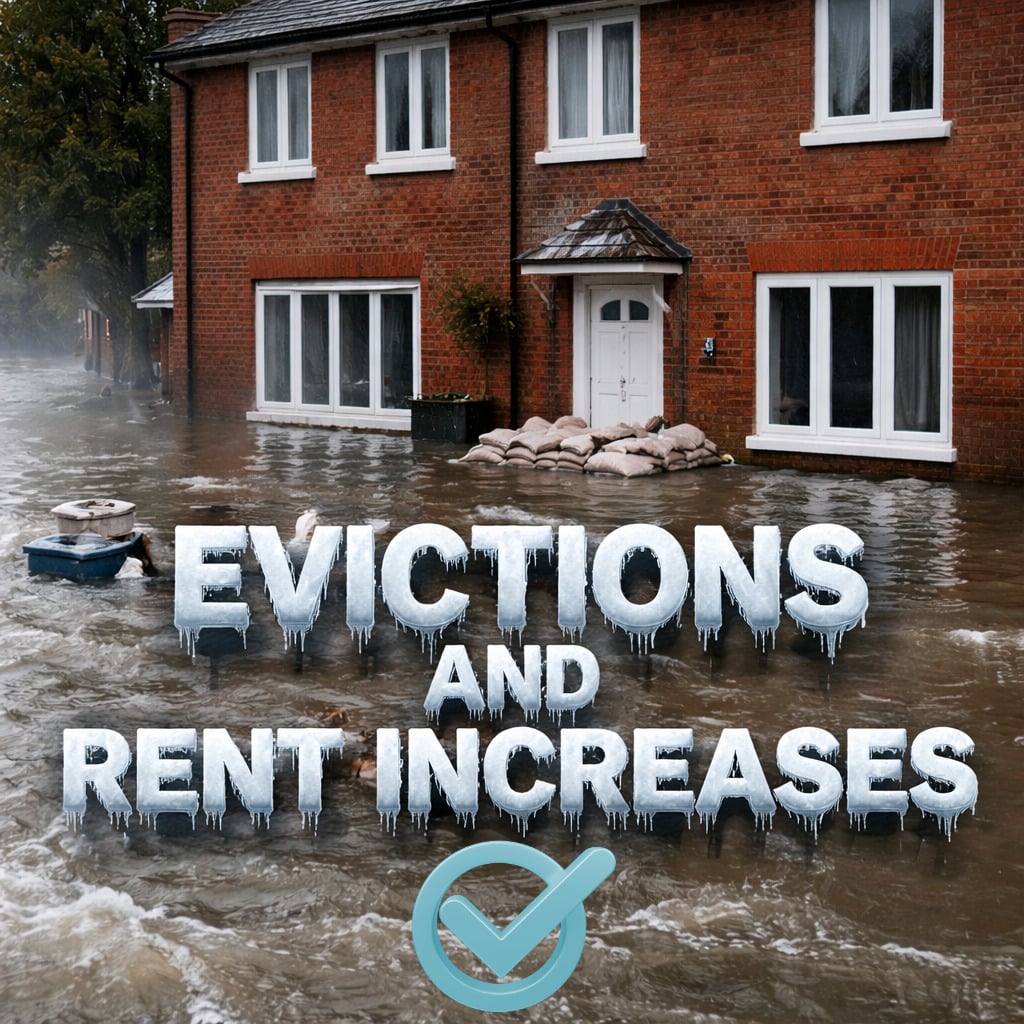
Tenant group urges freeze on evictions and rent increases following floods
A tenant group has demanded a freeze on evictions and rents during any post-flood repairs.
ACORN says there is no national voice for tenants on flooding, and renters bear the brunt of the consequences.
However, ACORN fails to mention that renters can take out insurance to protect their belongings in case of flooding.
Freeze on evictions and rent rises
In a policy document, the group says: “In England, landlords are responsible for making repairs to a property after flooding, and tenants can claim for a rent reduction while the repairs are carried out. While this is a good thing in principle, it is gravely undermined by the lack of protection from eviction for the tenants through this process.
“People will stay in terrible conditions because they are worried they will be evicted if they get the landlords to make the necessary repairs. Tenants should not have to choose between living in a potentially dangerous property and risking eviction.”
ACORN is now calling for a freeze on rents and evictions during flooding to help tenants and
The group adds: “There should be a freeze on evictions and rent rises during any improvement works and after they have been completed for a certain period, in order to ensure tenants feel empowered to demand repairs and to make sure that costs are not passed onto them.
“Until such national protections are in place, housing providers with properties in flood-prone areas should introduce policies that guarantee no evictions or rent hikes in the event of flooding.”
The group adds that funds should be made available to community organisations such as ACORN for flood resilience projects.
Only 46% of tenants hold contents insurance
However, ACORN fails to mention that if a rental property is flooded, it is the landlord’s responsibility to pay out of their own pocket for repairs to the property and any landlord-provided furnishings, and landlord insurance will typically cover alternative accommodation while repairs are carried out.
For tenant belongings, tenants need to take out contents insurance themselves to protect their belongings. However, as previously reported by Property118, only 46% of the UK’s private tenants currently hold contents insurance.
The post Tenant group urges freeze on evictions and rent increases following floods appeared first on Property118.
View Full Article: Tenant group urges freeze on evictions and rent increases following floods
Categories
- Landlords (19)
- Real Estate (9)
- Renewables & Green Issues (1)
- Rental Property Investment (1)
- Tenants (21)
- Uncategorized (12,723)
Archives
- May 2026 (70)
- April 2026 (78)
- March 2026 (72)
- February 2026 (55)
- January 2026 (52)
- December 2025 (62)
- August 2025 (51)
- July 2025 (51)
- June 2025 (49)
- May 2025 (50)
- April 2025 (48)
- March 2025 (54)
- February 2025 (51)
- January 2025 (52)
- December 2024 (55)
- November 2024 (64)
- October 2024 (82)
- September 2024 (69)
- August 2024 (55)
- July 2024 (64)
- June 2024 (54)
- May 2024 (73)
- April 2024 (59)
- March 2024 (49)
- February 2024 (57)
- January 2024 (58)
- December 2023 (56)
- November 2023 (59)
- October 2023 (67)
- September 2023 (136)
- August 2023 (131)
- July 2023 (129)
- June 2023 (128)
- May 2023 (140)
- April 2023 (121)
- March 2023 (168)
- February 2023 (155)
- January 2023 (152)
- December 2022 (136)
- November 2022 (158)
- October 2022 (146)
- September 2022 (148)
- August 2022 (169)
- July 2022 (124)
- June 2022 (124)
- May 2022 (130)
- April 2022 (116)
- March 2022 (155)
- February 2022 (124)
- January 2022 (120)
- December 2021 (117)
- November 2021 (139)
- October 2021 (130)
- September 2021 (138)
- August 2021 (110)
- July 2021 (110)
- June 2021 (60)
- May 2021 (127)
- April 2021 (122)
- March 2021 (156)
- February 2021 (154)
- January 2021 (133)
- December 2020 (126)
- November 2020 (159)
- October 2020 (169)
- September 2020 (181)
- August 2020 (147)
- July 2020 (172)
- June 2020 (158)
- May 2020 (177)
- April 2020 (188)
- March 2020 (234)
- February 2020 (212)
- January 2020 (164)
- December 2019 (107)
- November 2019 (131)
- October 2019 (145)
- September 2019 (123)
- August 2019 (112)
- July 2019 (93)
- June 2019 (82)
- May 2019 (94)
- April 2019 (88)
- March 2019 (78)
- February 2019 (77)
- January 2019 (71)
- December 2018 (37)
- November 2018 (85)
- October 2018 (108)
- September 2018 (110)
- August 2018 (135)
- July 2018 (140)
- June 2018 (118)
- May 2018 (113)
- April 2018 (64)
- March 2018 (96)
- February 2018 (82)
- January 2018 (92)
- December 2017 (62)
- November 2017 (100)
- October 2017 (105)
- September 2017 (97)
- August 2017 (101)
- July 2017 (104)
- June 2017 (155)
- May 2017 (135)
- April 2017 (113)
- March 2017 (138)
- February 2017 (150)
- January 2017 (127)
- December 2016 (90)
- November 2016 (135)
- October 2016 (149)
- September 2016 (135)
- August 2016 (48)
- July 2016 (52)
- June 2016 (54)
- May 2016 (52)
- April 2016 (24)
- October 2014 (8)
- April 2012 (2)
- December 2011 (2)
- November 2011 (10)
- October 2011 (9)
- September 2011 (9)
- August 2011 (3)
Calendar
Recent Posts
- Feeling the heat? How we turned a landlord nightmare into a cool £12k win — without having to evict tenants
- Potential pitfalls when inheriting rental properties
- Private rented sector key to solving London housing crisis – NRLA
- New buy to let deals unveiled by four lenders
- Renters’ Rights Act information sheet deadline warning issued to landlords
