
What you might not know about Inheritance Tax and Whole of Life insurance
 admin
admin 

Property118

What you might not know about Inheritance Tax and Whole of Life insurance
One of the biggest misconceptions surrounding inheritance tax planning is that people can “sort it out later”.
In reality, delaying inheritance tax planning, especially when it relies on Whole of Life cover, has a direct and measurable cost that compounds with every birthday and every change in health.
Many landlords now sit on portfolios worth several million pounds, yet still postpone meaningful IHT planning or, some might say ‘selfishly‘ leave the problem to their children to “work it out when the time comes”.
As explained previously in Why Whole of Life in trust might be the most misunderstood legacy savings plan available, the purpose of this type of planning is liquidity, certainty and control at precisely the moment a family is most vulnerable.
The timing of when you arrange cover can materially change affordability.
Take the following indicative monthly premiums for £1 million of Whole of Life cover for a single male ingood health:
| Age | Monthly premium |
|---|---|
| 55 | £1,083.31 |
| 60 | £1,328.20 |
| 65 | £1,789.18 |
| 70 | £2,364.00 |
Those figures alone tell a powerful story, because waiting from age 55 to age 70 more than doubles the monthly premium. That increase is simply the insurer recognising that the statistical likelihood of a claim has increased substantially. Postponing also risks becoming uninsuranble, or worse!
The following is indicative pricing for a healthy married couple or civil partners on a Joint Life Second Death basis for the same £1 million sum assured:
| Age | Monthly premium |
|---|---|
| 55 | £860.00 |
| 60 | £990.48 |
| 65 | £1,307.00 |
| 70 | £1,655.00 |
Joint Life Second Death policies are often more suitable for married couples and civil partners. This is because, under current UK inheritance tax rules, transfers between spouses and civil partners are generally exempt from inheritance tax.
That means when the first person dies, assets can normally pass to the surviving spouse or civil partner without triggering an immediate inheritance tax charge. The real inheritance tax problem often arises on the second death, when the combined family wealth eventually passes down to children or other beneficiaries, and that is precisely why Joint Life Second Death policies exist. Rather than paying out on the first death, the policy pays once both individuals have died. From an inheritance tax planning perspective, this can align far more closely with the point at which the tax liability actually crystallises.
The above also explains why many long-term unmarried couples are now considering civil partnerships. In many cases, the decision is not ideological or symbolic, it is commercial, practical and family focused. A civil partnership can fundamentally alter inheritance tax exposure between a couple and can also make certain legacy planning structures materially more efficient. For some families, that single legal step can preserve hundreds of thousands of pounds that might otherwise be lost unnecessarily to inheritance tax or forced property sales.
The hidden risk is not just age
The hidden risk is also health.
As discussed in The £200,000 diagnosis: why timing matters in inheritance tax planning, many people wrongly assume that insurance remains available whenever they eventually decide to apply, but that is not how underwriting works.
A diagnosis of diabetes, heart disease, cancer, high blood pressure, obesity, or even relatively common medical issues can dramatically increase premiums. In some cases, cover may become unavailable altogether.
The difference between arranging cover at 55 versus attempting to arrange it at 65 after a medical diagnosis can easily run into hundreds of thousands of pounds over the lifetime of the policy.
Why writing the policy into trust is usually critical
For many landlords, the most important part of Whole of Life planning is not actually the policy itself, it’s how the policy is owned.
If a Whole of Life policy is not written into trust, the payout normally forms part of the deceased’s estate., and that can create two significant problems.
First, the insurance proceeds themselves may become subject to inheritance tax, which partially defeats the purpose of arranging the cover in the first place.
Second, the funds may become tied up in probate at precisely the moment beneficiaries need liquidity most urgently.
That delay can create serious practical problems for families with large property portfolios because mortgage payments still need to be maintained, properties still need to be managed and inheritance tax may still become payable before the estate is fully administered.
By contrast, when a policy is correctly written into trust, the proceeds will normally sit outside the estate and can usually be paid far more quickly to trustees for the benefit of the intended beneficiaries.
That speed and accessibility can make an enormous difference.
Rather than beneficiaries becoming forced sellers under time pressure, trustees may have immediate access to liquidity that can be used to reduce debt, cover inheritance tax liabilities, stabilise cashflow or simply provide breathing space whilst longer-term decisions are made properly.
In many cases, the trust structure is just as important as the insurance policy itself.
Trust planning can also become more sophisticated for larger estates. Some families use discretionary trusts to provide flexibility across generations, whilst others combine life cover with lending structures, business succession planning or wider asset protection strategies.
The correct structure depends entirely on personal circumstances, ownership arrangements, debt levels, family dynamics and longer-term objectives.
That is another reason why inheritance tax planning should never be reduced to simply “buying an insurance policy”. The legal structure surrounding the policy is often where much of the long-term value and protection actually sits.
Special thanks for Georgiana Lacey-Scane, a whole of market, FCA regulated, Independent Financial Adviser for providing the indicative monthly premiums and general commentary above. This must not, however, be regarded as financial advise.
Why liquidity matters for landlords
For landlords, there is another important consideration: property wealth is often highly illiquid.
A family may appear wealthy on paper whilst simultaneously lacking the cash required to pay inheritance tax bills, refinance debt, or maintain portfolio continuity after death.
Beneficiaries may then face pressure to sell properties quickly, accept discounted offers, or refinance under difficult circumstances. That can be particularly damaging if the estate includes properties that would otherwise have been retained for income, succession or long-term family security.
For those reasons, many experienced landlords now view Whole of Life cover written into trust less as an insurance purchase and more as a liquidity planning tool.
The objective is often not to make beneficiaries richer, it is to stop families becoming forced sellers at exactly the wrong moment.
The above is not financial advice, nor is Whole of Life insurance written into trust a ‘silver bullet’ that solves every inheritance tax problem. It is simply one of several planning tools that Property118 consultants may discuss where business continuity, legacy planning and inheritance tax mitigation are important considerations for you and your family.
Arrange a free initial 30-minute Zoom consultation
OR …
/* “function”==typeof InitializeEditor,callIfLoaded:function(o){return!(!gform.domLoaded||!gform.scriptsLoaded||!gform.themeScriptsLoaded&&!gform.isFormEditor()||(gform.isFormEditor()&&console.warn(“The use of gform.initializeOnLoaded() is deprecated in the form editor context and will be removed in Gravity Forms 3.1.”),o(),0))},initializeOnLoaded:function(o){gform.callIfLoaded(o)||(document.addEventListener(“gform_main_scripts_loaded”,()=>{gform.scriptsLoaded=!0,gform.callIfLoaded(o)}),document.addEventListener(“gform/theme/scripts_loaded”,()=>{gform.themeScriptsLoaded=!0,gform.callIfLoaded(o)}),window.addEventListener(“DOMContentLoaded”,()=>{gform.domLoaded=!0,gform.callIfLoaded(o)}))},hooks:{action:{},filter:{}},addAction:function(o,r,e,t){gform.addHook(“action”,o,r,e,t)},addFilter:function(o,r,e,t){gform.addHook(“filter”,o,r,e,t)},doAction:function(o){gform.doHook(“action”,o,arguments)},applyFilters:function(o){return gform.doHook(“filter”,o,arguments)},removeAction:function(o,r){gform.removeHook(“action”,o,r)},removeFilter:function(o,r,e){gform.removeHook(“filter”,o,r,e)},addHook:function(o,r,e,t,n){null==gform.hooks[o][r]&&(gform.hooks[o][r]=[]);var d=gform.hooks[o][r];null==n&&(n=r+”_”+d.length),gform.hooks[o][r].push({tag:n,callable:e,priority:t=null==t?10:t})},doHook:function(r,o,e){var t;if(e=Array.prototype.slice.call(e,1),null!=gform.hooks[r][o]&&((o=gform.hooks[r][o]).sort(function(o,r){return o.priority-r.priority}),o.forEach(function(o){“function”!=typeof(t=o.callable)&&(t=window[t]),”action”==r?t.apply(null,e):e[0]=t.apply(null,e)})),”filter”==r)return e[0]},removeHook:function(o,r,t,n){var e;null!=gform.hooks[o][r]&&(e=(e=gform.hooks[o][r]).filter(function(o,r,e){return!!(null!=n&&n!=o.tag||null!=t&&t!=o.priority)}),gform.hooks[o][r]=e)}});
/* ]]> */
Contact Georgianna Lacey-Scane
-
Mr.Mrs.MissMs.Dr.Prof.Rev.
-
-
 Important Notice – Scope of Planning Support
Where our recommendations touch on areas requiring regulated input, we refer clients to appropriately authorised professionals for advice and execution.
-
-
-
/* = 0;if(!is_postback){return;}var form_content = jQuery(this).contents().find(‘#gform_wrapper_588′);var is_confirmation = jQuery(this).contents().find(‘#gform_confirmation_wrapper_588′).length > 0;var is_redirect = contents.indexOf(‘gformRedirect(){‘) >= 0;var is_form = form_content.length > 0 && ! is_redirect && ! is_confirmation;var mt = parseInt(jQuery(‘html’).css(‘margin-top’), 10) + parseInt(jQuery(‘body’).css(‘margin-top’), 10) + 100;if(is_form){jQuery(‘#gform_wrapper_588′).html(form_content.html());if(form_content.hasClass(‘gform_validation_error’)){jQuery(‘#gform_wrapper_588′).addClass(‘gform_validation_error’);} else {jQuery(‘#gform_wrapper_588′).removeClass(‘gform_validation_error’);}setTimeout( function() { /* delay the scroll by 50 milliseconds to fix a bug in chrome */ }, 50 );if(window[‘gformInitDatepicker’]) {gformInitDatepicker();}if(window[‘gformInitPriceFields’]) {gformInitPriceFields();}var current_page = jQuery(‘#gform_source_page_number_588′).val();gformInitSpinner( 588, ‘https://www.property118.com/wp-content/plugins/gravityforms/images/spinner.svg’, true );jQuery(document).trigger(‘gform_page_loaded’, [588, current_page]);window[‘gf_submitting_588′] = false;}else if(!is_redirect){var confirmation_content = jQuery(this).contents().find(‘.GF_AJAX_POSTBACK’).html();if(!confirmation_content){confirmation_content = contents;}jQuery(‘#gform_wrapper_588′).replaceWith(confirmation_content);jQuery(document).trigger(‘gform_confirmation_loaded’, [588]);window[‘gf_submitting_588′] = false;wp.a11y.speak(jQuery(‘#gform_confirmation_message_588′).text());}else{jQuery(‘#gform_588′).append(contents);if(window[‘gformRedirect’]) {gformRedirect();}}jQuery(document).trigger(“gform_pre_post_render”, [{ formId: “588”, currentPage: “current_page”, abort: function() { this.preventDefault(); } }]); if (event && event.defaultPrevented) { return; } const gformWrapperDiv = document.getElementById( “gform_wrapper_588″ ); if ( gformWrapperDiv ) { const visibilitySpan = document.createElement( “span” ); visibilitySpan.id = “gform_visibility_test_588″; gformWrapperDiv.insertAdjacentElement( “afterend”, visibilitySpan ); } const visibilityTestDiv = document.getElementById( “gform_visibility_test_588″ ); let postRenderFired = false; function triggerPostRender() { if ( postRenderFired ) { return; } postRenderFired = true; gform.core.triggerPostRenderEvents( 588, current_page ); if ( visibilityTestDiv ) { visibilityTestDiv.parentNode.removeChild( visibilityTestDiv ); } } function debounce( func, wait, immediate ) { var timeout; return function() { var context = this, args = arguments; var later = function() { timeout = null; if ( !immediate ) func.apply( context, args ); }; var callNow = immediate && !timeout; clearTimeout( timeout ); timeout = setTimeout( later, wait ); if ( callNow ) func.apply( context, args ); }; } const debouncedTriggerPostRender = debounce( function() { triggerPostRender(); }, 200 ); if ( visibilityTestDiv && visibilityTestDiv.offsetParent === null ) { const observer = new MutationObserver( ( mutations ) => { mutations.forEach( ( mutation ) => { if ( mutation.type === ‘attributes’ && visibilityTestDiv.offsetParent !== null ) { debouncedTriggerPostRender(); observer.disconnect(); } }); }); observer.observe( document.body, { attributes: true, childList: false, subtree: true, attributeFilter: [ ‘style’, ‘class’ ], }); } else { triggerPostRender(); } } );} );
/* ]]> */
The post What you might not know about Inheritance Tax and Whole of Life insurance appeared first on Property118.
View Full Article: What you might not know about Inheritance Tax and Whole of Life insurance
Guidance clarifies council powers to enter premises and seize documents
Property118

Guidance clarifies council powers to enter premises and seize documents
Councils can enter a landlord’s business premises under rules set out in the Renters’ Rights Act.
However, government guidance makes clear that the business premises power cannot be used to enter premises that are wholly or mainly used as a home.
In December last year, under the Renters’ Rights Act, councils were given powers to carry out inspections.
The government has now issued further guidance explaining how councils can use powers of entry, apply for warrants, and seize documents during investigations.
Councils must provide written evidence
The guidance says a rental sector business is defined in the Renters’ Rights Act, as a business connected with:
- letting residential accommodation in England
- creating licences to occupy such accommodation
- marketing such accommodation for a tenancy or licence to occupy
- managing such accommodation under a tenancy or licence to occupy
The investigatory powers guidance says councils may apply to a justice of the peace for a warrant to enter specified rental sector business premises where a non-routine inspection cannot be carried out with at least 24 hours’ notice.
The guidance says councils must provide written evidence on oath that one of the following applies:
- entry has been refused, or there are reasonable grounds to believe entry will be refused, and the occupier has been notified of the intention to apply for a warrant
- giving notice might result in evidence being hidden, removed, or tampered with
- no occupier is present, and waiting for an occupier to be present would defeat the purpose of entry
The guidance also says councils must provide evidence that they are acting in an official capacity, and that there are reasonable grounds to suspect the premises are being used for rental sector business and are not wholly or mainly residential accommodation.
Councils must also have reasonable grounds to expect relevant documents to be held on the premises which may be required to be produced or may be liable to seizure under the Renters’ Rights Act.
Officers must usually provide identification
Under the powers, councils can seize documents in electronic or written form.
The guidance explains that councils may require documents to help determine whether there has been compliance with rented accommodation legislation where there are reasonable grounds to suspect non-compliance.
Where a document is held electronically, the guidance says councils may require a copy in a format that can be easily taken away, such as a hard copy.
The guidance says that where officers enter business premises without a warrant, they must provide at least one person on the premises with evidence of their identity and authority, if anyone is present.
It also says that where it is not reasonably practicable to provide identification, information gathered during the inspection may still be used.
The guidance says: “When using either of the powers of entry into a business premises, you have the power to seize and detain documents if you have a reasonable suspicion that they may be required as evidence in proceedings for a breach or offence under the rented accommodation legislation.”
It adds: “If there are people on the premises, before you seize documents, you must show at least one person proof of your identity and authority. However, if it is not reasonably practicable to do so, you do not need to.”
Councils have more power than the police
Landlord law expert at Landlord Licensing & Defence, Phil Turtle, has previously told Property118 the new power of entry is simply embodying what councils have been able to bend the law to achieve for years.
He explains: “A council can still inspect a property even if the tenant and landlord refuse to give permission. Councils have more power than the police to enter your home.
“Already, before the Renters’ Rights Act powers of entry: The Housing Act gives councils entry under Section 239 which gives them the ability to go in and inspect because of an official complaint to determine whether any function under parts one to four of the Housing Act should be exercised. If the council think anything is wrong in the property or if anybody has complained, they can go in under Section 239 in 24 hours.”
“But when dealing with an unlicensed property, councils do not need to give 24-hour notice. If the council believe that there is an offence under Housing Act 2004 Section 72 which is anything to do with HMO licensing or Section 95 (selective licensing) and they have reason to believe the property is unlicensed, they don’t need to give notice they can just turn-up and demand entry.
“Often the council will do a dawn-style raid at five in the morning with eight or so officers dressed to look like police uniforms, and they’ll threaten their way in.”
He says landlords and tenants can be fined if they obstruct entry to the inspection.
He adds: “We hear so many stories that councils tell foreign nationals that if they don’t let them in, they will get deported.
“The officers will barge their way upstairs to count how many people are in beds and claim they are all living there. Councils seem to think that an unlicensed HMO is second only to murder!
“If a landlord or a tenant obstructs this entry, it will be classed as a level four fine costing up to £2,500, and they can still enter the property!
The post Guidance clarifies council powers to enter premises and seize documents appeared first on Property118.
View Full Article: Guidance clarifies council powers to enter premises and seize documents
The great landlord contradiction: wanting companies, stuck in personal ownership
Property118

The great landlord contradiction: wanting companies, stuck in personal ownership
If most landlords were starting again today, many would not structure things the same way. That is becoming increasingly clear. There is a growing disconnect between how portfolios are currently held and how landlords would choose to hold them if given a clean slate. The preference has shifted, but the structure has not. That gap is not accidental. It reflects friction.
For landlords who have built portfolios over many years, decisions were made under different conditions. Financing, tax treatment and practical considerations all pointed towards personal ownership at the time. Those decisions were rational when they were made.
The problem is that structures do not evolve as easily as thinking does. Changing ownership is rarely straightforward. It can involve financing constraints, tax considerations and legal complexity, all of which create inertia. As a result, many landlords find themselves operating within structures that no longer reflect how they would choose to invest today. This creates a tension. On one hand, there is a clear preference for a different approach. On the other, there are practical barriers to getting there.
Evidence of this can be seen in the Property118 Landlord Sentiment Survey Q1 2026, where a majority of landlords still hold property in personal ownership, despite many indicating that they would favour company structures for future acquisitions.
That combination is telling because it shows that the issue is not awareness, it is implementation. Landlords understand the direction they would take if starting today, but existing portfolios anchor them to decisions made in the past. Over time, that gap becomes more noticeable, particularly as portfolios mature and long-term planning becomes more important. This is where structural questions begin to move to the forefront, not because landlords are looking to make wholesale changes overnight, but because they are increasingly aware that their current structure may not fully support where they want to go next.
For now, one conclusion stands out: landlords are not lacking clarity about how they would invest today, they are navigating the complexity of changing what they built yesterday.
For many landlords, the question is not whether the market is changing, but what that change means for their own position.
If you are holding a portfolio with relatively low borrowing, or are beginning to reassess how your assets are structured, this is often the point where a more joined-up view becomes useful.
An invitation for established landlords
If you find the Property118 articles helpful and are curious about how those ideas apply to your own portfolio, you are welcome to take the conversation a step further.
These conversations are typically most useful for landlords with established portfolios and relatively modest borrowing who are beginning to reflect on how their assets could work more effectively in the years ahead.
/* “function”==typeof InitializeEditor,callIfLoaded:function(o){return!(!gform.domLoaded||!gform.scriptsLoaded||!gform.themeScriptsLoaded&&!gform.isFormEditor()||(gform.isFormEditor()&&console.warn(“The use of gform.initializeOnLoaded() is deprecated in the form editor context and will be removed in Gravity Forms 3.1.”),o(),0))},initializeOnLoaded:function(o){gform.callIfLoaded(o)||(document.addEventListener(“gform_main_scripts_loaded”,()=>{gform.scriptsLoaded=!0,gform.callIfLoaded(o)}),document.addEventListener(“gform/theme/scripts_loaded”,()=>{gform.themeScriptsLoaded=!0,gform.callIfLoaded(o)}),window.addEventListener(“DOMContentLoaded”,()=>{gform.domLoaded=!0,gform.callIfLoaded(o)}))},hooks:{action:{},filter:{}},addAction:function(o,r,e,t){gform.addHook(“action”,o,r,e,t)},addFilter:function(o,r,e,t){gform.addHook(“filter”,o,r,e,t)},doAction:function(o){gform.doHook(“action”,o,arguments)},applyFilters:function(o){return gform.doHook(“filter”,o,arguments)},removeAction:function(o,r){gform.removeHook(“action”,o,r)},removeFilter:function(o,r,e){gform.removeHook(“filter”,o,r,e)},addHook:function(o,r,e,t,n){null==gform.hooks[o][r]&&(gform.hooks[o][r]=[]);var d=gform.hooks[o][r];null==n&&(n=r+”_”+d.length),gform.hooks[o][r].push({tag:n,callable:e,priority:t=null==t?10:t})},doHook:function(r,o,e){var t;if(e=Array.prototype.slice.call(e,1),null!=gform.hooks[r][o]&&((o=gform.hooks[r][o]).sort(function(o,r){return o.priority-r.priority}),o.forEach(function(o){“function”!=typeof(t=o.callable)&&(t=window[t]),”action”==r?t.apply(null,e):e[0]=t.apply(null,e)})),”filter”==r)return e[0]},removeHook:function(o,r,t,n){var e;null!=gform.hooks[o][r]&&(e=(e=gform.hooks[o][r]).filter(function(o,r,e){return!!(null!=n&&n!=o.tag||null!=t&&t!=o.priority)}),gform.hooks[o][r]=e)}});
/* ]]> */
Enquire about a free initial discussion with a Property118 consultant
-
About you
So our Executive Assistant knows who to greet. -
Mr.Mrs.MissMs.Dr.Prof.Rev.
-
-
Your portfolio
A short picture of how you currently hold property. -
-
-
-
-
-
-
Your situation
So the conversation can start where it should. -
-
-
-
-
-
-
-
-
Important Notice – Scope of Planning Support
Where our recommendations touch on areas requiring specialist or regulated input, we may refer you to appropriately authorised professionals for advice and implementation.
-
-
/* = 0;if(!is_postback){return;}var form_content = jQuery(this).contents().find(‘#gform_wrapper_585′);var is_confirmation = jQuery(this).contents().find(‘#gform_confirmation_wrapper_585′).length > 0;var is_redirect = contents.indexOf(‘gformRedirect(){‘) >= 0;var is_form = form_content.length > 0 && ! is_redirect && ! is_confirmation;var mt = parseInt(jQuery(‘html’).css(‘margin-top’), 10) + parseInt(jQuery(‘body’).css(‘margin-top’), 10) + 100;if(is_form){jQuery(‘#gform_wrapper_585′).html(form_content.html());if(form_content.hasClass(‘gform_validation_error’)){jQuery(‘#gform_wrapper_585′).addClass(‘gform_validation_error’);} else {jQuery(‘#gform_wrapper_585′).removeClass(‘gform_validation_error’);}setTimeout( function() { /* delay the scroll by 50 milliseconds to fix a bug in chrome */ }, 50 );if(window[‘gformInitDatepicker’]) {gformInitDatepicker();}if(window[‘gformInitPriceFields’]) {gformInitPriceFields();}var current_page = jQuery(‘#gform_source_page_number_585′).val();gformInitSpinner( 585, ‘https://www.property118.com/wp-content/plugins/gravityforms/images/spinner.svg’, true );jQuery(document).trigger(‘gform_page_loaded’, [585, current_page]);window[‘gf_submitting_585′] = false;}else if(!is_redirect){var confirmation_content = jQuery(this).contents().find(‘.GF_AJAX_POSTBACK’).html();if(!confirmation_content){confirmation_content = contents;}jQuery(‘#gform_wrapper_585′).replaceWith(confirmation_content);jQuery(document).trigger(‘gform_confirmation_loaded’, [585]);window[‘gf_submitting_585′] = false;wp.a11y.speak(jQuery(‘#gform_confirmation_message_585′).text());}else{jQuery(‘#gform_585′).append(contents);if(window[‘gformRedirect’]) {gformRedirect();}}jQuery(document).trigger(“gform_pre_post_render”, [{ formId: “585”, currentPage: “current_page”, abort: function() { this.preventDefault(); } }]); if (event && event.defaultPrevented) { return; } const gformWrapperDiv = document.getElementById( “gform_wrapper_585″ ); if ( gformWrapperDiv ) { const visibilitySpan = document.createElement( “span” ); visibilitySpan.id = “gform_visibility_test_585″; gformWrapperDiv.insertAdjacentElement( “afterend”, visibilitySpan ); } const visibilityTestDiv = document.getElementById( “gform_visibility_test_585″ ); let postRenderFired = false; function triggerPostRender() { if ( postRenderFired ) { return; } postRenderFired = true; gform.core.triggerPostRenderEvents( 585, current_page ); if ( visibilityTestDiv ) { visibilityTestDiv.parentNode.removeChild( visibilityTestDiv ); } } function debounce( func, wait, immediate ) { var timeout; return function() { var context = this, args = arguments; var later = function() { timeout = null; if ( !immediate ) func.apply( context, args ); }; var callNow = immediate && !timeout; clearTimeout( timeout ); timeout = setTimeout( later, wait ); if ( callNow ) func.apply( context, args ); }; } const debouncedTriggerPostRender = debounce( function() { triggerPostRender(); }, 200 ); if ( visibilityTestDiv && visibilityTestDiv.offsetParent === null ) { const observer = new MutationObserver( ( mutations ) => { mutations.forEach( ( mutation ) => { if ( mutation.type === ‘attributes’ && visibilityTestDiv.offsetParent !== null ) { debouncedTriggerPostRender(); observer.disconnect(); } }); }); observer.observe( document.body, { attributes: true, childList: false, subtree: true, attributeFilter: [ ‘style’, ‘class’ ], }); } else { triggerPostRender(); } } );} );
/* ]]> */
From there we can arrange a free introductory discussion to explore how your portfolio works as a whole and what that might mean for the years ahead.
|
★★★★★
|
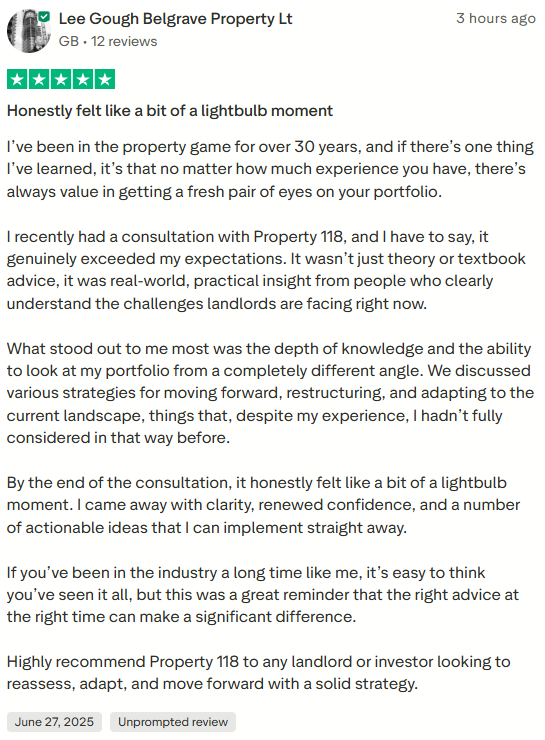
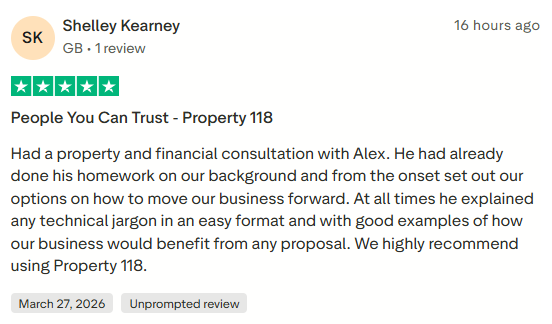
Help other landlords find Property118If you have found Property118 useful, a short Trustpilot review would make a meaningful difference. It helps other landlords decide whether our research is worth following. |
The post The great landlord contradiction: wanting companies, stuck in personal ownership appeared first on Property118.
View Full Article: The great landlord contradiction: wanting companies, stuck in personal ownership
Why some landlords are selling before the next repair bill arrives
Property118

Why some landlords are selling before the next repair bill arrives
Landlords rarely decide to sell because of one dramatic event, they decide after years of smaller ones. For example, they may have dealt with all of the following over several years of ownership.
- The boiler that fails just before winter.
- The roof leak that appears after heavy rain.
- The tenant issue that becomes a weekly distraction.
- The appliance replacement that arrives at the wrong time.
- The contractor who promises Monday and appears Thursday.
The slow accumulation of friction
Owning rental property can be rewarding, but it can also create a gradual build-up of mental drag, especially for landlords who have owned for many years. It is rarely a single event that changes how an owner feels, it is the interruptions. The sense that another job is always around the corner and the feeling that weekends and holidays are never entirely your own.
It is not always about wanting out
Many sellers are not abandoning property altogether, they may simply be choosing to dispose of one higher-maintenance asset, reduce management workload, release capital from weaker stock, keep easier, better-performing properties and/or simplify life without full exit.
David Coughlin, director of Landlord Sales Agency, explains: “Most landlords we speak to are not panicking or fire-selling, they’re simply tired of the friction that builds up over years of ownership.
“We currently have a landlord who originally purchased five properties through us in the North West back in 2006–07 and has now come back looking to simplify her portfolio. All the properties are tenanted and not in great condition, so the best solution is likely selling ‘as-is’ to avoid voids and major refurbishment costs.
“One of the tenants is already interested in buying, and even if we don’t sell every property, selectively disposing of a few higher-maintenance or underperforming assets can significantly improve cashflow and reduce stress across the wider portfolio.”
The hidden cost of “just one more year”
We often hear: “I’ll hold it one more year.”, and sometimes that works well, but sometimes that extra year brings another repair cycle, another difficult tenancy issue, another insurance increase, another period of avoidable stress and another delay to wider plans. Time has value too.
Why certain properties can still sell well
In selected markets, properties with mainstream appeal, sensible condition and realistic pricing can still attract strong interest. That is particularly true where both landlords and owner-occupiers may compete. The key is understanding which assets are likely to perform best in today’s market.
A conversation worth having?
If you are already wondering whether the next repair bill may be the moment you finally act, it may be worth reviewing options before that bill arrives.
Sometimes the right answer is to hold.
Sometimes it is to improve the property.
Sometimes it is to sell one tiring asset and keep the stronger remainder.
These discussions are often most useful for established landlords who want fewer interruptions, more control and decisions made on their terms rather than a leaking roof’s.
/* “function”==typeof InitializeEditor,callIfLoaded:function(o){return!(!gform.domLoaded||!gform.scriptsLoaded||!gform.themeScriptsLoaded&&!gform.isFormEditor()||(gform.isFormEditor()&&console.warn(“The use of gform.initializeOnLoaded() is deprecated in the form editor context and will be removed in Gravity Forms 3.1.”),o(),0))},initializeOnLoaded:function(o){gform.callIfLoaded(o)||(document.addEventListener(“gform_main_scripts_loaded”,()=>{gform.scriptsLoaded=!0,gform.callIfLoaded(o)}),document.addEventListener(“gform/theme/scripts_loaded”,()=>{gform.themeScriptsLoaded=!0,gform.callIfLoaded(o)}),window.addEventListener(“DOMContentLoaded”,()=>{gform.domLoaded=!0,gform.callIfLoaded(o)}))},hooks:{action:{},filter:{}},addAction:function(o,r,e,t){gform.addHook(“action”,o,r,e,t)},addFilter:function(o,r,e,t){gform.addHook(“filter”,o,r,e,t)},doAction:function(o){gform.doHook(“action”,o,arguments)},applyFilters:function(o){return gform.doHook(“filter”,o,arguments)},removeAction:function(o,r){gform.removeHook(“action”,o,r)},removeFilter:function(o,r,e){gform.removeHook(“filter”,o,r,e)},addHook:function(o,r,e,t,n){null==gform.hooks[o][r]&&(gform.hooks[o][r]=[]);var d=gform.hooks[o][r];null==n&&(n=r+”_”+d.length),gform.hooks[o][r].push({tag:n,callable:e,priority:t=null==t?10:t})},doHook:function(r,o,e){var t;if(e=Array.prototype.slice.call(e,1),null!=gform.hooks[r][o]&&((o=gform.hooks[r][o]).sort(function(o,r){return o.priority-r.priority}),o.forEach(function(o){“function”!=typeof(t=o.callable)&&(t=window[t]),”action”==r?t.apply(null,e):e[0]=t.apply(null,e)})),”filter”==r)return e[0]},removeHook:function(o,r,t,n){var e;null!=gform.hooks[o][r]&&(e=(e=gform.hooks[o][r]).filter(function(o,r,e){return!!(null!=n&&n!=o.tag||null!=t&&t!=o.priority)}),gform.hooks[o][r]=e)}});
/* ]]> */
Enquire about a free initial discussion with a Property118 consultant
-
About you
So our Executive Assistant knows who to greet. -
Mr.Mrs.MissMs.Dr.Prof.Rev.
-
-
Your portfolio
A short picture of how you currently hold property. -
-
-
-
-
-
-
Your situation
So the conversation can start where it should. -
-
-
-
-
-
-
-
-
Important Notice – Scope of Planning Support
Where our recommendations touch on areas requiring specialist or regulated input, we may refer you to appropriately authorised professionals for advice and implementation.
-
-
/* = 0;if(!is_postback){return;}var form_content = jQuery(this).contents().find(‘#gform_wrapper_585′);var is_confirmation = jQuery(this).contents().find(‘#gform_confirmation_wrapper_585′).length > 0;var is_redirect = contents.indexOf(‘gformRedirect(){‘) >= 0;var is_form = form_content.length > 0 && ! is_redirect && ! is_confirmation;var mt = parseInt(jQuery(‘html’).css(‘margin-top’), 10) + parseInt(jQuery(‘body’).css(‘margin-top’), 10) + 100;if(is_form){jQuery(‘#gform_wrapper_585′).html(form_content.html());if(form_content.hasClass(‘gform_validation_error’)){jQuery(‘#gform_wrapper_585′).addClass(‘gform_validation_error’);} else {jQuery(‘#gform_wrapper_585′).removeClass(‘gform_validation_error’);}setTimeout( function() { /* delay the scroll by 50 milliseconds to fix a bug in chrome */ }, 50 );if(window[‘gformInitDatepicker’]) {gformInitDatepicker();}if(window[‘gformInitPriceFields’]) {gformInitPriceFields();}var current_page = jQuery(‘#gform_source_page_number_585′).val();gformInitSpinner( 585, ‘https://www.property118.com/wp-content/plugins/gravityforms/images/spinner.svg’, true );jQuery(document).trigger(‘gform_page_loaded’, [585, current_page]);window[‘gf_submitting_585′] = false;}else if(!is_redirect){var confirmation_content = jQuery(this).contents().find(‘.GF_AJAX_POSTBACK’).html();if(!confirmation_content){confirmation_content = contents;}jQuery(‘#gform_wrapper_585′).replaceWith(confirmation_content);jQuery(document).trigger(‘gform_confirmation_loaded’, [585]);window[‘gf_submitting_585′] = false;wp.a11y.speak(jQuery(‘#gform_confirmation_message_585′).text());}else{jQuery(‘#gform_585′).append(contents);if(window[‘gformRedirect’]) {gformRedirect();}}jQuery(document).trigger(“gform_pre_post_render”, [{ formId: “585”, currentPage: “current_page”, abort: function() { this.preventDefault(); } }]); if (event && event.defaultPrevented) { return; } const gformWrapperDiv = document.getElementById( “gform_wrapper_585″ ); if ( gformWrapperDiv ) { const visibilitySpan = document.createElement( “span” ); visibilitySpan.id = “gform_visibility_test_585″; gformWrapperDiv.insertAdjacentElement( “afterend”, visibilitySpan ); } const visibilityTestDiv = document.getElementById( “gform_visibility_test_585″ ); let postRenderFired = false; function triggerPostRender() { if ( postRenderFired ) { return; } postRenderFired = true; gform.core.triggerPostRenderEvents( 585, current_page ); if ( visibilityTestDiv ) { visibilityTestDiv.parentNode.removeChild( visibilityTestDiv ); } } function debounce( func, wait, immediate ) { var timeout; return function() { var context = this, args = arguments; var later = function() { timeout = null; if ( !immediate ) func.apply( context, args ); }; var callNow = immediate && !timeout; clearTimeout( timeout ); timeout = setTimeout( later, wait ); if ( callNow ) func.apply( context, args ); }; } const debouncedTriggerPostRender = debounce( function() { triggerPostRender(); }, 200 ); if ( visibilityTestDiv && visibilityTestDiv.offsetParent === null ) { const observer = new MutationObserver( ( mutations ) => { mutations.forEach( ( mutation ) => { if ( mutation.type === ‘attributes’ && visibilityTestDiv.offsetParent !== null ) { debouncedTriggerPostRender(); observer.disconnect(); } }); }); observer.observe( document.body, { attributes: true, childList: false, subtree: true, attributeFilter: [ ‘style’, ‘class’ ], }); } else { triggerPostRender(); } } );} );
/* ]]> */
The post Why some landlords are selling before the next repair bill arrives appeared first on Property118.
View Full Article: Why some landlords are selling before the next repair bill arrives
Categories
- Landlords (19)
- Real Estate (9)
- Renewables & Green Issues (1)
- Rental Property Investment (1)
- Tenants (21)
- Uncategorized (12,747)
Archives
- June 2026 (24)
- May 2026 (70)
- April 2026 (78)
- March 2026 (72)
- February 2026 (55)
- January 2026 (52)
- December 2025 (62)
- August 2025 (51)
- July 2025 (51)
- June 2025 (49)
- May 2025 (50)
- April 2025 (48)
- March 2025 (54)
- February 2025 (51)
- January 2025 (52)
- December 2024 (55)
- November 2024 (64)
- October 2024 (82)
- September 2024 (69)
- August 2024 (55)
- July 2024 (64)
- June 2024 (54)
- May 2024 (73)
- April 2024 (59)
- March 2024 (49)
- February 2024 (57)
- January 2024 (58)
- December 2023 (56)
- November 2023 (59)
- October 2023 (67)
- September 2023 (136)
- August 2023 (131)
- July 2023 (129)
- June 2023 (128)
- May 2023 (140)
- April 2023 (121)
- March 2023 (168)
- February 2023 (155)
- January 2023 (152)
- December 2022 (136)
- November 2022 (158)
- October 2022 (146)
- September 2022 (148)
- August 2022 (169)
- July 2022 (124)
- June 2022 (124)
- May 2022 (130)
- April 2022 (116)
- March 2022 (155)
- February 2022 (124)
- January 2022 (120)
- December 2021 (117)
- November 2021 (139)
- October 2021 (130)
- September 2021 (138)
- August 2021 (110)
- July 2021 (110)
- June 2021 (60)
- May 2021 (127)
- April 2021 (122)
- March 2021 (156)
- February 2021 (154)
- January 2021 (133)
- December 2020 (126)
- November 2020 (159)
- October 2020 (169)
- September 2020 (181)
- August 2020 (147)
- July 2020 (172)
- June 2020 (158)
- May 2020 (177)
- April 2020 (188)
- March 2020 (234)
- February 2020 (212)
- January 2020 (164)
- December 2019 (107)
- November 2019 (131)
- October 2019 (145)
- September 2019 (123)
- August 2019 (112)
- July 2019 (93)
- June 2019 (82)
- May 2019 (94)
- April 2019 (88)
- March 2019 (78)
- February 2019 (77)
- January 2019 (71)
- December 2018 (37)
- November 2018 (85)
- October 2018 (108)
- September 2018 (110)
- August 2018 (135)
- July 2018 (140)
- June 2018 (118)
- May 2018 (113)
- April 2018 (64)
- March 2018 (96)
- February 2018 (82)
- January 2018 (92)
- December 2017 (62)
- November 2017 (100)
- October 2017 (105)
- September 2017 (97)
- August 2017 (101)
- July 2017 (104)
- June 2017 (155)
- May 2017 (135)
- April 2017 (113)
- March 2017 (138)
- February 2017 (150)
- January 2017 (127)
- December 2016 (90)
- November 2016 (135)
- October 2016 (149)
- September 2016 (135)
- August 2016 (48)
- July 2016 (52)
- June 2016 (54)
- May 2016 (52)
- April 2016 (24)
- October 2014 (8)
- April 2012 (2)
- December 2011 (2)
- November 2011 (10)
- October 2011 (9)
- September 2011 (9)
- August 2011 (3)
Calendar
Recent Posts
- Landlord rent incomes hit record
- The biggest obstacle stopping landlords from selling isn’t what you think
- Has your holiday home become your most expensive luxury?
- Buy to let mortgage searches fall again
- Cost of installing heat pumps?
